
What to Eat Before a Run
 Steve Carmichael·Last updated
I have coached runners who could not get through 5 miles without a stomach ache, and in almost every case the fix was not a special food. It was eating the right amount of the right kind of carbohydrate at the right time.
This guide is organized the way the decision actually gets made: by how much time you have between eating and running. You will find meal and snack options for each window, what to avoid, the foods that a sports dietitian would move to after your run, and what the research actually supports.
How much should you eat before a run?
Carbohydrate is the fuel that matters here. Your muscles and liver store it as glycogen, and that store is what limits you on anything hard or long. Fat and protein are important in your diet, they are just not what makes the next hour feel good.
The joint position stand from the Academy of Nutrition and Dietetics, Dietitians of Canada and the American College of Sports Medicine puts the pre-exercise target at 1 to 4 grams of carbohydrate per kilogram of body weight, taken 1 to 4 hours before exercise.1 That is a wide range on purpose. The bottom of it is a snack. The top of it is a proper pre-race breakfast.
| What you are running | Carbohydrate to aim for | What that looks like |
|---|---|---|
| Easy run under 60 minutes | 0 to 30 g | Nothing, or a banana or a slice of toast with honey |
| Run of 60 to 90 minutes | 30 to 60 g | Bagel with jam, or oatmeal with a banana |
| Long run of 90 minutes or more | 60 to 100 g | A real breakfast 2 to 3 hours out, plus a small top-up |
| Hard workout or intervals | 40 to 80 g | Snack 90 minutes out, gel or sports drink 15 minutes out |
| Half marathon or marathon morning | 1 to 4 g per kg of body weight | 75 to 150 g for most runners, eaten 3 hours out |
To put the per-kilogram math in plain numbers: a 150 pound runner is about 68 kg, so 1 to 4 g per kg is roughly 68 to 272 grams. Almost nobody eats the top of that range before a normal training run. Race morning for a marathon, though, is exactly where the higher numbers belong.
If you want the arithmetic done for you, including what to carry during the run, use the race fueling calculator. For the background on why carbohydrate specifically, see my guide to carbohydrates and running performance.
How long before a run should you eat?
Timing matters as much as the food. Eat too close to the run and your stomach is still working on it while your blood is being redirected to your legs. Eat too far out and you are running on fumes.
The rule I give my runners: the closer you get to the start, the smaller and simpler the food.
| Time before your run | What to eat | What to keep out of it |
|---|---|---|
| 3 to 4 hours | A full meal, 75 to 150 g of carbohydrate, some protein | Heavy fat, large amounts of fiber, anything untested |
| 2 hours | A small meal, 50 to 75 g of carbohydrate | Fried food, creamy sauces, big salads, beans |
| 60 to 90 minutes | A snack, 30 to 60 g of carbohydrate | Most fat and fiber, more than about 10 g of protein |
| 30 minutes | Fast carbohydrate, 15 to 30 g | Solid food that needs chewing and digesting |
| 10 to 15 minutes | A gel, chews, or a few sips of sports drink | Everything else |
For most runners on a normal training day, the sweet spot is 60 to 120 minutes. I wrote a separate guide on how long to wait to run after eating if you want to go deeper on the timing question.
What to eat before a run, by how much time you have
Here is the practical part. Everything below is easy to digest, easy to get hold of, and has been tested by real runners. Pick from the window that matches your situation.
2 to 4 hours before: a real meal
This is where you can eat something that resembles an actual breakfast or lunch. There is time to digest, so a moderate amount of protein and a little fat are fine and will keep you satisfied.
| Meal | Carbs (approx.) | Notes |
|---|---|---|
| Bagel with jam and a glass of juice | 80 to 90 g | The classic pre-race breakfast for a reason |
| Oatmeal with banana and honey | 65 to 75 g | Use quick oats if you are inside 2 hours |
| Two slices of toast with jam plus a banana | 70 to 80 g | Cheap, portable, works everywhere |
| Pancakes or waffles with syrup and fruit | 65 to 80 g | Frozen waffles count, nobody is judging |
| White rice bowl with a scrambled egg | 50 to 60 g | Excellent if bread sits heavy on you |
| Turkey and veggie wrap on a flour tortilla | 40 to 50 g | Go easy on raw vegetables and avocado |
| Greek yogurt with granola and berries | 45 to 55 g | Keep the granola portion modest |
| Mediterranean breakfast wrap | 27 g carbs, 19 g protein | Pairs well with a banana to lift the carbs |
60 to 90 minutes before: a proper snack
This is the window most runners are actually in. You want 30 to 60 grams of carbohydrate that leaves your stomach quickly, which means keeping fat, fiber and protein small.
| Snack | Carbs (approx.) | Why it works |
|---|---|---|
| Medium banana | 27 g | Fast carbs plus about 420 mg of potassium |
| Two slices of toast with honey | 40 to 45 g | Easiest thing in the world on a sleepy stomach |
| Half a bagel with jam | 35 to 40 g | Low fat, low fiber, high carb |
| Packet of instant oats | 19 to 27 g | Quicker to cook and gentler than steel-cut |
| Cup of unsweetened applesauce | 28 g | Almost no fiber, very easy on the gut |
| Two fig bar cookies | 22 g | Portable, and they survive a jacket pocket |
| One ounce of pretzels | 23 g | Adds roughly 350 mg of sodium, useful in heat |
| One ounce of animal crackers | 21 g | Genuinely good pre-run food, not just for kids |
| English muffin with jam | 40 g | Sturdier than toast, still low fat |
| Cup of low-fiber cereal with a splash of milk | 25 to 30 g | Check the label, skip the bran varieties |
| Peanut butter and banana sandwich | 45 to 55 g | Use one tablespoon of peanut butter, not three |
| Rice cakes with honey | 25 to 30 g | Almost nothing to digest |
30 minutes or less: fast carbohydrate only
Short runway. Anything with fat, fiber or much protein is going to be sitting in your stomach when you start, so this window belongs to simple sugars and liquids.
| Option | Carbs (approx.) | Notes |
|---|---|---|
| Half a banana | 14 g | The default answer for most runners |
| Energy gel | 22 to 25 g | Take it with water, not a sports drink |
| 12 oz of sports drink | about 21 g | Fuel and fluid in one, see my sports drink comparison |
| Two Medjool dates | about 36 g | Small, sweet, dense. Two is plenty |
| Energy chews | about 24 g | Easier to ration than a gel |
| Fruit puree pouch | 15 to 20 g | Squeeze pouches are underrated pre-run food |
| Tablespoon of honey in water | 17 g | Cheapest gel you will ever make |
| Two graham cracker sheets | about 22 g | Dry, plain, and easy to keep down |
| Toaster pastry | about 38 g | Not health food, but it works |
My go-to pre-run foods
Those tables cover the options. These are the ones I actually come back to, and why.
Peanut butter and banana sandwich
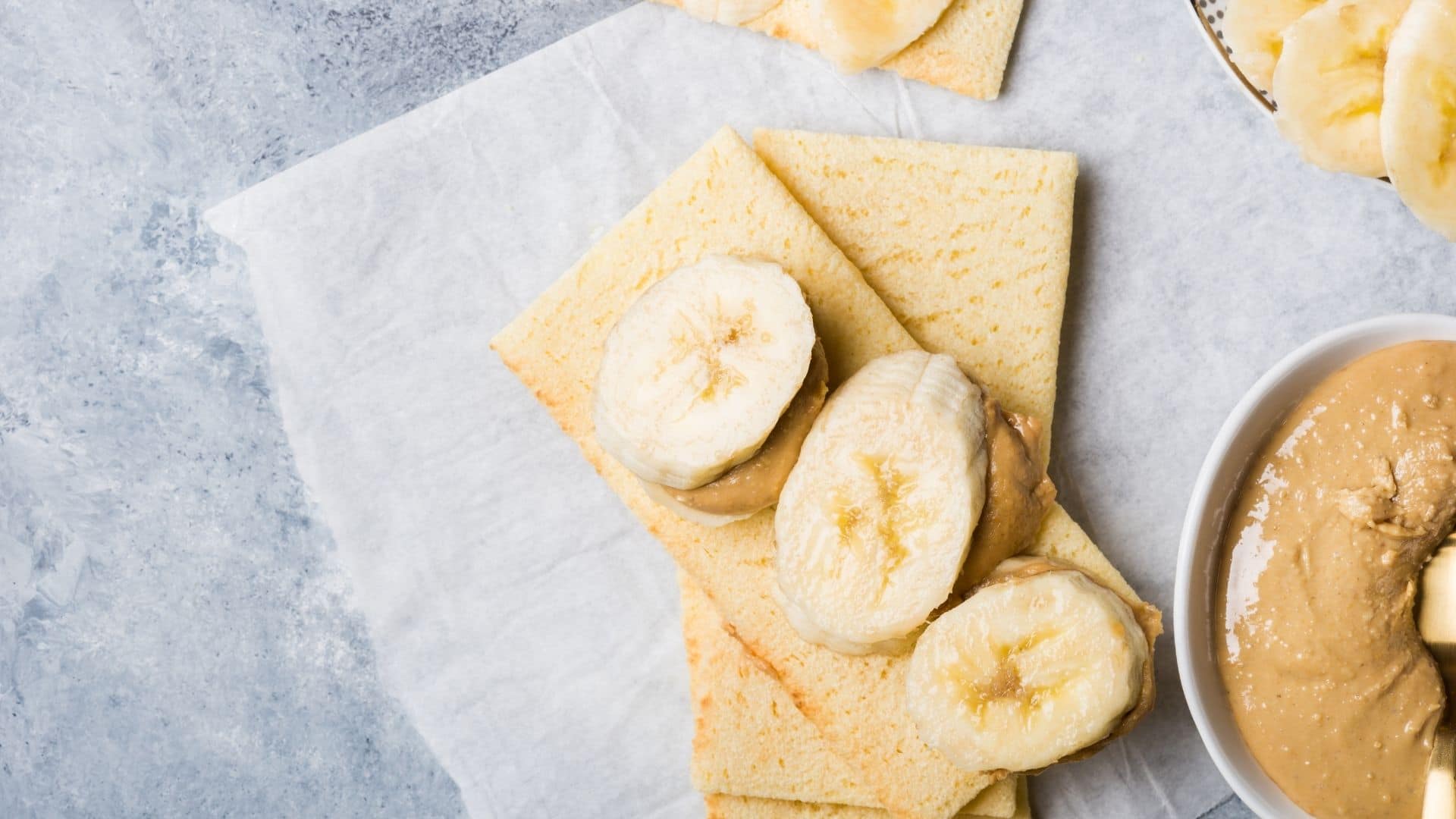
Simple, fast to put together, and it hits every note. The bread and banana supply the carbohydrate, the banana adds potassium, and a modest amount of peanut butter keeps hunger away without slowing you down.
The mistake runners make is loading it up. Two tablespoons of peanut butter is 16 grams of fat, and fat is the single biggest brake on stomach emptying. One tablespoon, 90 minutes out, is the version that works.
Oatmeal with fruit
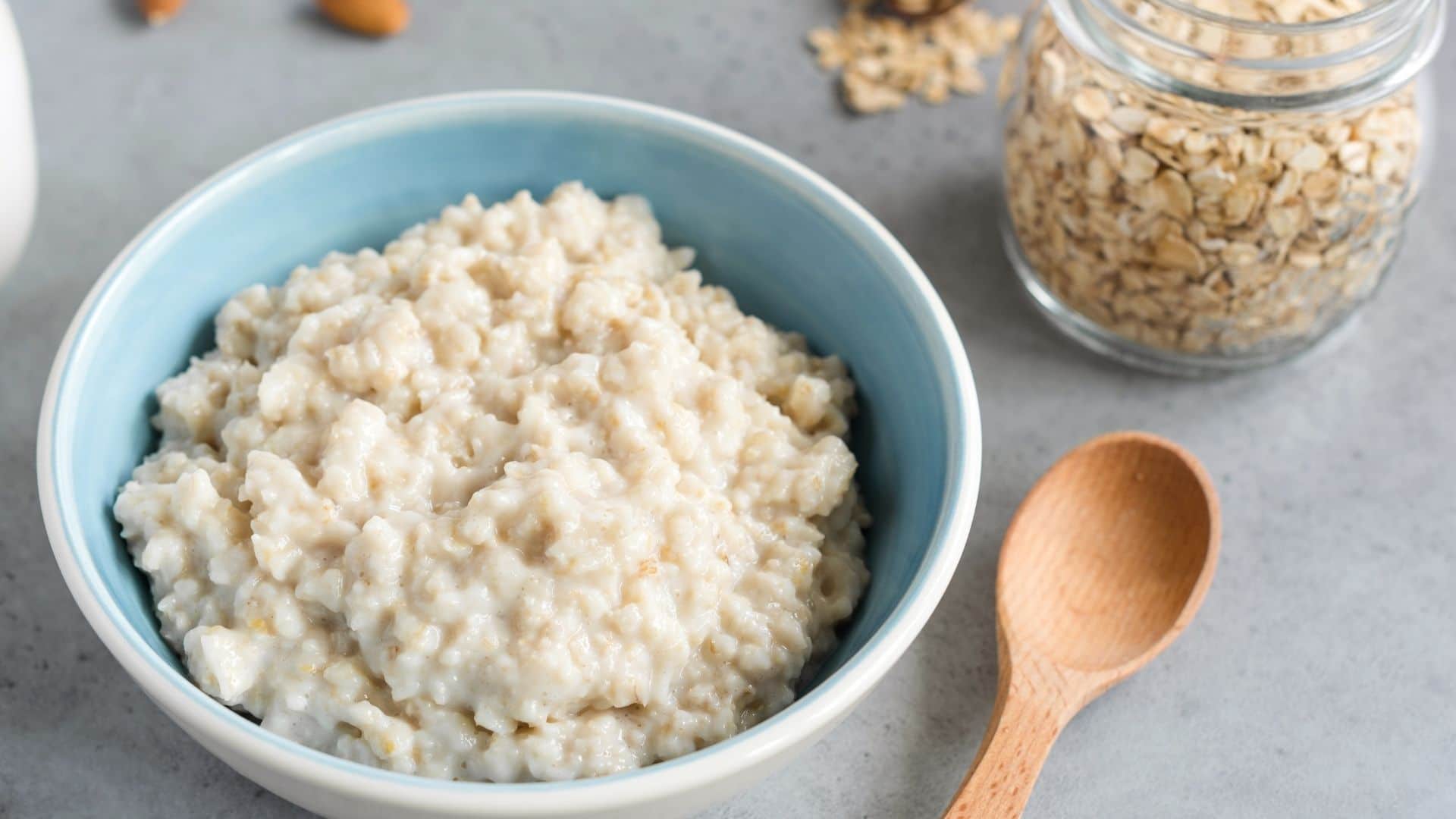
Oats with almond or soy milk and berries on top is a solid pre-run breakfast, and a good source of B vitamins alongside the carbohydrate.
One correction to the advice I used to give here. Steel-cut oats take about 30 minutes to cook and are the slowest-digesting form of oats. If you have three hours, they are great. Inside of two, use quick or instant oats instead. Same food, faster out of your stomach, and you are not standing over a pot when you should be lacing up.
Waffles or pancakes with syrup, honey, jam or fruit

Pancakes and waffles, including the frozen kind, are fast-digesting carbohydrate that most people find easy on the stomach. Top with maple syrup, honey, jam or fruit for the extra energy.
If you want to make them yourself, try my healthy chocolate pancakes or the gluten free peach pancakes.
Fig bar cookies

Densely packed with carbohydrate, easy to digest, and they travel well. Two cookies is about 22 grams of carbohydrate for a gram and a half of fiber, which is a good ratio for something you are eating an hour before a run. Plenty of ultrarunners use them mid-run as well.
Toast with honey, jam or banana
My most-used pre-run snack, and the one I recommend first to runners who are new to fueling. Quick carbohydrate, easy on the stomach, and no cooking involved. A pinch of salt on top is a genuine upgrade in hot weather.
Mediterranean breakfast wraps
Mediterranean breakfast wraps are simple to make and taste great. With 27 grams of carbohydrate and 19 grams of protein, they work well as a 2 to 3 hour pre-run meal and even better as a post-run recovery meal. View the full recipe.

For more ideas, there are dozens of runner-friendly recipes on the site, plus a guide to homemade energy bars, bites and gels if you would rather make your own fuel than buy it.
What to eat before a morning run
Early morning is the hardest case. You have been fasting for eight hours, your glycogen stores are partly drawn down from overnight, and you have twenty minutes between the alarm and the door.
What I tell runners to do, in order of how much time they have:
- Easy run under an hour: water and go. You do not need to eat, and most runners feel better not eating.
- 45 to 90 minutes, or anything with quality in it: 20 to 40 grams of fast carbohydrate. Half a banana, toast with honey, a handful of animal crackers, or a few sips of sports drink while you get dressed.
- Long run or a workout: get up 60 to 90 minutes earlier and eat 40 to 60 grams. This is the single change that turns bad long runs into good ones for most people.
The trick nobody mentions: put the food on the nightstand. If your snack is next to your alarm, you will eat it. If it is in the kitchen behind a closed door, you will skip it.
What to eat before an evening run
Evening runners have a different problem. It is not an empty stomach, it is a lunch that was five hours ago and a 5 p.m. energy dip.
Eat a carbohydrate snack of 30 to 40 grams about 60 to 90 minutes before you head out. A banana, a granola bar, crackers, an English muffin with jam. If you run straight from work, keep that snack in your desk drawer rather than relying on whatever is in the break room.
Two things to avoid: a heavy late lunch that is still with you at 6 p.m., and the mistake of treating your pre-run snack as dinner. Eat the snack, run, then eat a real meal afterward.
What to eat before a long run or on race morning
The longer the effort, the more the pre-run meal matters, and the further ahead of the start it needs to go in.
| Distance | Carbohydrate | When | Top-up |
|---|---|---|---|
| 5K | 15 to 30 g, or nothing | 1 to 2 hours before | Not needed |
| 10K | 30 to 50 g | 2 hours before | Optional gel 15 minutes before |
| Half marathon | 50 to 80 g | 2 to 3 hours before | Gel 15 minutes before |
| Marathon | 1 to 4 g per kg, usually 75 to 150 g | 3 to 4 hours before | Gel or sports drink 15 minutes before |
Two rules that have saved more races than any specific food.
Nothing new on race day. Not the hotel breakfast buffet, not the free bar in the goodie bag, not the coffee from a machine you have never used. Whatever you eat on race morning should be something you have eaten before at least three long runs.
Practice the whole thing, including the timing. If your race starts at 7 a.m. and you plan to eat at 4 a.m., you need to have done that at least twice in training. Your stomach adapts to what you ask of it, and it does not adapt on the day.
For what to take with you once you are running, see my complete guide to fueling on the run.
What foods should you avoid before a run?
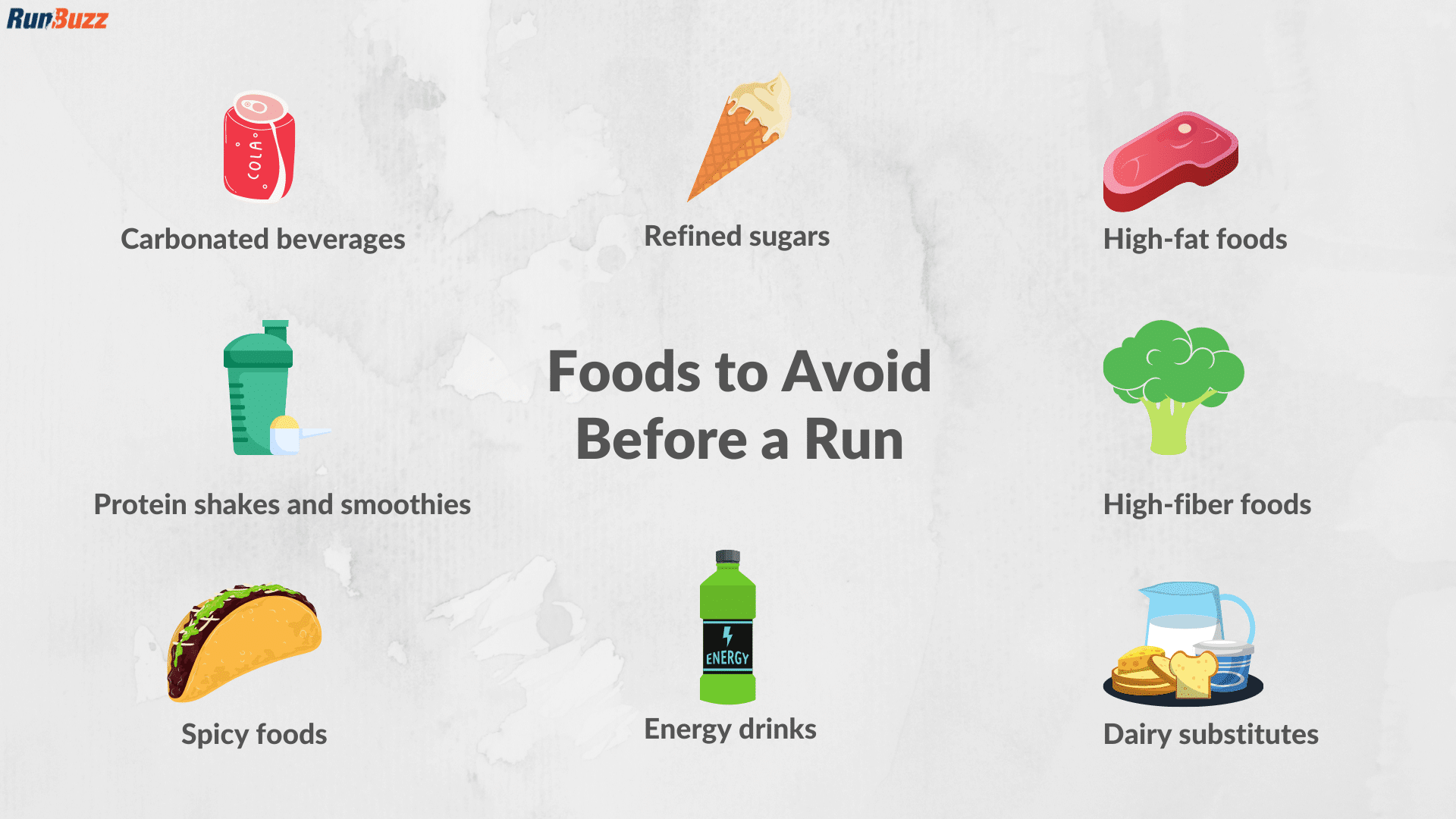
Start with the obvious: stay away from anything you already know upsets your stomach, and anything you have an intolerance to. Beyond that, the categories below cause most of the trouble.
| Avoid before a run | Why | What to do instead |
|---|---|---|
| High-fiber foods: beans, lentils, chickpeas, bran cereal, raw cruciferous vegetables, large salads | Fermentable fiber produces gas and draws water into the gut | Keep fiber under about 5 g in the 2 hours before. White bread, white rice, ripe banana, applesauce |
| High-fat foods: fried food, cheese, creamy sauces, large portions of nut butter or avocado | Fat is the strongest brake on stomach emptying, so the meal is still there when you start | Under about 10 g of fat in the 90 minutes before |
| Large protein loads: steak, egg-heavy plates, a 30 g protein shake | Slow to digest and it does not fuel the run | 5 to 10 g of protein pre-run is plenty. Save the rest for afterward |
| Spicy food | Reflux and urgency, both worse when you are bouncing | Keep the curry for the evening after a morning long run |
| Carbonated drinks and energy drinks | Gas and bloating, and energy drinks stack caffeine with things you have not tested | Water, or a proper sports drink |
| Sugar alcohols and high-fiber bars: sorbitol, maltitol, xylitol, chicory root, inulin | Poorly absorbed, pull water into the intestine, a very common cause of mid-run urgency | Read the bar label. If fiber is above 5 g or you see the ingredients above, save it for later |
| Alcohol the night before | Dehydration and poor sleep, and you feel both the next morning | Move it to after the long run, not before |
| Anything new on race day | You cannot fix a bad decision at mile 3 | Test everything in training first |
Popular pre-run foods that belong after your run instead
Some foods that get recommended as pre-run snacks are genuinely good foods that are working against you in that specific window. They are usually too high in protein, fat or fermentable fiber to be digested in time. Nothing here is unhealthy. It is a timing problem, not a food problem.
| Food | The problem before a run | Better used |
|---|---|---|
| Scrambled egg and avocado over brown rice | Fat from the egg and avocado plus the fiber in brown rice. Brown rice is deliberately slow-releasing, which is the opposite of what you want here | As a recovery meal, or 3 to 4 hours out with white rice instead |
| Quinoa and chickpea wrap | Chickpeas are one of the highest-GOS foods there is, and a classic trigger for mid-run gas and cramping | Lunch after a morning run |
| A cup of cottage cheese with a cup of blueberries | Roughly 28 g of protein plus a large fiber and lactose load in one sitting | Recovery snack, where the protein is genuinely useful |
| Five egg whites and a whole egg with toast and a banana | Protein-dominant. Good food, wrong job | Post-run breakfast |
| Baked granola apples | Apple skin plus granola is a lot of fiber, and it takes 30 minutes in the oven | Evening snack, or after a run |
| Half a mashed avocado on toast | Half an avocado is about 15 g of fat and 7 g of fiber | Fine 3 hours out, or use a thin scrape rather than half |
| Wraps loaded with raw vegetables | The wrap is fine, the raw fiber is not | Hold the vegetables pre-run and add them at lunch |
| Greek yogurt with peach | Peaches are high in sorbitol, which is poorly absorbed. Yogurt adds lactose | 2 hours or more out, and swap the peach for banana or berries |
| Protein bars and "high fiber" bars | Protein, fiber and sugar alcohols are the three worst things to have in your stomach at the start of a run | Read the label and pick a bar that is mostly carbohydrate, or eat it afterward |
More pre-run options sports dietitians reach for
These come up constantly in sports nutrition practice and rarely on food blogs, because none of them look impressive in a photo. They are low fiber, low fat, high carbohydrate, and they sit quietly in your stomach, which is the whole job.
| Option | Carbs (approx.) | Why it earns a spot |
|---|---|---|
| Plain white bagel with jam | 70 to 80 g | The most reliable big pre-race breakfast there is |
| White rice with a pinch of salt | 45 g per cup | Standard pre-race food for a lot of elite distance runners |
| Salted boiled or roasted potatoes | about 37 g per medium potato | Carbohydrate plus sodium, and no packaging |
| Cream of rice or grits | 30 to 40 g per serving | Warm, bland, almost no fiber. Ideal for nervous stomachs |
| Rice cakes with honey or jam | 25 to 30 g | About as easy to digest as solid food gets |
| Sourdough or white toast with honey and salt | 40 to 45 g | Sourdough is lower in fructans than standard wheat bread |
| Graham crackers | about 22 g for two sheets | Dry, plain and forgiving at 5 a.m. |
| Low-fiber cereal such as corn or rice based | 25 to 30 g per cup | Fast, familiar, and easy to portion |
| Small box of raisins or other dried fruit | about 34 g | Concentrated carbohydrate that fits in a pocket |
| Fruit puree pouch | 15 to 20 g | Baby food aisle, half the price of a gel |
| Carbohydrate drink mix or sports drink | 20 to 50 g depending on mix | The answer when solid food will not go down |
| Fruit leather | 10 to 15 g per strip | Easy to carry and easy to chew on the move |
Notice how boring that list is. That is the point. Pre-run food is not where your diet needs to be interesting. It needs to be predictable.
Should you run on an empty stomach?
For an easy run under an hour, yes, if you feel fine doing it. Past that, the evidence favors eating first.
A 2018 systematic review and meta-analysis identified 46 studies and found that pre-exercise feeding enhanced prolonged aerobic performance, while making no difference to shorter-duration efforts.2 Fasted exercise did raise circulating free fatty acids afterward and altered signaling in muscle and fat tissue.2 That is a metabolic difference, not a performance advantage, and the two are easy to confuse.
If your reason for running fasted is fat loss, the picture is not what most people expect. In a controlled trial, women were assigned to an hour of steady-state cycling either fasted or after a meal replacement, both groups following the same calorie-restricted diet for four weeks. Both groups lost weight and fat mass, and there was no significant difference between them.5 Doing it on an empty stomach did not add anything.
Two more practical points. Skipping the pre-run snack often produces a large appetite later in the day, which is its own problem. And running long in a fasted state raises the physiological stress of the session, which is fine occasionally and counterproductive as a habit.
There is a legitimate place for some fasted easy running in an endurance program. I go through it properly in the runner's guide to intermittent fasting and running. Just do not confuse an easy 40 minutes before breakfast with a fasted 16 mile long run.
What if you are not hungry before your run?
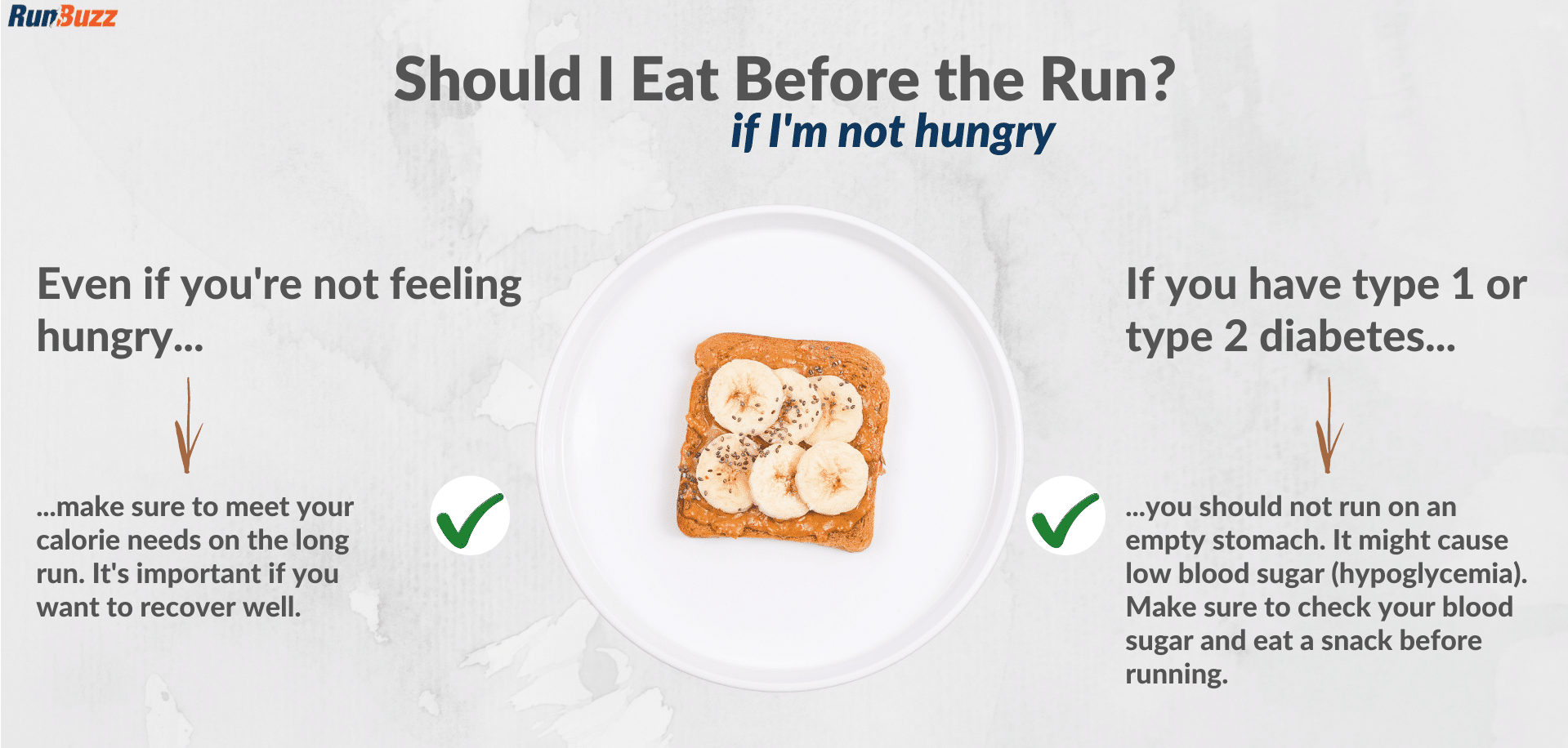
This is one of the most common problems I hear about, especially from runners who go out first thing in the morning. Appetite is usually suppressed early, and it takes a while to come back.
Three things that work:
- Drink your carbohydrate instead of chewing it. Juice, a sports drink or a thin smoothie goes down when toast will not.
- Start smaller than you think you need. Fifteen grams of carbohydrate is enough to begin with. Appetite tolerance builds over a few weeks.
- Eat something the night before. A carbohydrate snack in the evening tops up liver glycogen overnight and takes some pressure off breakfast.
Even when you are not hungry, if the run is long you still have to meet your energy needs for the day. Under-eating around long runs is one of the fastest ways to end up flat, run down and injured.
What should you drink before a run?
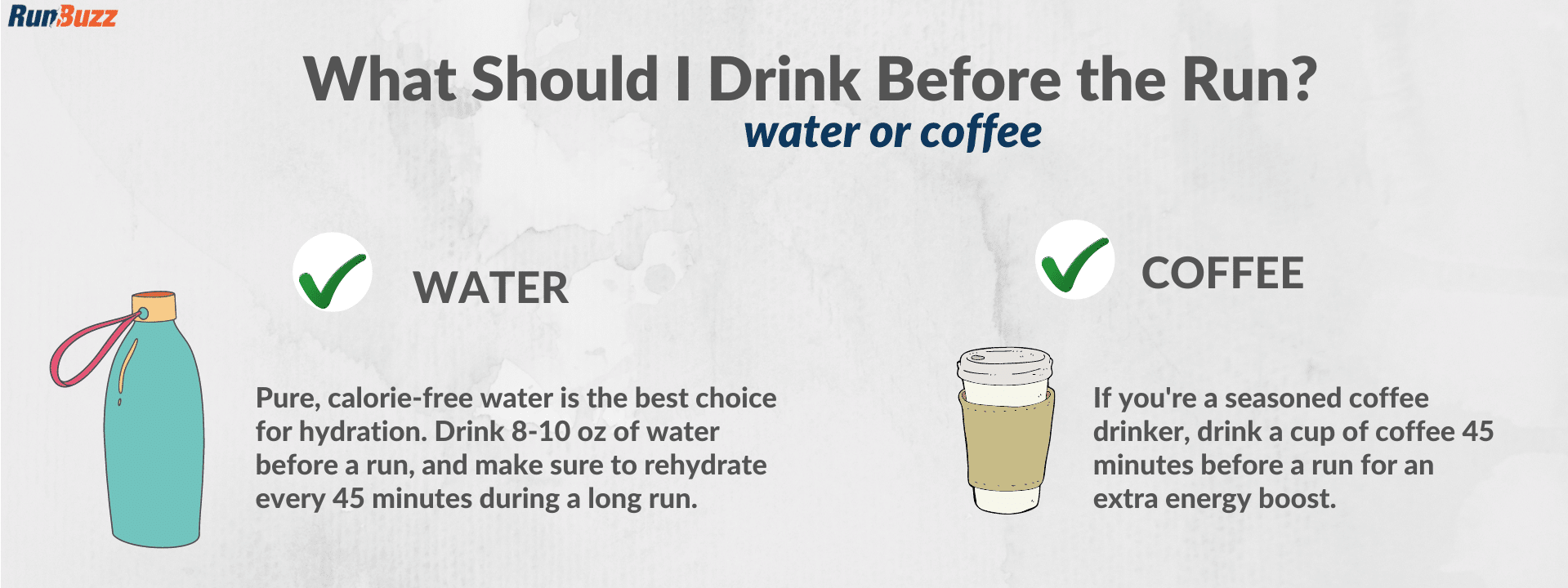
Water, in most cases. Being properly hydrated is what lets your body regulate its temperature, and dehydration shows up as cramping, headaches, fatigue, brain fog and thirst long before you think of it as a hydration problem.
The ACSM guideline for prehydration is about 5 to 7 mL of fluid per kilogram of body weight at least four hours before exercise, which is roughly 12 to 17 oz for a 150 pound runner, with a bit more two hours out if your urine is still dark.6 For a normal training run, 8 to 16 oz of water in the hour before is fine.
During the run, drink to thirst on anything short, and take fluid every 15 to 20 minutes on longer efforts rather than waiting for a set time to pass. In heat, or if you are a heavy or salty sweater, use a drink with sodium in it rather than plain water. There is more detail in my guide to staying properly hydrated when you run.
Do not overdo it either. Drinking far more than you need before a run leaves you sloshing and looking for a bathroom at mile 2.
Should you drink coffee before a run?
If you already drink coffee, yes, and the research on caffeine as a performance aid is some of the strongest in sports nutrition.
The International Society of Sports Nutrition position stand puts the effective range at 3 to 6 mg of caffeine per kilogram of body weight, with 60 minutes before exercise the most commonly used timing, and reports the most consistent benefits in aerobic endurance.7 For a 150 pound runner that is roughly 200 to 400 mg, or two to four cups of brewed coffee. Doses above about 9 mg per kg do not add anything and increase side effects.7
Response to caffeine varies a lot between individuals, partly for genetic reasons.7 If you are not a habitual coffee drinker or you are sensitive to it, a pre-run cup can cause nausea, heartburn, a racing heart or an urgent trip to the bathroom. Test it on an easy run, not on race morning.
One practical note: coffee is a gut stimulant for many people. That is helpful if you want to use the bathroom before you leave, and unhelpful if you drink it 10 minutes before a workout. Most runners find 45 to 60 minutes ahead is the right gap. More detail in the effects of caffeine on running performance.
If your stomach gives you trouble on the run
You are not unusual. Studies suggest 30 to 50 percent of endurance athletes experience gastrointestinal complaints, and the causes fall into three groups: physiological, mechanical and nutritional.8 During hard exercise, and especially when you are dehydrated, blood flow to the gut drops, which is thought to be one of the main drivers.8
Work through these in order:
- Fix hydration first. Reduced blood flow to the gut is worse when you are already low on fluid.8
- Cut fat, fiber and protein in the 2 hours before. This alone solves it for most runners.
- Move the meal earlier rather than making it smaller, if you can.
- Try a low FODMAP approach for a week. In a crossover trial, 16 recreational runners followed a low FODMAP diet for seven days and reported fewer exercise-related gut symptoms and a better perceived ability to exercise than on a high FODMAP diet.9 Wheat, onion, garlic, apples, pears, stone fruit, legumes and lactose are the usual suspects. Trial it in training, and see a registered dietitian before making it a long-term diet.
- Train your gut. Gastric emptying and stomach comfort are adaptable. Practicing higher carbohydrate and fluid intakes in training improves tolerance, which is exactly why race nutrition needs to be rehearsed rather than improvised.10
Keep notes. Endurance athletes managing gut symptoms report that the strategies which work are highly individual, and the only way to find yours is to write down what you ate, when you ate it, and what happened.11
How to build a pre-run routine that works for you
Everything above is a starting point. The specific answer for your body comes out of a few weeks of deliberate trial.
- Pick one option from the timing window you are usually in.
- Use it for three runs at the same distance and intensity, so you are comparing like with like.
- Write down four things: what you ate, how much, how long before, and how the run felt. Energy and stomach, both.
- Change one variable at a time. If it did not work, move the timing before you change the food.
- Once you find it, keep it. This is what you will use on race morning, and it should be so familiar by then that it is boring.
The runners who never have fueling problems are not the ones with the best diet. They are the ones who found something that works and stopped experimenting.
Frequently asked questions about eating before a run (FAQ)
What should I eat 30 minutes before a run?
Fast carbohydrate and not much of it. Half a banana, a gel, a few dates, some sports drink, or a couple of graham crackers, in the range of 15 to 30 grams of carbohydrate. Skip fat, fiber and protein entirely in that window.
Is it OK to run on an empty stomach?
For an easy run under an hour, yes. For anything longer or harder, eating first improves performance: a 2018 systematic review of 46 studies found pre-exercise feeding enhanced prolonged aerobic performance, while making no difference to shorter efforts. If you have diabetes, do not run fasted.
Is a banana enough before a run?
For a run up to about an hour, usually yes. A medium banana provides roughly 27 grams of carbohydrate and about 420 mg of potassium. For a long run, pair it with toast, a bagel or oatmeal to get closer to 50 or 60 grams.
What should I eat before a 5K?
Something small, 1 to 2 hours out: 15 to 30 grams of easy carbohydrate such as toast with honey or half a bagel. A 5K is short enough that you are racing on the glycogen you already have, so the goal is to feel fueled without feeling full.
How long should I wait after eating before I run?
Roughly 60 to 120 minutes after a snack and 3 to 4 hours after a full meal, though it varies a lot between individuals. There is a more detailed breakdown in my guide to how long to wait to run after eating.
Does eating before a run make you gain weight?
No. A pre-run snack is fuel you are about to use, and it typically makes it easier to manage total intake because you are not starving afterward. Body composition is driven by your overall diet, not by whether the calories arrive before or after the run. In a four week controlled trial, fasted and fed aerobic exercise produced no significant difference in fat loss.
What is the best breakfast before a morning long run?
A bagel with jam, oatmeal with banana and honey, or toast with honey and a banana, eaten 60 to 90 minutes before you start, in the range of 40 to 60 grams of carbohydrate. Add coffee if you normally drink it. Whatever you choose, use the same thing every long run so race morning is not a new experience.
Can I eat too close to a run?
You can eat too much too close. A large or fatty meal inside 30 minutes is likely to sit with you. But the specific fear that a small carbohydrate snack in the hour before a run will cause a blood sugar crash and hurt performance is not supported by the research: a review of the literature on that exact question concluded the advice to avoid carbohydrate in the hour before exercise is unfounded.
Final thoughts
Pre-run nutrition is simpler than the internet makes it look. Carbohydrate is the fuel. The closer you are to the start, the smaller and simpler it should be. Fat, fiber and protein are for the rest of your day, not the ninety minutes before you run.
Start with one option from the right timing window, use it consistently, and write down what happens. Within a few weeks you will have a pre-run routine you never have to think about again.
If you would like help building that into a training plan, along with everything else that goes into running well, I coach runners online and in person at Run For Performance. And whatever you are training for next, let's get the fueling sorted before the race that matters.
Have a great week.
Sources
- Thomas DT, Erdman KA, Burke LM. Position of the Academy of Nutrition and Dietetics, Dietitians of Canada, and the American College of Sports Medicine: Nutrition and Athletic Performance. Journal of the Academy of Nutrition and Dietetics, 2016. PubMed 26920240
- Aird TP, Davies RW, Carson BP. Effects of fasted vs fed-state exercise on performance and post-exercise metabolism: A systematic review and meta-analysis. Scandinavian Journal of Medicine & Science in Sports, 2018. PubMed 29315892
- Jeukendrup AE, Killer SC. The myths surrounding pre-exercise carbohydrate feeding. Annals of Nutrition and Metabolism, 2010. PubMed 21346333
- de Ataide e Silva T, Di Cavalcanti Alves de Souza ME, de Amorim JF, Stathis CG, Leandro CG, Lima-Silva AE. Can carbohydrate mouth rinse improve performance during exercise? A systematic review. Nutrients, 2013. PubMed 24451304
- Schoenfeld BJ, Aragon AA, Wilborn CD, Krieger JW, Sonmez GT. Body composition changes associated with fasted versus non-fasted aerobic exercise. Journal of the International Society of Sports Nutrition, 2014. PubMed 25429252
- American College of Sports Medicine, Sawka MN, Burke LM, Eichner ER, Maughan RJ, Montain SJ, Stachenfeld NS. American College of Sports Medicine position stand. Exercise and fluid replacement. Medicine & Science in Sports & Exercise, 2007. PubMed 17277604
- Guest NS, VanDusseldorp TA, Nelson MT, et al. International Society of Sports Nutrition position stand: caffeine and exercise performance. Journal of the International Society of Sports Nutrition, 2021. PubMed 33388079
- de Oliveira EP, Burini RC, Jeukendrup A. Gastrointestinal complaints during exercise: prevalence, etiology, and nutritional recommendations. Sports Medicine, 2014. PubMed 24791919
- Wiffin M, Smith L, Antonio J, Johnstone J, Beasley L, Roberts J. Effect of a short-term low fermentable oligosaccharide, disaccharide, monosaccharide and polyol (FODMAP) diet on exercise-related gastrointestinal symptoms. Journal of the International Society of Sports Nutrition, 2019. PubMed 30646926
- Jeukendrup AE. Training the Gut for Athletes. Sports Medicine, 2017. PubMed 28332114
- Scrivin R, Costa RJS, Pelly F, Lis D, Slater G. An exploratory study of the management strategies reported by endurance athletes with exercise-associated gastrointestinal symptoms. Frontiers in Nutrition, 2022. PubMed 36438762
- U.S. Department of Agriculture, Agricultural Research Service. FoodData Central. Used for the carbohydrate, fiber and potassium figures in this article. fdc.nal.usda.gov
This article is general information for healthy adult runners and is not medical or individualized nutrition advice. If you have diabetes, a gastrointestinal condition, a history of disordered eating, or you are pregnant, work with your physician or a registered dietitian.
Related Articles



Related Podcast Episodes
Dive deeper into this topic with these episodes from the RunBuzz Running Podcast.
Episode 162
How To Develop Systems So You Can Have A Healthy Relationship With Food - Jaclyn Ricchio Stover
Episode 160
Easy, Quick Meal Prepping For Runners With Simone McKenna
Episode 149
Intermittent Fasting With Serena Marie RD
Episode 126