
The Unofficial Guide to the 2026 Chicago Marathon
 Steve Carmichael·Last updated
The 2026 Bank of America Chicago Marathon is one of the largest marathons in the world and will be held on Sunday, October 11, 2026. For those who do not live in the Chicago area, it is an amazing destination race that is famously well organized, has world-class crowd support, and has hosted more world records than any other marathon in the United States.
In my opinion, Chicago is one of the best marathons in the world. I ran it in 2010, and it has been one of my favorite and most memorable races. As a running coach, I have coached over 20 marathoners specifically to run this race and have been a spectator a few other times. I attend whenever I can make the trip.
In this unofficial guide, I share information and tips about the race, the course, what to do in Chicago, and how to train for and race it well — pulled from the official Chicago Marathon website, participant experience, and my own time at the race as a runner and coach.
This is an Unofficial Guide
This article is not produced by, endorsed by, or affiliated with the Bank of America Chicago Marathon or the Chicago Event Management. It is a runner’s and coach’s perspective, pulled together to help you prepare.
Race details, dates, entry rules, and course specifics can and do change. Always confirm all official information at chicagomarathon.com before you register, travel, or race.
Key Takeaways — 2026 Chicago Marathon
- Race date: Sunday, October 11, 2026. The 48th running.
- Field size: more than 55,000 participants — the largest field in race history, drawn from a record pool of over 200,000 applicants.
- Course: flat loop through 29 Chicago neighborhoods, starting and finishing in Grant Park. Seven world records have been set here, and roughly 1.7 million spectators line the route.
- Entry for 2026: the lottery closed November 18, 2025 and tour-operator packages closed August 16, 2026. Charity entry is the only remaining path in — open through September 15, 2026 or until teams fill.
- Time limit: 6 hours, 30 minutes (about 15:00 per mile).
- Weather: typically 50–70°F, but Chicago in October has produced everything from 28°F to 89°F on race day — plan for variability.
- Expo: Abbott Health & Fitness Expo at McCormick Place North Building, Thursday Oct 8 through Saturday Oct 10. Packet pickup is in person only. No race-day pickup.
2026 Chicago Marathon at a Glance
| Race date | Sunday, October 11, 2026 |
|---|---|
| Edition | 48th Bank of America Chicago Marathon |
| Distance | 26.2 miles (42.195 km) |
| Start & finish | Grant Park, Chicago (Columbus Drive) |
| Field size | More than 55,000 participants — largest in race history |
| Participants from | 100+ countries and all 50 US states |
| Course type | Flat, USATF-certified loop through 29 neighborhoods |
| Race label | World Athletics Platinum Label event; Abbott World Marathon Major |
| Spectators | Approximately 1.7 million along the course |
| Time limit | 6 hours 30 minutes (15:00 per mile) |
| Wheelchair start | 7:20 a.m. (men), 7:21 a.m. (women) |
| Handcycle start | 7:23 a.m. |
| Wave 1 open start | 7:30 a.m. CT |
| Wave 2 start | 8:00 a.m. CT |
| Wave 3 start | 8:35 a.m. CT |
| Expo | McCormick Place North Building, Oct 8–10, 2026 |
| Title sponsor | Bank of America |
| Official site | chicagomarathon.com |
Race History and Course Records
The Chicago Marathon has been run every October since 1977 (with a few pandemic-era adjustments). It is one of the Abbott World Marathon Majors, alongside Boston, New York, London, Berlin, Tokyo, and Sydney. The flat course and cool October weather make it one of the fastest marathons on the planet — seven world records have been set here.
| Record | Time | Athlete | Year |
|---|---|---|---|
| Men’s course record | 2:00:35 | Kelvin Kiptum (Kenya) | 2023 |
| Women’s course record | 2:09:56 | Ruth Chepngetich (Kenya) | 2024 |
| Wheelchair men’s | 1:22:37 | Marcel Hug (Switzerland) | 2023 |
| Wheelchair women’s | 1:36:12 | Catherine Debrunner (Switzerland) | 2024 |
A note on the women’s record: Ruth Chepngetich accepted a three-year doping ban in October 2025 after testing positive for a banned diuretic in a March 2025 sample. Because the positive test came after her October 2024 Chicago run, that performance was not annulled — her 2:09:56 still stands as both the Chicago course record and the women’s marathon world record.
Chicago has also been the site of some of the fastest American marathoning ever. Conner Mantz ran 2:04:43 here in 2025 to break the American record, a mark that still stands — faster times run by Americans at Boston do not count for record purposes, because Boston’s point-to-point course is not record-eligible.
The 2026 Elite Field
Chicago Event Management has announced what it is billing as one of the deepest professional fields in race history for 2026 — 44 elite men and 29 elite women, with six men in the field having broken 2:04.
Elite Men
| Athlete | Country | Personal best |
|---|---|---|
| Jacob Kiplimo | Uganda | 2:00:28 (London 2026) |
| Amos Kipruto | Kenya | 2:01:39 (London 2026) |
| Milkesa Mengesha | Ethiopia | 2:03:17 (Berlin 2024) |
| Tadese Takele | Ethiopia | 2:03:23 (Tokyo 2025) |
| Charles Hicks | USA | 2:04:35 (Boston 2026) |
| Clayton Young | USA | 2:05:41 |
| Vincent Mauri | USA | 2:05:54 |
| Galen Rupp | USA | 2:06:07 |
Elite Women
| Athlete | Country | Personal best |
|---|---|---|
| Brigid Kosgei | Kenya | 2:14:04 (Chicago 2019) |
| Hawi Feysa | Ethiopia | 2:14:57 (Chicago 2025) |
| Sutume Kebede | Ethiopia | 2:15:55 (Tokyo 2024) |
| Sharon Lokedi | Kenya | 2:17:22 (Boston 2025) |
| Susanna Sullivan | USA | 2:21:56 |
| Natosha Rogers | USA | 2:23:28 |
Also worth watching: Emma Grace Hurley makes her marathon debut after setting the American 8K record, and two-time Olympian Des Linden races Chicago as preparation for a 100-mile debut.
Wheelchair Divisions
The professional wheelchair fields are equally strong. Marcel Hug, a six-time Chicago champion and the men’s course record holder, returns to face Daniel Romanchuk (USA) and David Weir (Great Britain). In the women’s division, Tatyana McFadden — the most decorated athlete in the event’s history — is back in the field.
The elite fields are the first thing to change as race weekend approaches. Check the official press releases page for late additions and withdrawals.
How to Enter the 2026 Chicago Marathon
Entry status for 2026
The 2026 race is effectively sold out. The lottery closed November 18, 2025, and international tour-operator packages closed August 16, 2026. Charity entry is the only remaining way in — first-come, first-served through September 15, 2026, or until individual teams fill. If you are reading this after mid-September, your next opportunity is the 2027 race.
1. Non-Guaranteed Entry (Lottery) — CLOSED for 2026
The general lottery was open October 21, 2025 through November 18, 2025. Drawing results were announced on December 11, 2025. Demand was extraordinary: more than 200,000 people applied for the 2026 race, a record.
2. Guaranteed Entry via Time Qualifier — CLOSED for 2026
Time qualifiers for 2026 had to submit a qualifying marathon run between January 1, 2024 and November 18, 2025 on a USATF- or World Athletics-certified course, and apply within the same October–November 2025 window as the general lottery. Only marathon times count — results at other distances are not considered, and there are no exceptions for narrowly missing a standard.
Qualifying standards tightened by roughly 5 minutes for all runners under age 70 from 2025 to 2026. Standards for 2027 are typically published when the application window opens.
| Age group (race day) | Men | Women / Non-binary |
|---|---|---|
| 16–29 | 2:50 | 3:20 |
| 30–34 | 2:50 | 3:20 |
| 35–39 | 2:55 | 3:25 |
| 40–44 | 3:00 | 3:30 |
| 45–49 | 3:10 | 3:40 |
| 50–54 | 3:15 | 3:50 |
| 55–59 | 3:25 | 3:55 |
| 60–64 | 3:40 | 4:15 |
| 65–69 | 3:55 | 4:30 |
| 70–74 | 4:15 | 4:45 |
| 75–79 | 4:30 | 5:00 |
| 80+ | 4:50 | 5:20 |
3. Charity Entry — Still Open for 2026
Running for an official charity is the only remaining path into the 2026 race. You commit to a minimum fundraising total through one of the Chicago Marathon’s official charity partners. Entries are first-come, first-served and remain open through September 15, 2026, or until individual charity teams fill. Roughly one-third of the field runs for charity each year.
Understand the real cost before you commit. Three things trip people up:
- The $2,200 minimum is fundraising, not the entry fee. You also pay the standard entry fee ($250 US / $260 non-US) plus processing.
- Each charity sets its own terms. Many raise the minimum to $3,000 for runners who sign up after the lottery drawing, and benefits vary by team.
- If you do not hit your minimum by the deadline, most charities charge the shortfall to the credit card you put on file. Read your team’s agreement carefully.
Find the charity list at chicagomarathon.com/apply/charity-teams/.
4. International Tour Operators — CLOSED for 2026
If you are traveling from outside the US, official Chicago Marathon tour operators bundle guaranteed race entry with hotel, transfers, and often an expo tour. For 2026 these packages closed on August 16, 2026. A full list of operators by country is at chicagomarathon.com/apply/tour-program/ — worth bookmarking for 2027, since the tour program usually stays open months longer than the lottery.
5. Other Guaranteed-Entry Programs
Beyond the lottery and time qualifying, several smaller programs offer guaranteed entry. All of them closed alongside the main application window for 2026, but they are worth knowing about for future years:
- Legacy Finisher — for runners with a long history of Chicago Marathon finishes.
- Chicago Distance Series — complete a designated series of local races to earn guaranteed entry.
- High Performance — a reduced-rate program for fast non-professional runners. This one had a later deadline (September 1) but reached capacity for 2026.
- Para Athletics Program — for wheelchair, handcycle, and ambulatory para athletes.
- American Development Program (ADP) — for sub-elite American runners hitting designated standards. ADP athletes race under stricter rules than the general field, including a headphone restriction.
Entry Fees (2026)
- US residents: $250 USD (plus non-refundable processing fee)
- Non-US residents: $260 USD (plus non-refundable processing fee)
- Charity: the same entry fee, plus a minimum fundraising commitment of $2,200 (often $3,000 post-drawing)
Looking Ahead to 2027
Chicago is always held the second Sunday in October, which puts the 2027 race on October 10, 2027. The application window has historically opened in the fall of the preceding year, but Chicago Event Management has not yet published the 2027 dates — do not plan around an assumed date. The most reliable way to catch the announcement is the official Mile by Mile e-newsletter, or watch chicagomarathon.com/apply/.
Race Weekend Schedule
The marathon is the main event, but race weekend has more going on than a lot of first-timers realize. Here is the shape of the weekend:
| Day | Event | Details |
|---|---|---|
| Thursday, Oct 8 | Abbott Health & Fitness Expo opens | 10 a.m. – 6 p.m., McCormick Place North Building |
| Friday, Oct 9 | Expo continues | 9 a.m. – 6 p.m. |
| Saturday, Oct 10 | Abbott Chicago 5K | Corrals open 6:30 a.m.; wheelchair start 7:25 a.m.; race start 7:30 a.m.; finish line closes 9 a.m. |
| Saturday, Oct 10 | Expo final day | 9 a.m. – 6 p.m. — last chance for packet pickup |
| Sunday, Oct 11 | Bank of America Chicago Marathon | Gear check opens 5:30 a.m.; first start 7:20 a.m. |
A word of caution on the 5K: it is a fun event and a nice way to include family who are not running the marathon. But if you are running the marathon on Sunday, think hard before racing it. Running it easy as a shakeout is fine. Racing it the day before a marathon is not.
Abbott Health & Fitness Expo (Packet Pickup)
There is no packet pickup on race day. You will have to pick up your participant packet at the Abbott Health & Fitness Expo on Thursday, Friday, or Saturday of race week. I highly recommend going on Thursday or Friday to avoid the biggest crowds. If you have to go Saturday, right at opening or later in the day before closing is best.
The Chicago expo is one of the best in running. You can easily spend an hour or two walking around — merchandise, guest speakers, running celebrities. When I ran it in 2010, I met Dean Karnazes, one of my running idols. That was four years before the RunBuzz podcast launched, and I was later fortunate to interview Dean on episode 42 of the RunBuzz podcast.
Pro tip: when you are at the expo, take a few minutes to watch the course video screen. It helps you visualize the neighborhoods and turns you will see on race day.
2026 Expo Location and Hours
| Venue | McCormick Place, North Building, 2301 S. Martin Luther King Jr. Drive, Chicago, IL 60616 |
|---|---|
| Thursday, Oct 8 | 10 a.m. – 6 p.m. |
| Friday, Oct 9 | 9 a.m. – 6 p.m. |
| Saturday, Oct 10 | 9 a.m. – 6 p.m. |
| Pickup rules | Photo ID and packet-pickup email required. No proxies, no race-day pickup, no mailing. |
| Cost | Free and open to the public |
What Is in Your Packet
Your participant packet contains your bib number with safety pins, your timing device, your gear check tag, a Nike running shirt, and the participant bag. Registered participants 21 and over also receive a beer redemption tag attached to the bib, good at the post-race party.
Check your bib carefully before you leave the expo. Confirm the name, the corral assignment, and that the timing device is attached. Sorting out a problem at the expo takes ten minutes; sorting it out at 6 a.m. on race morning may not be possible at all.
Chicago Transit Authority (CTA) Tips
The CTA offers several economical and convenient ways to get to the expo by bus and train. More info at transitchicago.com.
Train
From any downtown CTA rail line, transfer to a southbound Green Line train (toward Ashland/63rd or Cottage Grove) to the Cermak-McCormick Place station. Walk three blocks east on Cermak Road to McCormick Place.
Driving
If you are driving, head to 2301 S. Martin Luther King Drive and Parking Lot A. The convention center is huge, and parking in the wrong spot will easily add a half mile to a mile to your walk. Get your parking ticket validated at the Expo to receive a reduced rate.
Rideshare and Bike
Uber, Lyft, Taxi: thousands of other people are doing the same thing and traffic is heavy on expo weekend. Reserve transportation in advance if possible. Divvy bikes: two docking stations near the expo — Calumet & 18th Street, and along the bike path at Burnham Harbor.
Best Place to Park on Race Morning
The closest parking options to Grant Park are at the Millennium Garages. Go early to avoid the crowds and to ensure the garage is not full. Trust me, you want to arrive early.
The Course
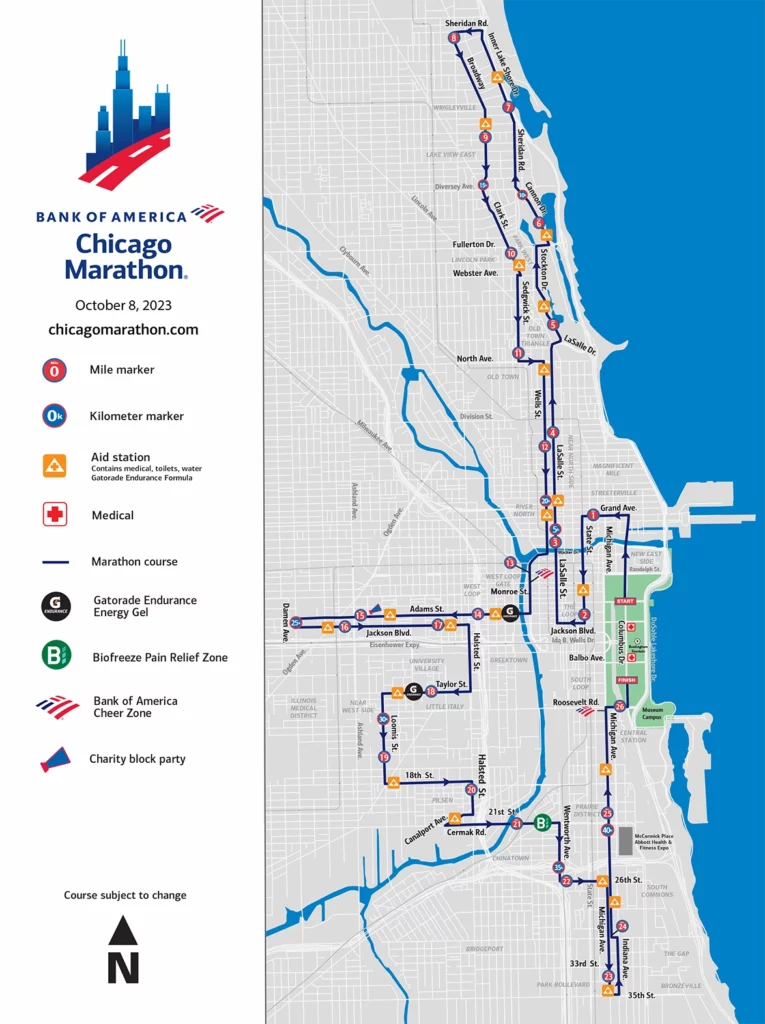
The Chicago Marathon is a flat, fast loop starting and finishing in Grant Park. You will run through 29 distinct neighborhoods in front of roughly 1.7 million spectators, and the course has produced seven world records — a reputation earned through the combination of flat terrain, wide streets, and usually cool October weather.
Course Profile at a Glance
| Total distance | 26.2 miles / 42.195 km |
|---|---|
| Neighborhoods | 29, including The Loop, Lincoln Park, Wrigleyville, Old Town, Greektown, Little Italy, Pilsen, Chinatown, and Bronzeville |
| Average elevation | ~600 ft above sea level |
| Terrain | Famously flat. The only notable climb is the short rise on Roosevelt Road at mile 26 ("Mount Roosevelt") |
| Surface | Asphalt road, closed to traffic |
| Course certification | USATF & World Athletics certified |
| Aid stations | 20 on-course stations, spaced roughly 1–2 miles apart |
| Timing checkpoints | Start, every 5K, halfway, miles 20 through 25, mile 25.2, and the finish |
The start line is located in Grant Park at the intersection of Columbus Drive and Monroe Street. The race heads north out of Grant Park, and you will have no trouble finding the start — thousands of runners and spectators will be walking toward Grant Park on race morning. Just follow the flow.
Pro tip: pay close attention to your corral closing time. Wave 1 corrals close at 7:20 a.m., ten minutes before that wave starts. Race staff will lock you out if you arrive late and you will have to wait until all corrals have left before being allowed into a later wave.
Aid Stations and On-Course Fueling
There are 20 on-course aid stations, roughly 1–2 miles apart, with the first around mile 1.6. Every station has Gatorade Endurance Formula (lemon-lime), water, medical support, portable toilets (including ADA), and a public address announcer. At each station, Gatorade is served first and water second — know which one you want before you arrive so you are not cutting across the flow.
Beyond fluids, several partners set up dedicated stations on course:
- Maurten Hydrogel Fuel Depots — three depots in the middle third of the race, at approximately miles 12.5, 15.7, and 18.2. Products are Maurten Gel 100 and Gel 100 Caf 100.
- Gatorade Endurance Carb Energy Chews — typically at the mid-course aid station (around mile 13).
- Chiquita bananas — at aid stations in the miles 20 to 23 range.
- Biofreeze Pain Relief Zone — around mile 21 near Cermak Road and Archer Avenue. Biofreeze personnel help apply the spray for the final five miles.
Important: Chicago Event Management publishes exact aid station contents closer to race weekend, and the specialty depot locations have shifted by a few tenths of a mile from year to year. Treat the mile markers above as approximate, and confirm the final numbers on the official course amenities page or in the participant guide you receive at the expo.
The most important advice for on-course fuel: only use what you have trained with. If you do not use Maurten or Gatorade in training, do not start on race day. Bring your own.
Medical Support
Medical support is available at 22 on-course locations — a staffed medical tent at all 20 aid stations, plus two additional stations (between miles 14–15 and in the final mile). Each aid station also has access to a Runner Transport vehicle for non-emergency assistance. The Main Medical Tent, Podiatry Tent, and Ice Station are in Grant Park just past the finish line, and there is another medical tent at the post-race party.
Race organizers encourage participants and spectators alike to be CPR-trained. On a course this size, the nearest responder to a runner in trouble is usually another runner.
Race-Day Logistics and Timeline
| Time (CT) | Event |
|---|---|
| 5:30 a.m. | Gear check and start corrals open |
| 7:20 a.m. | Wave 1 corrals close — and men’s pro wheelchair start |
| 7:21 a.m. | Women’s pro wheelchair start |
| 7:23 a.m. | Handcycle start |
| 7:30 a.m. | Wave 1 start (elite + corrals A–E) |
| 8:00 a.m. | Wave 2 start (corrals F, G, H, J) |
| 8:35 a.m. | Wave 3 start (corrals K, L, M, N) |
| 9:30 a.m. | 27th Mile Post-Race Party opens; beer sales begin; Grant Park opens to spectators (not the start or finish zone) |
| 3:30 p.m. | Beer sales end |
| 4:00 p.m. | Post-race party ends and gear check closes |
One planning detail that catches people out: the 4 p.m. cutoff is measured on the clock, not on your watch. If you start in Wave 3 at 8:35 a.m., 4 p.m. gives you about 7 hours 25 minutes of clock time — comfortably inside the 6:30 limit. But gear check also closes at 4 p.m., so a slower finisher who lingers at the post-race party risks losing access to their bag. Collect your gear first, celebrate second.
Getting to the Starting Line
Walking
If you are staying in a hotel near Grant Park, walking is the best option. Taxis are pricey and traffic is at a standstill on race morning.
Train
The CTA is your best bet after walking. The Red and Blue Line trains run 24/7. Depending on your corral, exit at Monroe, Jackson, or Harrison. The trains will be packed with runners — just follow the crowd and you will get to the right place.
Bus and Rideshare (not recommended)
Buses get delayed in traffic. Uber and Lyft are available but expensive and unreliable on race morning — I strongly recommend walking or taking the train if possible.
Driving (also not recommended)
Take mass transit if you can. If you must drive, reserve parking in advance at Millennium Garages. When I was walking to the marathon in 2010, traffic on all roads within a mile of the start was at a dead standstill.
Weather Considerations
Chicago in early October is usually great for running. But "usually" is doing a lot of work in that sentence — this race has produced everything from freezing starts to 89°F heat. Plan for variability.
| Measure | Value |
|---|---|
| Average race-day high | ~67°F (19°C) |
| Average race-day low | ~50°F (10°C) |
| Typical start temperature | 45–55°F |
| Record high (2007) | 89°F — race was halted, 1 fatality, 400+ medical incidents |
| Record low (1999) | 28°F |
| Precipitation | Generally low but occasional rain or lakefront drizzle |
| Wind | Usually moderate; Lake Michigan can produce gusts along the lakefront and at downtown bridge crossings |
What to wear based on forecast temperature at the start:
- 30s°F: tights or capris, long-sleeve base layer + singlet, gloves, thin beanie, arm sleeves you can toss mid-race.
- 40s°F: shorts or light capris, singlet or light long-sleeve, gloves, arm sleeves.
- 50s°F: shorts and a singlet. Throwaway top at the start if it is windy.
- 60s+ °F: shorts, singlet, and a plan to drink more than you think.
Remember that you will be standing in a corral for 30 to 60 minutes before you start. Dress for the run, not for the wait, and bring a throwaway layer you do not mind losing.
For the full cold and heat training picks, see my guides on running in the heat and cold-weather running tips.
Chicago Marathon Course Strategy
The Chicago Marathon has an amazing course. The crowd support is second to none, and I have run many races. The course will be heavily packed with runners, and most people will be forced to run slower the first few miles than they would like to. It took a few miles before I felt like I had enough space to control my own pace.
Step 1 — Study the Course
"He who controls information controls the world." — Dr. Stephen Franklin
In simple words, the runner who knows the course is more prepared and has a better chance to succeed. Take some time to study the map, watch course videos, and read the available information on amenities. For other race day strategies, see my race day strategies and race week preparation articles.
Step 2 — Miles 0 to 4: Slow Down
The race starts in gorgeous Grant Park. You will feel the support of a large crowd, but do not get too excited. Run slowly through the Urban Center and Financial District of Chicago and save your energy. It will be very crowded, so in a way, the race will hold you back early. My best advice is to just ride it out. After a few miles, things will spread out and you can settle into your pace.
Pro tip: do not waste energy trying to weave around runners. In most cases, you will be jammed together and it is pointless anyway. Relax and enjoy the moment. Focus on finding your rhythm. With a record 55,000+ runners in 2026, expect the early miles to be more congested than ever.
Step 3 — Miles 5 to 10: Control Your Pace
Maintain your pace and do not speed up. You will feel the support of the cheering crowd and get excited, but do not let it interfere with your pacing. Do not burn through your fuel before the fun begins. This is where most people take their first energy gel or sports drink. If you need suggestions, see my best sports drinks for runners post.
Pro tip: have a plan for when your GPS watch drifts. In downtown Chicago, tall buildings interfered with my GPS reception, and once it drifts it never really recovers. Know your pace by feel and by the mile markers.
During this phase, you will enjoy the quieter Sedgwick and Clark Streets with beautiful houses. Focus on settling in.
Step 4 — Miles 11 to 17: Old Town and River North
In this phase you will pass the Old Town of Chicago and River North, and reach an aid station around mile 13 where you can fuel — this is typically where the Gatorade Endurance Carb Energy Chews appear. Around mile 15.7 you hit a Maurten Hydrogel Fuel Depot — if you have not used Maurten before, do not start now. Stick with what you brought.
You will also pass Greektown and Little Italy, which include some of the city’s most stunning landmarks. Near mile 18, another Maurten depot. Same rule: only use what you have trained with.
Step 5 — Miles 18 to 20: Pilsen
Somewhere between miles 18 and 20, most runners start feeling the signs of fatigue. Hang in there and do not panic. You may have a few tough miles ahead, but you are getting close. "You got this" was a mantra I used over and over during this part of the race.
Running through the Pilsen neighborhood, you will experience a great vibe from Hispanic spectators, which boosts motivation to keep running. Bananas start showing up at aid stations from about mile 20 onward.
Step 6 — Mile 21 to Finish: Time to Shine
At this point, many runners are hurting. Many are doubting themselves. Not you. Here is where you trick your mind, visualize the finish line, and keep going.
The closer you get to the finish, the louder the crowds get — all of it is for you. The last quarter mile is amazing. Enjoy the sudden adrenaline. If this is your first marathon, be prepared for all the feels. I was extremely emotional as I approached and crossed the finish line.
Soak it all in. This is why you signed up.
Note on the last climb: at about mile 26, you face the brief rise on Roosevelt Road — affectionately known as "Mount Roosevelt." It is short and not actually steep, but at 26 miles it will feel like a mountain. Save a little energy for it.
Biofreeze Pain Relief Zone: around mile 21 near Cermak Road and Archer Avenue, Biofreeze personnel help you apply the spray to reduce soreness and kill the final five miles.
After the race, if you do not feel well, get help at the Main Medical Tent, Podiatry Tent, or Ice Station near the finish line. If you head to the post-race party in Grant Park, there is another medical tent there.
My best advice is to start rehydrating and eating as soon as possible. Something with protein and carbs — chocolate milk, a protein shake, a banana — jump-starts your recovery. Replace electrolytes with a banana or sports drink.
Course Strategy Key Takeaways
- Control your pace — especially in the first 10 miles.
- Stop by the aid stations. Do not skip them even if you feel fine.
- Practice your hydration and fueling strategy in training, not on race day.
- Celebrate your journey and your accomplishment.
8 Additional Tips for Running the Chicago Marathon
Do not try anything new on race day. This includes food, gels, shoes, and clothing. Everything you use on race day should have been tested during your long runs. If the official aid stations do not carry your preferred fuel brand, bring your own.
Do not wear a brand-new pair of shoes. Use the ones you have tested during long runs. I like to do a shoe change about 30 days from the race using the same brand and model I trained in — so there is adequate cushioning for race day. And please do not run the marathon in a cotton t-shirt. Wear a lightweight technical shirt, lycra shorts or capris, and a light running belt for gels and your key.
Skip the first Port-A-Potty stop and the first few aid stations. They have the longest lines. There are plenty of aid stations and Port-A-Potties along the course. Expect queues in the first half of the race and plan to stop later if you can.
Avoid sugary foods and saturated fats the night before. If your stomach is easily upset, skip the sugary desserts and heavy cheese plates. Eat the same meals you eat the night before a long training run. And you do not need to stuff your face with pasta — a moderate carb increase in the days leading up is fine, but do not over-do it. See my what to eat before a run and meal planning for runners articles.
Stay hydrated — but know the equipment rules. Hydration backpacks are prohibited under the official event rules. You can use a hydration belt or hand-held bottles. If you use a specific sports drink, practice with it in training so you do not need to carry your own during the race. Aid stations use Gatorade Endurance; Maurten at select depots.
Do not sightsee the day before the marathon. Walking around the city before a race beats up your legs and impacts performance. I once went sightseeing the day before the Cherry Blossom 10 Mile in Washington DC and wrecked my legs. I had trained well and barely finished. Take care of your legs.
Give family and friends the tools to track you. Have them install the official Chicago Marathon app. Plan specific meetup spots with them using the race map so they can see you at multiple points on the course. Good spectator spots include:
- Near the start: Grand Avenue, between Columbus and State
- Closer to the finish: the Bank of America Cheer Zone
Note: spectators do not have access to the finish line itself. Reunite with your family at the Runner Reunite area in Grant Park.
Practice visualization. Sit in a comfortable position and imagine yourself running the course, passing each neighborhood, crossing the finish line. Do this at night before sleep and in the morning.
"I always visualize the run before I do it. By the time I get to the start gate, I’ve run that race 100 times already in my head, picturing how I’ll take the turns." — Lindsey Vonn, Olympic gold medalist skier
Spectator Guide — Best Places to Watch
Chicago is one of the most spectator-friendly marathons in the world. The loop course means a smart spectator can actually see their runner three or even four times without moving more than a few transit stops.
Top Spectator Spots
| Location | Approximate Mile | Why It’s Good |
|---|---|---|
| Grand Avenue (Columbus & State) | ~1 | Right near the start — see the early energy. Easy walk from any downtown hotel. |
| Lincoln Park / Wrigleyville | ~5–7 | Big crowd energy, great atmosphere, multiple bars and cafes to warm up in. |
| Old Town | ~11–12 | Accessible via the Red Line (Sedgwick stop). Halfway point vibe. |
| Greektown / Little Italy | ~15–17 | Brunch neighborhoods — good for spectators who want to eat while they wait. |
| Pilsen | ~19 | The loudest neighborhood on the course by most accounts. Hispanic community puts on a show. |
| Chinatown | ~22 | Dragon dancers and drums — a memorable visual for your runner. |
| Cheer Zone (Michigan Ave near the finish) | ~25 | Bank of America sponsored cheer zone. Big crowds, huge energy. |
| Runner Reunite Area, Grant Park | Finish | Spectators cannot reach the finish line itself — meet here post-race. |
Tracking Your Runner
The Chicago Marathon app lets spectators follow up to 10 runners in real time using the bib number. Signup is free. Timing checkpoints are at the start, every 5K, the halfway point, each mile from 20 through 25, mile 25.2, and the finish — so the updates get more frequent exactly when your runner is struggling and you most want to know where they are. This is how most spectators know when to start moving to the next viewing point.
CTA Tips for Spectators
Get a Ventra pass before race morning. The Red and Brown lines are the most useful for hopping between viewing points. Buses will be slower than trains on race day.
Bring a sign. Runners love signs. Keep it simple, funny, and legible from 30 feet.
Where to Stay During the Chicago Marathon
Note: make sure to check special offers from the official housing provider for the Bank of America Chicago Marathon and the Hilton Chicago (the official headquarters hotel). Book as early as possible — good options go fast, and with a record field in 2026 downtown rooms will be tighter than usual.
Where to book: visit the official hotels, travel and parking page and book well in advance.
How to Choose Your Chicago Marathon Hotel
There are many options in Chicago, from budget hostels to luxurious hotels. Most runners have one of four priorities: close to the start, family-friendly, pet-friendly, or amenities like a pool or spa. Here are hotels I frequently see recommended in each category.
Hotels Closest to the Chicago Marathon Start
- The Silversmith Hotel (~0.3 km to start)
- The Palmer House Hilton (~0.3 km)
- Chicago Athletic Association (~0.4 km)
- Loews Chicago Hotel (~0.4 km)
- The Alise (~0.5 km)
Family-Friendly Hotels
- Hampton Majestic Chicago Theatre District (~1.1 km)
- The Blackstone, Autograph Collection (~0.6 km)
- Silversmith Hotel Chicago Downtown (~0.3 km)
- W Chicago City Center (~0.9 km)
Pet-Friendly Hotels
- The Hilton Chicago (~0.8 km)
- The Palmer House Hilton (~0.3 km)
- The W Chicago Lakeshore Hotel (~1.2 km)
- Virgin Hotels Chicago (~0.6 km)
Hotels with On-Site Fitness Center and Indoor Pool
- The Hilton Chicago (~0.8 km)
- The Silversmith Hotel (~0.3 km)
- Chicago Athletic Association (~0.4 km)
- The Chicago Swissotel (~0.8 km)
- Sheraton Grand Chicago (~0.6 km)
- Hyatt Centric Chicago Magnificent Mile (~1.0 km)
Hotels with a Relaxing Spa
After a tough race, cold water with ice can reduce inflammation, but the days after, a spa is a great way to relax tight and sore muscles.
- The Hilton Chicago (~0.8 km)
- The Palmer House Hilton (~0.3 km)
- The Chicago Swissotel (~0.8 km)
- Hyatt Centric Chicago Magnificent Mile (~1.0 km)
Approximate distances are to the Grant Park start and are a planning guide only — confirm with the hotel when you book.
Alternatives to Hotels
Airbnb: if you prefer an apartment with a full kitchen, Airbnb has many options from cozy studios to multi-bedroom places. Great for families or runners who want full diet control.
Hostels: if you want to save money, hostels are a legitimate option. The Chicago Getaway Hostel is popular with solo travelers and is ten minutes on foot from the Fullerton Subway Station. The Freehand Chicago Hostel has community-style accommodations and even a fitness center.
Where to Eat Before the Marathon
Race day is a big day, and proper nutrition is critical. If you are traveling, eating can be a logistical challenge.
Important: do not experiment with unknown meals before the marathon, and ask the server about ingredients you cannot tolerate. Try to maintain your normal nutrition routine.
Your plate on Saturday night should be: Protein + complex carbs + modest fiber + some natural sugar.
Book your Saturday dinner reservation now if you have not already. Downtown restaurants fill up on marathon weekend, and a record field means more competition for tables — a 5:30 or 6 p.m. seating is easier to get and better for your sleep anyway.
Chicago Restaurants Serving Runner-Friendly Meals
LYFE Kitchen
Allergy-conscious menu with fresh sandwiches, soups, and nutritious grain bowls. A great place to fuel up.
True Food Kitchen
Dishes made with fresh, whole ingredients. One of the best options in Chicago for dietary restrictions.
Beatrix
A popular brunch spot with granola, freshly squeezed juices, coffee, and healthy options. Busy on weekends — make a reservation.
Torali Italian-Steak
Great signature pasta, made in-house daily. Visit before the race for carbs, or after to celebrate. Menu here.
Hotels Serving Pre-Race Snacks and Meals
Almost every downtown hotel does its best to support runners during marathon weekend. Many offer pasta specials Saturday night and grab-and-go bags Sunday morning with bananas, granola bars, and water. Offerings change year to year — ask your hotel directly when you book.
Palomar Chicago (~1.0 km to start)
Palomar is well-prepared for marathon weekend. Guests typically get a carb-rich breakfast Sunday morning, plus granola bars and water.
Embassy Suites Chicago (~1.3 km)
Embassy Suites by Hilton Chicago Downtown is another great option. Pasta, bread, and other runner-focused options. This is where I stayed when I was in Chicago.
The James Chicago (~1.5 km)
Carb-loading meal Saturday, complimentary grab-and-go breakfast bag Sunday (muffins, croissants, fruit, yogurt).
Residence Inn by Marriott (~1.7 km)
Grab-and-go snack bags with bananas and water.
Hotel Lincoln (~8.4 km)
Even hotels farther from the start provide complimentary snacks, energy bars, fruit, and water. Ask your hotel — most offer something for marathon runners.
Where to Celebrate After the Marathon
Visit a restaurant with a great vibe to party, enjoy a delicious meal, and toast with sparkling wine. Many Chicago restaurants offer specials for marathon runners — wear your medal.
Places commonly recommended:
- Four Entertainment Group venues
- Maple & Ash
- Dos Urban Cantina
- Onward
- Play Kitchen & Cocktails
- Ocean Prime Chicago
Show your medal and reward yourself with well-deserved calories and the ambiance of your running buddies.
Goose Island Beer Company 27th Mile Post-Race Party
Hosted in Butler Field, Grant Park, 9:30 a.m. to 4:00 p.m. on race day. Free for participants with their bib. Participants 21 and over get a beer redemption tag attached to their bib at the expo — do not remove it. Beer sales run from 9:30 a.m. until 3:30 p.m. Engage with other participants, grab a beer, soak in the atmosphere.
After-Party in Hotel
Chicago Marathon is an important event for the entire city, and many hotels throw rooftop after-parties. The Godfrey Hotel, for example, is known for a rooftop celebration featuring prime rib, sushi, pasta, and dessert.
Where to Wander and Relax After the Marathon
When the marathon is over, take your time to do some sightseeing and simply relax.
Tip for tourists: if it is your first time in Chicago, consider a Go Chicago Pass, which can save you up to 55% on attraction admission.
The Best Instagram Spots in Chicago
- The Skydeck Chicago at Willis Tower (233 S. Wacker Dr.)
- The Cloud Gate ("The Bean") in Millennium Park
- Michigan Avenue Bridge Viewpoint
- Fern House at Garfield Park Conservatory
- wndr museum — a place of art and illusions
Must-Try Classic Chicago Foods
Chicago-Style Deep-Dish Pizza
Not a thin-crust pizza — a thick pie with huge amounts of cheese and chunky tomato sauce. Try Uno Pizzeria, sister location Pizzeria Due, Lou Malnati’s, Giordano’s, or Gino’s East.
Italian Beef
Tender shredded beef dipped in au jus on a long Italian-style roll. Best at Al’s Beef in Little Italy.
Garrett Popcorn
Garrett Mix at the Garrett Popcorn Shop — a famous salty-sweet blend. Multiple locations throughout Chicago.
The Original Rainbow Cone
Chocolate, Strawberry, Palmer House, Pistachio, and Orange Sherbet layered into one. Locations in the Beverly neighborhood and at Navy Pier.
Places to Relax and Unwind
Shopping — The Magnificent Mile
A bustling shopping district with high-end stores and luxury boutiques. If shopping is your way to celebrate, this is where to go.
Theater — The Chicago Theatre
Hosts concerts and special events. Browse the calendar and tickets.
Spa and Recovery
Aire Ancient Baths in River West offers six thermal baths, massage, and aromatherapy steam rooms. King Spa & Sauna is family-friendly. The luxury Chuan Spa at The Langham offers Traditional Chinese Medicine-based treatments.
Chicago Marathon FAQs
When is the Chicago Marathon?
The 2026 Bank of America Chicago Marathon is Sunday, October 11, 2026. The race is held the second Sunday of October, which puts the 2027 race on October 10, 2027.
How do I enter the 2026 Chicago Marathon?
The general lottery closed on November 18, 2025, and results were announced on December 11, 2025. International tour-operator packages closed August 16, 2026. For 2026, charity entry is the only remaining option, open through September 15, 2026 or until individual teams fill. Chicago Event Management has not yet published the 2027 application dates.
How big is the 2026 field?
More than 55,000 participants — the largest field in the race’s history, selected from a record pool of over 200,000 applicants. Runners come from more than 100 countries and all 50 US states.
Who is running the 2026 elite race?
Defending champions Jacob Kiplimo and Hawi Feysa both return. The men’s field includes six sub-2:04 runners plus Americans Charles Hicks, Clayton Young, Vincent Mauri, and 2017 Chicago champion Galen Rupp. The women’s field features former world record holder Brigid Kosgei, two-time Boston champion Sharon Lokedi making her Chicago debut, and Des Linden.
Is there a virtual option for 2026?
Not officially announced for 2026. The marathon offered a virtual option during pandemic years but it has not consistently returned. Confirm with the official site before assuming yes.
Are participants required to pick up their race packet in person?
Yes. All registered participants must pick up their packet in person at the Abbott Health & Fitness Expo with photo ID and their packet-pickup email. No proxies, no race-day pickup, no mailing.
What are the 2026 expo hours?
Thursday, October 8: 10 a.m. to 6 p.m. Friday, October 9: 9 a.m. to 6 p.m. Saturday, October 10: 9 a.m. to 6 p.m. McCormick Place North Building, 2301 S. Martin Luther King Jr. Drive. Admission is free and open to the public.
What comes in the participant packet?
Your bib with safety pins, timing device, gear check tag, a Nike running shirt, and the participant bag. Participants 21 and over also get a beer redemption tag attached to the bib.
Can you walk the Chicago Marathon?
Yes, but you must finish within the 6-hour-30-minute course time limit (about 15:00 per mile, including any stops). The course reopens to traffic on a rolling schedule, and participants still on the course after the limit are moved to the sidewalk to finish on their own. Participants finishing after 4 p.m. may not receive official recognition.
Is the Chicago Marathon course flat?
Very. The course is famously fast and flat — seven world records have been set here. The only notable rise is Roosevelt Road at mile 26, a brief climb runners jokingly call "Mount Roosevelt." Total net elevation change across the course is trivial compared to almost any other major.
Can I use headphones and a GPS watch?
Yes, for most participants — music devices are permitted and there is no restriction on GPS watches. Athletes in the American Development Program are restricted from headphones, and anyone competing for overall awards or prize money cannot use music or communication devices under USATF championship rules. Drones, selfie sticks and camera rigs, hydration backpacks, strollers, pets (other than working service animals), and full-face costumes are all prohibited. See the official event rules.
What fuel is provided on the course?
Gatorade Endurance Formula (lemon-lime) and water at all 20 aid stations. Maurten Gel 100 and Maurten Gel 100 Caf 100 at three Hydrogel Fuel Depots in the middle third of the race (approximately miles 12.5, 15.7, and 18.2). Gatorade Endurance Carb Energy Chews at the mid-course station, and bananas at aid stations from roughly mile 20 onward. Exact locations are confirmed closer to race weekend — check the official course amenities page or your participant guide.
What if I cannot participate — can I cancel or defer?
Yes, through your participant account, and the terms are better than most runners realize. If you cancel by October 7, 2026, you receive a guaranteed entry for the 2027 race — though you still have to submit a new application and pay the entry fee again. All 2026 event fees are non-refundable, and once you cancel the process cannot be undone. Important exception: this option is not available to runners who entered through a charity team or a tour operator. There is also a separate pregnancy and postpartum policy worth reading if it applies to you.
Can I transfer my entry to someone else?
No. Race entries are non-transferable. Selling, trading, or transferring a bib will get everyone involved disqualified and potentially banned from future events.
What is the time limit?
6 hours and 30 minutes — about 15:00 per mile including all stops. Participants still on course after the limit are still allowed to finish but on the sidewalk with the course reopening behind them.
Sources and Official Information
All race details in this guide were pulled from the following official sources and verified in August 2026. Confirm everything before registering or traveling — dates, times, rules, and course details can change.
- chicagomarathon.com — official homepage
- Apply — entry pathways and qualifying standards
- Application FAQs — fees, deadlines, policies
- Charity Teams
- Tour Program — international entries
- Cancellation Policy
- Expo & Packet Pickup
- Course & Amenities — course map, aid stations, time limit
- Race Day Timeline
- Hotels, Travel & Parking
- Spectator Info
- Event Rules
- Press Releases — elite field announcements and field size
- Abbott Chicago 5K
- Wikipedia — Chicago Marathon (history, records, past winners)
This guide is unofficial. Some details may be dated by the time you read this. Always verify with the official race site before making travel, training, or registration decisions.
Steve Carmichael is an RRCA and USATF Certified Running Coach.
Related Articles




Related Podcast Episodes
Dive deeper into this topic with these episodes from the RunBuzz Running Podcast.
Episode 139
How To Adjust Your Training and Mindset When Races Are Cancelled or Delayed
Episode 135
7 Tips To Help You Run or Race At Higher Altitude and Elevations
Episode 134
Runner Case Study - Coaching Call With Carrie Poss - Part III - Race Week And Recap
Episode 133