
The Unofficial Guide to the 2027 Boston Marathon
 Steve Carmichael·Last updated
The Boston Marathon is the world’s oldest annual marathon — run every year since 1897 — and for most runners it is the ultimate bucket-list race. The 131st Boston Marathon is held on Monday, April 19, 2027 — Patriots’ Day, the Massachusetts state holiday that shuts down much of the region in celebration of the race. The 130th ran on Monday, April 20, 2026, where John Korir set a new men’s course record of 2:01:52 and Sharon Lokedi successfully defended her women’s title in 2:18:51.
Boston is different from every other major marathon. You don’t enter a lottery. You qualify — by running a time fast enough for your age and gender at another certified marathon — or you raise money for one of the official charities. That qualifying bar is why Boston is so revered, and why a BQ (Boston Qualifier) is a running milestone in its own right.
The course itself is famously difficult: a net downhill that tricks you into running too fast early, followed by the Newton Hills that start at mile 16 and culminate in the infamous Heartbreak Hill around mile 20.5. Finish on Boylston Street and you are part of a tradition that includes Johnny Kelley, Bobbi Gibb, Kathrine Switzer, Bill Rodgers, Uta Pippig, Meb Keflezighi, and countless first-time finishers who qualified on their own.
In this unofficial guide I share what I know about Boston — qualifying, registration, the course, the expo, where to stay, what to eat, and how to plan a trip that does the race justice. All of it pulled from the official BAA site, my own time around the race, and participant experience.
This is an Unofficial Guide
This article is not produced by, endorsed by, or affiliated with the Boston Athletic Association (BAA) or the Boston Marathon. It is a runner’s and coach’s perspective, put together to help you prepare.
Race details, qualifying standards, registration windows, and logistics can and do change year to year. Always confirm all official information at baa.org before you register, travel, or race.
Key Takeaways — Boston Marathon
- 130th Boston: Monday, April 20, 2026. 131st Boston: Monday, April 19, 2027.
- No lottery. Entry is via qualifying time, charity, or a handful of invitational/sponsor paths. For 2026, the qualifying cutoff was BQ minus 4 minutes 34 seconds.
- Qualifying standards tightened for 2026 — 5 minutes faster across all age groups under 60, with standards mirroring women’s for the non-binary division.
- Course: point-to-point, Hopkinton to Boston. Net downhill (~459 ft), but famously hard due to the Newton Hills (miles 16–21) and Heartbreak Hill. Finish on Boylston Street.
- Expo: moved to the Hynes Convention Center for 2026 (from the Seaport/BCEC). Fri–Sun of race weekend. Packet pickup is in-person only.
- 2027 change to watch: BAA has announced a downhill-course penalty starting with 2027 registration — qualifying times on net-drop courses may receive time penalties or be disqualified.
Boston Marathon at a Glance
| 130th Boston Marathon | Monday, April 20, 2026 (Patriots’ Day) |
|---|---|
| 131st Boston Marathon | Monday, April 19, 2027 (Patriots’ Day) |
| Distance | 26.2 miles (42.195 km), point-to-point |
| Start | Main Street, Hopkinton, MA |
| Finish | Boylston Street, Copley Square, Boston |
| Field size | ~30,000 participants |
| Time limit | Finish line closes 5:30 p.m. (roughly 6 hours from the last wave start) |
| Entry fee (2026 qualifier) | $260 USD |
| Entry paths | Qualifying time, official charity, sponsor/invitational |
| Prize money | Yes — professional division + American bonuses |
| Title sponsor | Bank of America |
| Title governing body | Boston Athletic Association (BAA) |
| Expo (2026) | John B. Hynes Veterans Memorial Convention Center, Boston |
| Official site | baa.org |
Boston Marathon History and Course Records
The Boston Marathon began in 1897, inspired by the marathon event at the 1896 Athens Olympics. It is the oldest annual marathon in the world. Women were not officially allowed to enter until 1972, but Bobbi Gibb ran unofficially in 1966 and Kathrine Switzer famously entered under her initials in 1967. Today the race is the crown jewel of the World Marathon Majors and the qualifying standard for elite amateur marathon running.
| Record | Time | Athlete | Year |
|---|---|---|---|
| Men’s course record | 2:01:52 | John Korir (Kenya) | 2026 |
| Women’s course record | 2:17:22 | Sharon Lokedi (Kenya) | 2025 |
The 2026 race was the 130th running. John Korir defended his men’s title in a course-record 2:01:52, ahead of Alphonce Simbu (Tanzania, 2:02:47) and Benson Kipruto (Kenya, 2:02:50). Sharon Lokedi successfully defended her women’s title in 2:18:51, ahead of Loice Chemnung (Kenya, 2:19:35) and Mary Ngugi-Cooper (Kenya, 2:20:07). In the wheelchair divisions, Marcel Hug claimed his ninth Boston men’s wheelchair title (1:16:06) and Eden Rainbow-Cooper won her second Boston women’s wheelchair title (1:30:51).
How to Enter the Boston Marathon
Boston is the hardest major marathon in the world to get into. Three paths: run a qualifying time, raise money for charity, or earn an invitational/sponsor bib. There is no lottery.
1. Qualifying Time (The BQ)
You need to run a certified marathon on or after September of the year prior to the Boston you want to run. That time must be faster than the qualifying standard for your age and gender, and in most years you also need to beat the standard by a "buffer" (the cutoff). For the 2026 race, the cutoff was BQ minus 4 minutes 34 seconds, meaning 8,887 applicants who had run a BQ but did not beat it by enough were not accepted.
Qualifying Standards (2026 cycle; same standards apply for 2027)
| Age group on race day | Men | Women / Non-binary |
|---|---|---|
| 18–34 | 2:55:00 | 3:25:00 |
| 35–39 | 3:00:00 | 3:30:00 |
| 40–44 | 3:05:00 | 3:35:00 |
| 45–49 | 3:15:00 | 3:45:00 |
| 50–54 | 3:20:00 | 3:50:00 |
| 55–59 | 3:30:00 | 4:00:00 |
| 60–64 | 3:50:00 | 4:20:00 |
| 65–69 | 4:05:00 | 4:35:00 |
| 70–74 | 4:20:00 | 4:50:00 |
| 75–79 | 4:35:00 | 5:05:00 |
| 80+ | 4:50:00 | 5:20:00 |
Coming for 2027 Registration — Downhill Course Rule
Starting with registration for the 2027 Boston Marathon, BAA is introducing time penalties for qualifying times run on net-downhill courses. Net drops of 1,500–2,999 ft add 5 minutes to your time for qualifying purposes. Drops of 3,000–5,999 ft add 10 minutes. Courses with a net drop of 6,000+ ft will no longer be accepted. If you are targeting a 2027 Boston qualification, pick your qualifying race carefully.
2. Charity Program (Bank of America Official Charity Program)
About 10% of the Boston field runs for charity. You commit to a fundraising minimum — typically $10,000 to $15,000 depending on the charity — and in exchange you get a guaranteed entry even if you have never run a BQ. Applications for each year open in late September of the prior year, with charity team selections notified in December.
Find the list of participating charities at baa.org and apply directly to the charities themselves.
3. Registration Windows
| 2026 registration | September 8–12, 2025 (closed) |
|---|---|
| 2026 cutoff | BQ minus 4:34 |
| 2026 entry fee | $260 USD |
| 2027 qualifying window opens | September 13, 2025 (already open) |
| 2027 registration | September 2026 — exact dates TBD by BAA |
| 2027 cutoff | TBD (announced after registration closes) |
Boston Marathon Fan Fest & Expo
Venue as of 2026: the Boston Marathon Fan Fest & Expo moved to the John B. Hynes Veterans Memorial Convention Center (900 Boylston Street, Boston) after many years at the Boston Convention and Exhibition Center in the Seaport. The 2027 expo location has not yet been announced by the BAA. Packet pickup is in-person only — every runner must show photo ID and their bib number confirmation.
2026 Expo Location and Hours
| Venue | John B. Hynes Veterans Memorial Convention Center, 900 Boylston Street, Boston, MA |
|---|---|
| Friday, April 17 | 10:00 a.m. – 7:00 p.m. |
| Saturday, April 18 | 9:00 a.m. – 7:00 p.m. |
| Sunday, April 19 | 9:00 a.m. – 6:00 p.m. |
| Admission | Free and open to the public |
| Pickup rules | Photo ID + bib confirmation. No race-day pickup. No mailing. |
Expect the official adidas merchandise store (always the longest line), sponsor exhibits, a live stage with athlete appearances, and hundreds of running brands. The unique Boston collector-style merch is a major draw — if there is a specific jacket or poster you want, go Friday when it is least picked-over.
Getting to the Hynes Convention Center
The Hynes sits on Boylston Street, directly on the race-finish corridor — about a 5-minute walk from the Copley T station. From most downtown Boston hotels you can walk. The Hynes Convention Center stop on the Green Line is adjacent.
If you are driving, the Prudential Center (111 Huntington Ave) and Copley Place Parking (2 Copley Place) garages are within a couple of blocks.
The Course
The Boston Marathon is a point-to-point course starting in Hopkinton and finishing in downtown Boston. It is a net downhill of about 459 feet, but do not be fooled — Boston is one of the hardest major marathon courses in the world. The first 16 miles trick you into banking time, and then the Newton Hills start.
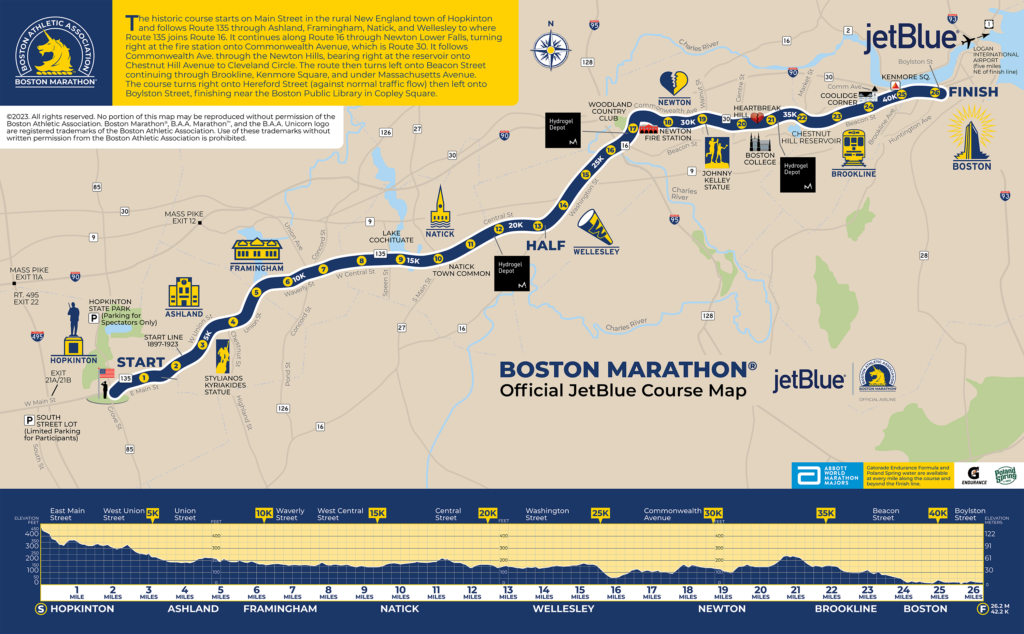
Course Profile at a Glance
| Distance | 26.2 miles / 42.195 km |
|---|---|
| Start | Main Street, Hopkinton, MA (~490 ft elevation) |
| Finish | Boylston Street, Copley Square, Boston (~30 ft elevation) |
| Net elevation change | ~459 ft net descent |
| Total gain / loss | ~815 ft gain / ~1,275 ft descent |
| World record eligible? | No — too much elevation drop and potential tailwind |
| Famous feature | Heartbreak Hill (just after mile 20) |
| Surface | Asphalt, closed to traffic |
| Certification | USATF certified |
Famous Course Landmarks
- Mile 0 — Hopkinton. Small New England town that empties completely on race morning. The Athletes’ Village at Hopkinton High School is where runners wait before moving to the start corrals.
- Miles 1–5 — early downhills. Steep descent right out of Hopkinton. This is where most first-time Boston runners ruin their race by going out too fast. The first four miles drop ~300 ft.
- Mile 6 — Framingham. Rolling terrain. Crowds start to thicken.
- Mile 12 — Wellesley College & the Scream Tunnel. Wellesley students line the course for a quarter mile, screaming so loudly you feel it in your chest. Many offer kisses to passing runners. You’ll hear them before you see them.
- Mile 13.1 — halfway. You feel great. Be suspicious.
- Miles 16–21 — The Newton Hills. Four distinct climbs, including Heartbreak Hill, spread across roughly five miles. Your legs are fatigued from the earlier downhills; the uphills feel punishing. This stretch decides most Boston finishes.
- Mile ~20.5 — Heartbreak Hill. Roughly 0.5 mile long, ~5% grade, a ~91-foot climb. Not the steepest hill in running, but at mile 20 it feels like a mountain.
- Mile 21 — Boston College. The downhill after Heartbreak is actually where many runners get their legs blown out — it is steep enough to hurt if your quads are cooked.
- Mile 25 — the Citgo Sign. Iconic neon sign above Kenmore Square. When you see it, you know the finish is 1.5 miles away.
- Mile 26 — Right on Hereford, Left on Boylston. Two of the most famous turns in running. Boylston Street stretches straight to the finish line for four-tenths of a mile. The crowd noise is overwhelming.
Aid Stations and On-Course Fueling
Aid stations are at mile 2 and every mile thereafter. Each has Gatorade Endurance (the official sports drink) and water. Medical stations are spread across the course.
Maurten Hydrogel fuel stations are at three specific points:
- Mile 11.8 (Wellesley, before the Scream Tunnel)
- Mile 17 (into the Newton Hills)
- Mile 21.5 (just past Boston College, after Heartbreak Hill)
Products offered: Maurten Gel 100 and Gel 100 CAF 100. As always, do not consume on race day anything you have not trained with.
Race-Day Logistics and Start Times
Because Boston is a point-to-point race, your hotel in Boston is 26.2 miles from the start. The BAA operates shuttle buses from Boston Common to the Athletes’ Village in Hopkinton on race morning. You get on the bus in Boston; you run back to Boston. It is unique to Boston among the majors and adds logistics you do not have with Chicago, NY, or Berlin.
2026 Start Times (Updated 6-Wave Format)
For 2026, BAA moved to a six-wave start format (up from four). More waves, smaller wave sizes, less crowding on the course.
| Division / Wave | Start Time (ET) |
|---|---|
| Wheelchair Men | 9:06 a.m. |
| Wheelchair Women | 9:09 a.m. |
| Handcycles / Duos | 9:30 a.m. |
| Professional Men | 9:37 a.m. |
| Professional Women | 9:47 a.m. |
| Para Athletics Division | 9:50 a.m. |
| Wave 1 | 10:00 a.m. |
| Wave 2 | 10:15 a.m. |
| Wave 3 | 10:28 a.m. |
| Wave 4 | 10:41 a.m. |
| Wave 5 | 11:01 a.m. |
| Wave 6 | 11:21 a.m. |
| All athletes expected across start | by 11:30 a.m. |
| Finish line closes | 5:30 p.m. |
Getting to the Starting Line
Your bib number and wristband are required to board the BAA shuttle buses. Buses depart from Charles Street, between the Public Garden and Boston Common, typically starting 6:00 a.m. on race morning. Exact pickup times depend on your wave assignment and are communicated by BAA closer to race day.
Plan for a lot of waiting. You will arrive at the Athletes’ Village 2–3 hours before your wave. Bring a throwaway warm top, snacks, a sports drink, and a plastic bag to sit on (the grass can be wet). You will donate your throwaway clothing at gear check; BAA donates the collected items.
Parking and Transit
Do not drive to Hopkinton on race morning. Roads close at 7:15 a.m. and parking is impossible. Use the BAA shuttle from Boston. If you are staying outside the city and need to get into Boston on race morning, MBTA transit is your friend:
- 1-Day LinkPass — $11, unlimited subway and bus for a day
- Commuter Rail weekend pass — unlimited rail and ferry
For race morning, the closest parking garages near the shuttle pickup point:
- Prudential Center Parking — 111 Huntington Ave / 800 Boylston St
- Copley Place Parking — 2 Copley Place
Weather Considerations
Mid-April in Boston is a coin flip. You might get perfect 45°F overcast with a breeze from the southwest (the ideal), or 80+ degrees in direct sun, or rain and 35°F with a headwind. Boston has seen all of it within the last 20 years.
| Typical race-day high | ~55–58°F (13–14°C) |
|---|---|
| Typical race-day low | ~43°F (6°C) |
| Ideal racing conditions | 45–50°F, overcast, SW breeze (tailwind) |
| 2012 heat race | 87°F — BAA offered deferrals; widespread medical issues |
| 1961 cold race | Snow squalls, mid-30s°F, wind gusts |
| 2018 Nor’easter | Heavy rain, headwinds, high 30s°F — one of the toughest Boston weather days on record |
| Historical ≥ 80°F probability | ~5% of race days |
What to wear based on forecast:
- Cold (30s°F): tights or capris, long-sleeve base layer plus singlet, gloves, hat, arm sleeves. Bring a throwaway warm layer to wear at the Athletes’ Village.
- Typical (45–55°F): shorts and a singlet, throwaway gloves. Plenty of throwaway for the 2-hour wait in Hopkinton.
- Warm (60–70°F): shorts and singlet. Drink aggressively at every aid station starting mile 2.
- Hot (75+°F): lightest kit you own. Consider a hat or visor for sun protection. Slow down — Boston in heat is brutal.
Boston Marathon Course Strategy
Boston is won and lost in the first half. The net downhill from Hopkinton tempts you into banking time. Then the Newton Hills deliver their lesson around mile 16. The runners who finish Boston well are usually the ones who were most conservative in the first 10 miles.
Miles 1–3: Downhill — Slow Down
The first few miles drop significantly — about 300 feet in the first 4 miles. If you have not practiced running downhill (and most runners have not), your quads will be wrecked by mile 18. Starting slow here is not just smart; it is survival.
You will be fired up and adrenaline will flow. Hold back. Most runners who have raced Boston well will tell you: run the first few miles slower than feels comfortable. You can always make up time later on flatter ground; you cannot un-destroy your quads.
Miles 4–7: Be Conservative
Alternating downhill stretches and small rollers. If you are feeling great, that is not permission to accelerate — that is the trap of Boston. Keep your pace disciplined. You will want this energy later.
Miles 8–9: The Climb and the Sun
More climbing, with little shade. On a warm year this stretch cooks you. Do not compete with other runners, do not weave. Just run your pace.
Miles 10–12: The Wellesley Approach
Rolling terrain with continued lack of shade. Even seasoned marathoners feel the effort here. Stay on top of your fueling. You are approaching the half and the Scream Tunnel.
Mile 12–13: The Wellesley Scream Tunnel
The Wellesley College students line the course for a quarter-mile. The noise is deafening. Many students offer kisses. Take the moment — the second half is where this race gets real.
Miles 14–16: Calm Before the Newtons
You’ve crossed the half. A big downhill at mile 15 sets up a steep uphill at mile 16 that is often the first real warning sign of the Newton Hills. Hydrate, watch your heart rate, and top off your fuel.
Miles 16–21: The Newton Hills
Four distinct hills spread across roughly 5 miles. The last one is Heartbreak. The climbs are not long individually, but the cumulative effect — on legs that have already run 16 miles of downhill — is what makes Boston hard.
Mile ~20.5: Heartbreak Hill
A 91-foot climb at a 3.3% grade over roughly 0.5 mile. The hill itself is not scary in isolation. What makes it a marathon-ender is its position — you arrive at mile 20 on fatigued legs, and you still have 6 miles after it. Control your breathing, shorten your stride, and just get over it. The crowd here is massive.
Miles 21–24: Downhill Into Boston
You are nearly done, but this stretch has a surprise: the downhill off Heartbreak can hurt worse than the climb if your quads are cooked. Be kind to your legs. Watch for the trolley tracks on the trolley right-of-way — they are slick in rain. This is where you start giving it what you have left.
Miles 25–26.2: Citgo, Hereford, Boylston
The Citgo sign marks your entry into Kenmore Square with 1 mile to go. Pass under it and you are home. Right on Hereford, Left on Boylston — two of the most famous turns in running. Boylston stretches for 0.4 miles to the finish line. The crowd noise on Boylston is overwhelming. Soak it in. This is why you qualified.
Course Strategy Key Takeaways
- Run the first 10 miles 10–15 seconds per mile slower than goal pace.
- Train on downhill runs before Boston — your quads are the limiting factor.
- Plan for the Newton Hills, especially Heartbreak at mile 20.5. Save legs for them.
- Do not try anything new. Race the fueling strategy you practiced.
- Take in the Scream Tunnel and Boylston Street. These moments are why you chose Boston.
8 Additional Tips for Running the Boston Marathon
Do not try anything new on race day. Food, gels, shoes, clothing, hydration — everything you use on race day should be something you have tested on long training runs. Bring your preferred fueling options to the start rather than trusting what is on the course.
Do not wear brand-new shoes. Have at least 30 days between a new pair of shoes and race day. I personally do a shoe change about 30 days out using the same brand and model I trained in, so I have fresh cushioning for Boston.
Use the bathroom before you line up. Port-a-potty lines at the Athletes’ Village are long, but they are longer at the start corrals. Go early.
Eat meals you are used to the night before. Avoid sugary desserts and saturated fats. If you normally eat pasta the night before long runs, eat pasta the night before Boston. Do not experiment.
Stay hydrated. Note: personal hydration systems (vest-style bladders) are prohibited at Boston. Standard manufactured fuel belts with bottles up to one liter are allowed. Plenty of aid stations on course means most runners do not need to carry much.
Save sightseeing for after the race. Do not spend Sunday walking the Freedom Trail. Your legs will thank you Monday. The Faneuil Hall visit can wait.
Give family and friends the BAA Racing App. Let them install the official app, and plan meetup spots along the course. Good spectator viewing: Wellesley Scream Tunnel (mile 12), Boston College (mile 21, right after Heartbreak), Kenmore Square (mile 25).
Visualize the course, especially the Newton Hills. Sit quietly and imagine yourself running the route — Hopkinton downhills, Framingham, Wellesley, Newton, Boston College, the Citgo Sign, Boylston. Do this at night before sleep and in the morning. By race day you will have run Boston in your head a hundred times.
Spectator Guide — Best Places to Watch Boston
Boston is a spectator’s marathon. The course is on public transit lines for much of its length, which means a smart spectator can catch their runner at multiple points with minimal traveling.
| Viewing Spot | Approximate Mile | Why It’s Good |
|---|---|---|
| Hopkinton start (requires credentials) | 0 | Small town, controlled access, but you see the leaders and the first waves roll out. |
| Framingham | 6 | Commuter rail line drops you near the course. Relaxed crowd. |
| Wellesley Scream Tunnel | 12–13 | Classic Boston. Accessible via Route 9 and Wellesley College. Massive energy. |
| Newton Hills / Heartbreak Hill | 16–20.5 | Watch the moment the race is made or broken. Green Line C Branch (Commonwealth Ave) runs parallel. |
| Boston College | 21 | Classic college-crowd energy just after Heartbreak. Green Line B Branch to BC. |
| Kenmore Square / Citgo Sign | 25 | Dense crowds, visible T stop (Kenmore). One mile to go. |
| Boylston Street | 26 | Finish line zone — credentials / secured perimeter. Viewing is on the approach to Copley. |
Spectator Pro Tips
- Commute between viewing spots on the Green Line. You can realistically catch your runner at Wellesley and then again at Kenmore Square if you plan transit timing well.
- The BAA Racing App provides live tracking with 5K splits. Use it to anticipate when your runner will pass each viewing point.
- Bring a sign. Keep it simple, funny, legible from 30 feet. Include your runner’s name so they can spot you.
- Dress for weather. You will be standing still for hours. Dress warmer than you think.
Where to Stay During the Boston Marathon
Boston hotels book up early for marathon weekend — the closer to race day you look, the fewer options and higher the prices. Book in January or earlier if you can. Two geographic choices: downtown Boston near the finish (expensive, but logistically ideal) or suburban hotels near Hopkinton/Framingham (cheaper, but you still need to get into Boston).
Downtown Boston (Near Finish Line)
The Revolution Hotel
Revolution Hotel is a cross between a hotel and a hostel — helpful staff, safe, convenient. Rooms are bare-bone; bring your own slippers for shared bath facilities. 40 Berkeley St, Boston, MA 02116.
Traditional Downtown Hotels
The full-service downtown options — Copley Plaza, Fairmont Copley, Westin Copley Place, Boston Marriott Copley Place — are within walking distance of the finish line and the expo at Hynes. They book early and charge premium rates on marathon weekend. If you can justify the cost, they eliminate most transportation headaches.
Suburban Hotels (Near the Start in Hopkinton/Framingham)
DoubleTree by Hilton Boston — Westborough
Near I-495, close to restaurants, indoor pool and fitness center, famous DoubleTree cookies. Pets not allowed. 5400 Computer Dr, Westborough, MA 01581.
Residence Inn by Marriott Boston Framingham
Spacious rooms with fully equipped kitchens. Older hotel, cheaper rates, get-what-you-pay-for quality. 400 Staples Dr, Framingham, MA 01702.
Courtyard by Marriott Boston Westborough
Friendly staff, clean rooms, fitness center, laundry, restaurant, complimentary parking. No pets. 3 Technology Dr, Westborough, MA 01581.
Fairfield Inn & Suites by Marriott Boston Milford
About 10 minutes by car from Hopkinton Center. Basic but clean, free coffee/tea, activities for kids, indoor pool. 1 Fortune Blvd, Milford, MA 01757.
Hotel Alternatives
Airbnb
Start looking early — marathon weekend inventory goes fast. Best areas: near the start line in Hopkinton/Framingham or near the finish in Back Bay/Copley Square.
Hostels and Bed & Breakfasts
- HI Boston Hostel — 19 Stuart St, Boston. Can rival hotel pricing for shared rooms; safe, without frills, several socializing areas.
- The College Club of Boston — 44 Commonwealth Ave, Boston. Historic building near Boylston and the Public Garden. Daily breakfast included. Friendly staff.
- Backpackers Hostel and Pub — 13 School St, Everett. Close to transit, quiet, clean. Free coffee and breakfast.
Where to Eat Before and After the Marathon
Make reservations early — Boston restaurants fill up fast on marathon weekend. Especially on Saturday night and Sunday night.
Near the Start (Hopkinton)
Ocean Nutrition
Smoothies, teas, protein-enriched iced coffees. Closed Sundays. 76 Main St, Hopkinton, MA 01748.
Central Public House
Regularly updated menu with clearly labeled vegetarian and gluten-free options. Good beer selection. 42 Main St, Hopkinton, MA 01748.
Bill’s Pizzeria Kitchen + Grille
Pizza, pasta, panini — 25 years in Hopkinton. Gluten-free and vegetarian options. Kid’s menu. 14 Main St, Hopkinton, MA 01748.
Ko Sushi and Grill
Sushi plus grilled meats. Vegan, gluten-free, and fresh-fish options. 25 Hayward St, Hopkinton, MA 01748.
Near the Finish (Boston)
The Salty Pig
Pork-focused bistro with diverse non-pork options. Try the Fresno Pepper Jam, the Salty Pig Pizza, or the local burrata. 130 Dartmouth St, Boston, MA 02116.
Abe & Louie’s
High-end Boston steakhouse with strong wine list. Wagyu, lobster, desserts. Not cheap. 793 Boylston St, Boston, MA 02116.
J.J. Foley’s Cafe
One of the best Irish pubs in Boston. Good food, strong drinks list: beer, wine, cocktails. Good celebration spot. 117 E Berkeley St, Boston, MA 02118.
The Bebop
Irish pub with live music seven days a week. Brunch on weekends. Salmon, avocado toast, shepherd’s pie. 1116 Boylston St, Boston, MA 02215.
Anchovies
Cozy neighborhood bar with tasty pastas, burrata ravioli, sandwiches. Good celebration spot. 433 Columbus Ave, Boston, MA 02116.
Parish Cafe & Bar
Gourmet sandwiches and craft cocktails. Open until 2 a.m. Saturdays. Each sandwich named after a famous Boston chef. 361 Boylston St, Boston, MA 02116.
Where to Wander and Relax After the Marathon
Boston is a city built for walking and photography. Here are my picks for when you are ready to be a tourist instead of a runner.
Best Photo and Walking Spots in Boston
Boston Public Garden (and the Swan Boats)
No trip to Boston is complete without the Public Garden. Live music, beautiful landscaping, picnic spots, and the famous swan boats. 4 Charles St, Boston, MA 02116.
Copley Square
Where you just finished. Walk it in daylight on the Tuesday after the race — Trinity Church, the Public Library (the first children’s room in the nation), and the Copley Plaza Hotel all within a block.
The Charles River Esplanade
Great for picnics, leisurely walks, and views of the city. Kid-friendly with a few playgrounds. Charles River, Esplanade, Boston.
Arnold Arboretum of Harvard University
Gorgeous garden that peaks in spring. Kid and pet-friendly. Don’t miss the bonsai collection. 125 Arborway, Boston, MA 02130.
Best Museums and Historic Sites
Boston Tea Party Ships & Museum
Floating history museum with in-character staff. Don’t miss the tea house. 306 Congress St, Boston, MA 02210.
Church of the Covenant
National Historic Landmark and stunning Gothic architecture. Tiffany Glass and Decorating Company made many of the stained-glass windows in the late 1800s. 67 Newbury St, Boston, MA 02116.
Citizens Bank Opera House
Beautifully restored venue for musicals and concerts. Eat before — food lines can be long. 539 Washington St, Boston, MA 02111.
Plimoth Patuxet Museums
Replica of the original Plymouth Colony settlement. Kid-friendly, in-character staff. 137 Warren Ave, Plymouth, MA 02360.
Harvard Museum of Natural History
Gems, glass art (the "Glass Flowers" collection is stunning), wide-ranging animal exhibits. Ticket includes entry to the Peabody. Affordable. 26 Oxford St, Cambridge, MA 02138.
The Sports Museum
Inside TD Garden. Boston-area sports memorabilia, especially Celtics, Bruins, and Red Sox. Engaging staff. 100 Legends Way, Boston, MA 02114.
Boston Marathon FAQs
When is the next Boston Marathon?
The 131st Boston Marathon is Monday, April 19, 2027. The 130th ran on April 20, 2026 (won by John Korir in a course-record 2:01:52). Boston is always the third Monday of April (Patriots’ Day).
How do I qualify for Boston?
Run a certified marathon faster than the qualifying standard for your age and gender. For the 2026 race, you also needed to beat the qualifying standard by at least 4 minutes 34 seconds to actually get in (that was the cutoff buffer). The qualifying window for 2027 opened September 13, 2025 and will run to the fall 2026 registration window.
Is there a lottery for Boston?
No. Boston is qualifier-based, plus charity and invitational paths. There is no general lottery.
Can I run Boston without qualifying?
Yes, through the Bank of America Official Charity Program. Fundraising minimums are typically $10,000–$15,000 depending on the charity. Applications open in late September for the following year’s race.
What is the qualifying standard for my age group?
See the full qualifying standards table earlier in this guide. Non-binary runners use the women’s times.
How much does Boston Marathon registration cost?
For the 2026 race the qualifier entry fee was $260 USD. 2027 fees have not been announced. Charity entries have their own program fees plus fundraising minimums.
Where does the Boston Marathon start?
Hopkinton, Massachusetts — about 26.2 miles west of downtown Boston. BAA operates shuttle buses from Boston Common on race morning.
What is Heartbreak Hill?
The final and most famous hill in the Newton Hills series, just after mile 20. About 0.5 mile long with a ~3.3% grade and ~91-foot climb. Hard on tired legs at mile 20.5.
Where is the Boston Marathon expo?
As of 2026, the Boston Marathon Fan Fest & Expo is at the John B. Hynes Veterans Memorial Convention Center, 900 Boylston Street, Boston (moved from the Seaport/BCEC). It runs Friday, Saturday, and Sunday of race weekend. The 2027 expo location has not yet been announced by the BAA.
Can I use headphones and a GPS watch?
Yes. Personal hydration system products (bladder-style vests) are prohibited, but standard fuel belts with bottles up to one liter are allowed.
What is the time limit?
The finish line closes at 5:30 p.m. All athletes are expected to have crossed the start by 11:30 a.m. In practice, that gives each wave roughly 6 hours to finish.
What is the downhill course rule starting in 2027?
BAA announced that starting with registration for the 2027 race, qualifying times run on net-downhill courses will receive time penalties or be disqualified:
- Courses with 1,500–2,999 ft of net drop: +5 minutes added to your qualifying time
- Courses with 3,000–5,999 ft of net drop: +10 minutes added
- Courses with 6,000+ ft of net drop: ineligible
This rule matters if you are planning to qualify via a famously fast downhill marathon. Check BAA for confirmed course-eligibility lists before you commit to a qualifier.
Sources and Official Information
Race details in this guide were pulled from the following official sources. Always confirm with BAA before registering or traveling.
- baa.org — BAA homepage
- Boston Marathon event page
- Qualifying Standards
- Registration
- Course Information
- Boston Marathon Expo
- Wikipedia — Boston Marathon (history, winners, records)
This guide is unofficial. Some details may be dated by the time you read this. Always verify with BAA before making travel, training, or registration decisions.
Chasing a BQ? Explore my online coaching for a training plan built around your goal race. — Steve Carmichael, RRCA/USATF Certified Running Coach.
Related Articles



Related Podcast Episodes
Dive deeper into this topic with these episodes from the RunBuzz Running Podcast.
Episode 139
How To Adjust Your Training and Mindset When Races Are Cancelled or Delayed
Episode 135
7 Tips To Help You Run or Race At Higher Altitude and Elevations
Episode 134
Runner Case Study - Coaching Call With Carrie Poss - Part III - Race Week And Recap
Episode 133