
The Unofficial Guide to the 2026 NYC Marathon
 Steve Carmichael·Last updated
The TCS New York City Marathon is the largest marathon in the world, and the 2026 race runs Sunday, November 1, 2026. It marks 50 years of the five-borough course, first run in 1976.
You start on the Verrazzano-Narrows Bridge and finish in Central Park at Tavern on the Green, covering Staten Island, Brooklyn, Queens, Manhattan, the Bronx, and Manhattan again. The 2025 edition finished 59,226 runners, the largest marathon in recorded history.
This unofficial guide covers entry, the course, race-day logistics, lodging, and spectating. A note on sourcing: NYRR’s website sits behind a virtual waiting room that I could not access directly, so figures below come from NYRR press coverage and other reliable sources, and I flag clearly where you need to confirm a detail with NYRR yourself. I would rather tell you something is unconfirmed than state it as fact.
This is an Unofficial Guide
This article is not produced by, endorsed by, or affiliated with New York Road Runners (NYRR) or the TCS New York City Marathon. It is a runner’s and coach’s perspective, put together to help you prepare.
Entry rules, fees, expo hours, and start times change year to year. Confirm everything at nyrr.org/tcsnycmarathon before you register, travel, or race.
Key Takeaways for 2026
- Race date: Sunday, November 1, 2026, the 50th anniversary of the five-borough course.
- The 2026 lottery is closed. NYRR received a record 240,000-plus applications and accepted about 1 percent, the lowest rate in race history.
- Still possible for 2026: charity entry and international tour operator packages, both subject to availability this late.
- Planning for 2027: the 9+1 program is the most reliable guaranteed path, and it has to be completed during the 2026 calendar year.
- Course: point to point across five bridges. The Queensboro at mile 15 to 16 and the Fifth Avenue rise at 21 to 23 decide most races here.
- Course records: Tamirat Tola 2:04:58 (2023) and Hellen Obiri 2:19:51 (2025).
2026 NYC Marathon at a Glance
| Race date | Sunday, November 1, 2026 |
|---|---|
| Distance | 26.2 miles (42.195 km), point to point |
| Start | Fort Wadsworth, Staten Island, onto the Verrazzano-Narrows Bridge |
| Finish | Central Park at Tavern on the Green |
| Boroughs | Staten Island, Brooklyn, Queens, Manhattan, Bronx, Manhattan |
| 2025 finishers | 59,226, the largest marathon in recorded history |
| 2026 entry fee | $269.66 NYRR member, $333.11 non-member |
| Expo | Jacob K. Javits Convention Center, Manhattan |
| Organizer | New York Road Runners (NYRR) |
| Official site | nyrr.org/tcsnycmarathon |
History and Course Records
The first New York City Marathon ran on September 13, 1970, entirely inside Central Park. Gary Muhrcke won in 2:31:38. Of 127 starters, 55 finished.
In 1976, for the U.S. bicentennial, Ted Corbitt proposed expanding the race across all five boroughs. The first five-borough edition was run on October 24, 1976. It worked well enough that the route became permanent, which is why 2026 is billed as its 50th anniversary.
NYRR is marking the year with a campaign called The Trailblazers, honoring the five people credited with getting that 1976 race onto the streets: Ted Corbitt, George Hirsch, Fred Lebow, George Spitz and Percy Sutton. Past champions return for race-week festivities, among them Bill Rodgers, who won in 1976 and still holds the record for most men’s open victories, and Danielle Mika Nagel, daughter of 1976 women’s champion Miki Gorman. Gorman’s back-to-back wins in 1976 and 1977 make her the last American woman to win the open division.
2026 also marks 50 years since the race introduced a professional elite field.
| Record | Time | Athlete | Year |
|---|---|---|---|
| Men’s course record | 2:04:58 | Tamirat Tola (Ethiopia) | 2023 |
| Women’s course record | 2:19:51 | Hellen Obiri (Kenya) | 2025 |
2025 Results
The 2025 race produced the closest finish in event history. Benson Kipruto won the men’s race in 2:08:09, beating Alexander Mutiso by three hundredths of a second. Hellen Obiri won the women’s race in 2:19:51 with the course record. In the wheelchair divisions, Marcel Hug took a record seventh New York title in 1:30:16 and Susannah Scaroni defended hers in 1:42:10.
The 2026 Professional Field
NYRR announced the professional field on August 19, 2026. All three defending champions return: Hellen Obiri in the women’s open division, Benson Kipruto in the men’s open, and Marcel Hug in the wheelchair division.
Former champions on the start list include Sheila Chepkirui, Catherine Debrunner, Geoffrey Kamworor, Tatyana McFadden, Abdi Nageeye, Madison de Rozario and David Weir. The American contingent includes Conner Mantz, Jess McClain, Joe Klecker, Zouhair Talbi, and Weini Kelati, who is making her marathon debut.
NYRR describes the field as 40 Olympians and Paralympians, 25 Olympic, Paralympic and World Championships medalists, and 22 national record holders.
How to Enter the NYC Marathon
New York is the hardest World Marathon Major to enter through the lottery. For 2026, NYRR received more than 240,000 applications from over 160 countries, roughly 20 percent above the previous record, competing for roughly 2,400 non-guaranteed bibs. That is an acceptance rate of about 1 percent, the lowest in the event’s history.
Which path matters to you depends entirely on timing, so start with where you actually are.
If You Want to Run in 2026
The lottery closed in February 2026 and the drawing was held March 4, 2026. Two paths may remain, both subject to whatever is left this close to race day:
- Charity entry. Official charity partners hold guaranteed entries in exchange for a fundraising commitment. Minimums start around $3,500 and run considerably higher at popular partners, and you pay the standard entry fee on top of the fundraising total. Deadlines are set by each charity rather than NYRR, and many fill by summer. Browse partners on the official charity page.
- International tour operators. NYRR-approved operators sell guaranteed-entry packages bundled with hotel and transfers. These are the usual last resort for overseas runners, and they sell out.
If You Are Targeting 2027: Start the 9+1 Now
For anyone who can get to New York races, 9+1 is the most reliable way in, and it is the one path that rewards planning rather than luck.
You run nine qualifying NYRR races and complete one NYRR volunteer shift during a calendar year, while holding NYRR membership. That earns guaranteed entry to the following year’s marathon. To run in 2027, the nine races and the volunteer shift have to be done during 2026, which means the clock is already running as you read this.
You still pay the standard entry fee when you claim the spot. Confirm the current membership requirement, the qualifying race list, and claim deadlines directly with NYRR, because the details are administered strictly and a missed technicality costs you the entry.
Time Qualifier
NYRR offers guaranteed entry to runners who hit an age-graded standard. One detail catches people out, so read it carefully:
Where the Qualifying Time Has to Be Run
A qualifying marathon time may be run at other races, but a qualifying half marathon time must be run at an NYRR race, such as the United Airlines NYC Half, the RBC Brooklyn Half, the Staten Island Half, or the Maybelline Women’s Half. A fast half somewhere else does not count. Net time is what NYRR evaluates, not gun time. Confirm the current rule and the qualifying window on the NYRR time qualifier page before you plan a season around it.
The published open standards are 2:53:00 for men and 3:13:00 for women and non-binary runners in the 18 to 34 band, easing with age to 4:55:00 and 6:35:00 at 80 and over. NYRR uses identical times for the women’s and non-binary categories, and the category your result is posted under determines the standard you must meet. The full age-band table is on the NYRR page linked above, and I have not reproduced it here because I could not verify every row against NYRR directly.
Entry Fees
| NYRR members | $269.66 |
|---|---|
| Non-members and international | $333.11 |
| Charity | Standard entry fee plus the partner’s fundraising minimum |
Expo and Packet Pickup
Packet pickup happens at the Jacob K. Javits Convention Center on Manhattan’s west side, and attendance is mandatory. There is no race-morning pickup and nothing is mailed.
Two features of NYC pickup worth planning around:
- You reserve a time slot in advance through your NYRR account. Book it as soon as slots open, because your choice shapes your whole race weekend.
- Proxy pickup is generally not permitted. New York is stricter than most majors here, so build your travel around collecting your own bib.
I could not verify the 2026 expo dates and hours, which NYRR publishes closer to race weekend. In recent years the expo has run Thursday through Saturday of race week, which would be October 29 to 31, 2026. Treat that as the likely pattern rather than a confirmed schedule, and check NYRR before booking flights.
Getting to Javits
Take the 7 train to 34 St-Hudson Yards and walk about three blocks. The M34 SBS bus crosses 34th Street with a stop nearby. From midtown hotels it is a 15 to 20 minute walk. Parking is limited and expensive on marathon weekend.
The Course
Five boroughs, five bridges, point to point, finishing in Central Park. Between the bridges it is flat to rolling through the densest crowds in the sport, with roughly a million spectators along the route.
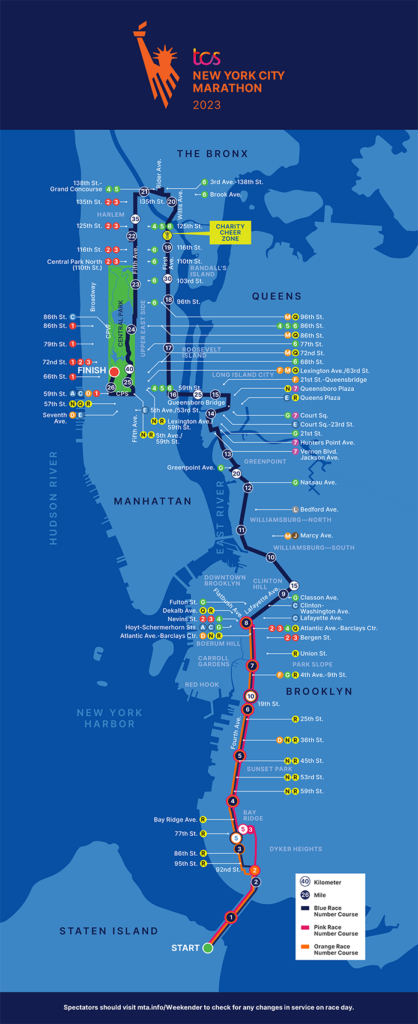
The Five Bridges
| Bridge | Around mile | Connects | What it means |
|---|---|---|---|
| Verrazzano-Narrows | 1 to 2 | Staten Island to Brooklyn | The biggest climb of the day, run on adrenaline |
| Pulaski | 13.1 | Brooklyn to Queens | Short climb arriving exactly at halfway |
| Queensboro | 15 to 16 | Queens to Manhattan | Long, exposed, and silent. No spectators |
| Willis Avenue | 20 | Manhattan to the Bronx | A steep ramp landing in the classic wall zone |
| Madison Avenue | 21 | Bronx to Manhattan | Back to Manhattan for the closing miles |
How the Race Unfolds
- Fort Wadsworth. The Athletes’ Village, where you will spend a long wait before your wave. Bring a throwaway layer and something to sit on.
- Miles 1 to 2, the Verrazzano. A cannon starts you and the bridge climbs immediately. The Manhattan skyline is off to your left on the upper deck.
- Miles 2 to 13, Brooklyn. The longest stretch in one borough and, by common agreement, the best crowds on the course. Bay Ridge, Sunset Park, Park Slope, Fort Greene, Williamsburg, Greenpoint, with bands every few blocks.
- Miles 13 to 15, Queens. Crowds thin slightly. Use it to set up for what comes next.
- Miles 15 to 16, the Queensboro. No spectators are allowed on the bridge. It is the quietest and mentally hardest stretch of the race.
- Mile 16, First Avenue. You come off the bridge into a wall of noise that runs for miles. It is the loudest moment in marathoning.
- Miles 16 to 20, Upper East Side and Harlem. Flat and fast, straight up First Avenue.
- Miles 20 to 21, the Bronx. Over the Willis Avenue Bridge, a short loop, then back across the Madison Avenue Bridge.
- Miles 21 to 23, Fifth Avenue. A long, gradual rise that most runners never see on an elevation chart and always feel in their legs.
- Miles 23 to 26.2, Central Park. In at the east side, down through the park, briefly out onto Central Park South, then back in to finish at Tavern on the Green.
On-Course Fueling
In recent years NYRR has served water and Gatorade Endurance at aid stations spaced roughly every mile through the middle of the course, with Maurten gel available at a small number of designated points. I could not confirm the 2026 aid station layout, contents, or gel locations, so check the official race day page once NYRR publishes it, and plan to carry your own fuel regardless.
That last point is not a hedge. With this many runners, tables get crowded and cups get dropped. Carrying what you trained on removes the variable entirely.
Race-Day Logistics
New York is the most logistically demanding major, because the start is on Staten Island and you cannot drive there. Private vehicles are prohibited near Fort Wadsworth on race morning. Your options are:
- The NYRR bus, boarding in midtown Manhattan near the New York Public Library. The most reliable choice, and the one I recommend for first-timers.
- The Staten Island Ferry plus a shuttle from the St. George terminal to Fort Wadsworth. Cheaper and more scenic, but capacity-limited with long early lines. You reserve a ferry slot through NYRR.
- Staying on Staten Island, which removes the commute but leaves you far from the finish with a return trip after 26.2 miles.
Whichever you choose, you book it in advance during registration. Do not leave it to race week.
NYRR ran four official transport options in 2025, and your assignment and departure time are printed on your bib:
| Option | Departure point (2025) |
|---|---|
| Staten Island Ferry | Whitehall Terminal, Manhattan |
| Midtown Manhattan bus | New York Public Library, Fifth Avenue at 40th Street |
| Midtown ferry | Pier 79, 12th Avenue and West 39th Street |
| New Jersey buses | MetLife Stadium Parking Lot K |
Waves, Colors, and Corrals
You are assigned a wave, a color (blue, orange, or pink), and a corral. The color determines your route onto the bridge, including whether you run the upper or lower deck, and the wave determines your start time. You can move back to a later wave or corral but never forward.
NYRR publishes the exact schedule each year in its official Runner Guide. The 2026 guide is normally released in October. The table below is the official 2025 schedule, taken from NYRR’s 2025 Runner Guide, and the shape of the day rarely changes much year to year. Confirm your own wave against your bib and the 2026 guide when it lands.
| Start time (2025) | Group |
|---|---|
| 8:00 a.m. | Men’s professional wheelchair division |
| 8:02 a.m. | Women’s professional wheelchair division |
| 8:22 a.m. | Pushrim and handcycle AWD categories |
| 8:25 a.m. | Mastercard start |
| 8:35 a.m. | Professional women |
| 9:05 a.m. | Professional men |
| 9:10 a.m. | Wave 1 |
| 9:45 a.m. | Wave 2 |
| 10:20 a.m. | Wave 3 |
| 10:55 a.m. | Wave 4 |
| 11:30 a.m. | Wave 5 |
The corral cutoffs matter more than the start time, because they are what you can actually miss:
| 2025 | Wave 1 | Wave 2 | Wave 3 | Wave 4 | Wave 5 |
|---|---|---|---|---|---|
| Corrals open | 8:10 a.m. | 9:05 a.m. | 9:45 a.m. | 10:25 a.m. | 11:00 a.m. |
| Corrals close | 8:45 a.m. | 9:25 a.m. | 10:00 a.m. | 10:40 a.m. | 11:15 a.m. |
| Wave starts | 9:10 a.m. | 9:45 a.m. | 10:20 a.m. | 10:55 a.m. | 11:30 a.m. |
Gear and the Finish
Gear check is available at the Athletes’ Village and your bag meets you in Central Park, though many runners skip it and use the poncho option instead. Either way, expect a long walk after you cross the line before you exit the park.
Plan your family meetup outside the park. Finish-area access is restricted, and trying to arrange a reunion inside Central Park is how people end up separated and cold for an hour.
What You Can and Cannot Bring
NYRR publishes a permitted and prohibited list, and the hydration rule is the one that catches experienced runners out. From the 2025 Runner Guide:
| Permitted | Prohibited |
|---|---|
| Waist belts with bottles, handhelds, clear disposable bottles of one liter or less | Hydration packs or vests with a rear bladder or reservoir, unless it is empty and stays unused |
| Hydration vests with front bottles only, one liter or less each | Any fluid container larger than one liter |
| The official NYRR clear start village bag | Backpacks, suitcases, rolling bags, opaque or non-transparent bags |
| Jackets, mylar blankets, small clear tarps or seating pads under 10 sq ft | Strollers, umbrellas, poles and sticks, selfie sticks, drones, weapons |
The Finish, and the Walk After It
Crossing the line is not the end of the walking. In 2025 every runner exited Central Park at West 77th Street, and NYRR’s own guidance was that you reach that exit roughly 20 to 30 minutes after finishing. If you are meeting people, that is the number to give them, not your finish time.
Runners using the poncho option and those claiming a pre-checked bag follow different routes out. The family reunion area sits on Central Park West, with exits around West 63rd to West 66th Street and at West 69th Street. The 2025 recovery bag contained Gatorade, a New York State McIntosh apple, Snyder’s of Hanover pretzels and a Maurten Solid.
Safety on Course
Two things worth putting in your phone before race morning. NYRR runs a color-coded Event Alert System that communicates race status and any weather or course warnings, and the race-day medical number is 866.705.6626. NYRR’s own guidance is that on race day this number is faster than dialing 911, because it routes straight to the event medical team.
Weather
The first Sunday in November is usually good marathon weather in New York, cool and often overcast, but the range is wide and the bridges are exposed to wind.
| Average race-day high | Around 56°F (13°C) |
|---|---|
| Average race-day low | Around 43°F (6°C) |
| Typical start temperature | Low to mid 40s°F |
| Wind | Often significant on the Verrazzano and Queensboro crossings |
What to wear based on the start temperature:
- 30s: tights or capris, long-sleeve base layer under a singlet, gloves, hat, arm sleeves, plus a heavy throwaway for the wait.
- 40s: shorts or light capris, singlet with a throwaway long-sleeve, gloves.
- 50s: shorts and a singlet, with throwaway gloves for the cold bridge start.
- 60s and up: your lightest kit, and drink more than feels necessary through First Avenue.
The wait at Fort Wadsworth is the detail that separates NYC from other majors. You may be there for hours in the cold before you run a step. Layer up with clothing you are willing to leave behind, since NYRR collects discarded clothing for donation.
Course Strategy
New York is not won on the Verrazzano. It is lost there, and again on First Avenue. This section is coaching judgment rather than official guidance.
The Verrazzano: Give Away Time on Purpose
You climb roughly 150 feet in the first mile on adrenaline, with a cannon and Sinatra behind you. Run the first mile 20 to 30 seconds per mile slower than goal pace. You cannot bank time in a crowd of 50,000 people on a closed bridge, but you can absolutely wreck your quads trying.
Brooklyn: The Trap Is Feeling Great
Eleven miles of flat, fast, deafening support. This is where most first-timers quietly run 10 to 15 seconds per mile faster than goal without noticing. Settle into pace by mile 3 and let the crowd carry you rather than pull you.
The Queensboro: Embrace the Quiet
No spectators, no music, just footfall echoing off the span. Your pace will slow and that is fine. Shorten your stride, run the climb by effort, and treat the silence as the only calm you will get all day.
First Avenue: The Most Expensive Mile
Coming off the bridge into that noise, nearly everyone speeds up. It feels free. It is not. The runners who blow up in Harlem are almost always the ones who surged here. Hold your pace and let the crowd be a gift rather than an instruction.
Fifth Avenue: The Climb Nobody Photographs
From roughly mile 21 to 23, Fifth Avenue rises steadily. It arrives exactly when your legs are worst and it does not look like anything. Run it on effort, keep your cadence quick, and know that the park comes soon after.
Strategy Summary
- Run mile 1 slower than goal pace. No exceptions.
- Brooklyn feels easy because it is early, not because you are fast.
- Pace the Queensboro by effort and accept the slower split.
- Do not surge on First Avenue.
- Plan for the Fifth Avenue rise before you get there.
What Runners Say About New York
Race reports, coaching write-ups and post-race coverage of New York converge on the same handful of observations year after year. None of this is official, and your race is your own, but if you have not run it before this is the collective wisdom worth arriving with.
The crowd is the course
New York draws around two million spectators, and almost every account of the race leads with the noise rather than the hills. Runners describe Brooklyn as eleven miles of continuous sound and First Avenue as the loudest stretch of road in the sport. The recurring warning attached to that: the crowd will happily run your race for you if you let it.
The Queensboro is the moment people remember
The bridge has no spectators. After sixteen miles of noise you get roughly a mile of nothing but footfall and breathing, uphill. Runners consistently describe it as the strangest and most memorable part of the day, and coaches consistently advise treating the silence as a rest rather than a crisis.
First Avenue is the most expensive mile in the race
This is the single most repeated piece of NYC-specific advice there is. You come off the Queensboro into a wall of sound, it feels effortless, and you speed up without deciding to. Coaches and race reports agree that most New York blow-ups in Harlem and on Fifth Avenue trace back to those two or three miles.
It is not a personal best course, and regulars stop expecting it to be
Five bridges, a late start, a rolling second half and a field of nearly 60,000 make New York slower than a flat autumn marathon for most people. The consensus among people who run it repeatedly is to come for the race and the city and to chase the time somewhere else.
Tips for Race Weekend
Nothing new on race day, including on-course fuel you have not trained with. Carry your own.
Pack for the Athletes’ Village, not just the race. A throwaway warm layer, a plastic bag to sit on, and your own snacks. You will be there far longer than you expect.
Use the bathroom at the Village, then again before your corral. Corral lines are worse than village lines.
Book your start transport and your expo slot the moment they open. Both constrain everything else about your weekend.
Write your name on your shirt in big block letters. A million spectators will use it. In the last 10K that is worth real time.
Stay off your feet the day before. The High Line and the Brooklyn Bridge are wonderful on Monday and costly on Saturday.
Agree on a meeting point outside the park and a backup plan if phones fail. Finish-area access is restricted and cell service gets overwhelmed.
Give your family the tracking link, and tell them your realistic pace rather than your dream pace so they are standing there when you pass.
Spectator Guide
New York is a wonderful race to watch and a difficult one to watch efficiently. The subway is the only sensible way to move between points.
| Spot | Around mile | Why |
|---|---|---|
| Fort Greene and Park Slope, Brooklyn | 8 to 10 | The best crowd energy on the course, easy subway access |
| Long Island City, Queens | 14 | Thinner crowds mean you can actually spot your runner |
| First Avenue, upper 60s to 80s | 17 to 18 | Enormous crowds and a long straight sightline |
| Central Park South | 25.5 | Close to the finish without needing finish-area access |
Runner tracking is available through NYRR’s app and website with splits at each 5K. Bring a sign, wear something bright, and pick a side of the street in advance so your runner knows where to look.
Where to Stay
New York hotels fill early for marathon weekend and prices peak. Start looking months out. The most practical choice is near the finish, on the Upper West Side or near Central Park, so you are not crossing the city on ruined legs.
NYRR works with an official travel partner for housing and packages, and international runners often book through approved tour operators. Verify any company claiming to sell official NYC Marathon packages through NYRR before paying.
Near the Finish
- Empire Hotel, 44 W 63rd St, a block from Central Park with a rooftop bar
- Hotel Beacon, 2130 Broadway, kitchenettes in the rooms if you want control over race-week meals
- Fairfield Inn & Suites Manhattan/Central Park, 538 W 58th St, free breakfast and a short walk to the park
- Park Lane Hotel, 36 Central Park South, directly on the park
Other Options
Rentals on the Upper West Side put you near the finish, midtown gives you the best subway access, and Brooklyn along the early miles is cheaper with a different feel. Budget travelers use HI NYC Hostel on the Upper West Side or The Local NYC in Long Island City.
Staten Island removes the race-morning commute entirely, which is a genuine advantage, but leaves you a long way from the finish afterward.
Where to Eat
Reservations are essential on marathon weekend. For pre-race dinner, stay close to your hotel and eat early.
Pre-Race
- Carmine’s, family-style Italian with an Upper West Side location near the finish
- Becco, Hell’s Kitchen, known for its unlimited pasta service
- Trattoria Dell’Arte, across from Carnegie Hall, calmer than most midtown rooms
After
- Tavern on the Green, at the finish line itself, if you can get a table
- Katz’s Delicatessen, Lower East Side, for a pastrami sandwich the size of your recovery deficit
- Balthazar, SoHo, for brunch the morning after
- Any good New York slice. Joe’s Pizza and Prince Street Pizza both earn the queue
A Recovery Day in New York
Keep Monday gentle. Central Park in early November is at peak foliage and is the obvious slow walk. The High Line is flat and short. The Met and the American Museum of Natural History are both close to the Upper West Side and let you sit down often. The Russian & Turkish Baths in the East Village is an old-school option for wrecked legs.
Save the Brooklyn Bridge walk and anything involving stairs for Tuesday.
What Comes After New York?
If you are chasing the six-star medal, New York is often the one that makes people serious about the rest. If you are staying closer to home, the OhioHealth Capital City Half Marathon in Columbus on Saturday, April 24, 2027 is a good spring target that keeps your November fitness working for you.
Start with post-race recovery, then build your next training block.
NYC Marathon FAQs
When is the 2026 NYC Marathon?
Sunday, November 1, 2026. New York runs on the first Sunday in November, which puts the 2027 race on November 7, 2027.
How hard is it to get in through the lottery?
For 2026, NYRR received more than 240,000 applications and accepted roughly 1 percent, the lowest acceptance rate in the race’s history and about a 20 percent increase in applications over the previous record.
What is the 9+1 program?
Run nine qualifying NYRR races and complete one NYRR volunteer shift during a calendar year, while holding NYRR membership, and you earn guaranteed entry to the following year’s marathon. You still pay the entry fee. To run in 2027, the nine races and volunteer shift must be completed during 2026.
Where does a qualifying time have to be run?
A qualifying marathon can be run at other races, but a qualifying half marathon must be run at an NYRR race. Net time is evaluated rather than gun time. Confirm current rules with NYRR before planning a season around a qualifier.
How much does entry cost?
For 2026, $269.66 for NYRR members and $333.11 for non-members and international runners. Charity runners pay the entry fee plus their fundraising minimum, which commonly starts around $3,500 and goes higher.
Can I still get into the 2026 race?
Only through a charity partner with bibs remaining or an approved international tour operator, and availability this close to race day is limited. Contact charities directly.
What are the start times and the time limit?
NYRR publishes wave start times and the course time limit for each year, and I was not able to verify the 2026 figures. Check the official race day page and your bib confirmation.
How do I get to the start?
By NYRR bus from midtown Manhattan, or by Staten Island Ferry plus shuttle. Private vehicles cannot reach Fort Wadsworth on race morning. You book your option during registration.
Is the course flat?
No. Total gain is commonly cited around 800 feet, concentrated in five bridges. The Verrazzano at the start, the Queensboro at miles 15 to 16, and the Fifth Avenue rise from 21 to 23 are the defining features.
What is the hardest part?
Mentally, the Queensboro Bridge, because it is long, exposed, and completely silent. Physically, the Fifth Avenue climb, because it arrives at mile 21.
Can spectators meet me at the finish?
No. Finish-area access in Central Park is restricted. Arrange to meet outside the park after you exit.
How big is the race?
The 2025 edition finished 59,226 runners, the largest marathon in recorded history.
Sources
A note on verification. NYRR’s main website and its press releases sit behind a virtual waiting room that blocks automated access, so those pages could not be read directly when this guide was updated in August 2026. NYRR does publish its official Runner Guide as a PDF on a separate host that is reachable, and the 2025 edition is the source for the start timeline, corral cutoffs, transport options, permitted and prohibited items, and the finish-area details in this guide. Those figures are labeled as 2025 throughout, because the 2026 Runner Guide had not been published at the time of writing. Everything else comes from NYRR press coverage in major outlets and other reliable published sources. Anywhere a 2026 operational detail could not be confirmed, this guide says so and points you to NYRR rather than guessing.
Primary and press sources used for this update:
- NYRR, 2025 TCS New York City Marathon Runner Guide (official PDF), for the start and corral timelines, transport options, kit rules, safety information and finish-area logistics
- NYRR press release, professional athlete field announcement, August 19, 2026, as reported by ABC7 New York and other outlets
- NYRR press release, record 240,000-plus applications for the 2026 drawing, March 4, 2026, as reported by PIX11 and Canadian Running
- Running USA and ABC7 New York, for the 59,226 finisher count and the largest-marathon-ever record
- NYRR 50th anniversary and “The Trailblazers” announcements, as reported by endurance.biz and Hoodline
- nyrr.org/tcsnycmarathon, the official race site and the authority on everything here
- The Course and Race Day, for start times, waves, and aid stations
- 9+1 guaranteed entry
- Marathon time qualifiers, for the full age-band standards
- Official charity partner program
- NYRR media center, for lottery figures and professional field announcements
- Wikipedia, New York City Marathon and 2025 New York City Marathon, for history, course records, and results
This guide is unofficial and some details will age. Verify with NYRR before making travel, training, or registration decisions.
Steve Carmichael is an RRCA and USATF Certified Running Coach.
Related Articles



Related Podcast Episodes
Dive deeper into this topic with these episodes from the RunBuzz Running Podcast.
Episode 139
How To Adjust Your Training and Mindset When Races Are Cancelled or Delayed
Episode 135
7 Tips To Help You Run or Race At Higher Altitude and Elevations
Episode 134
Runner Case Study - Coaching Call With Carrie Poss - Part III - Race Week And Recap
Episode 133