
Meal Planning for Runners: Save Time, Eat Better, and Fuel Your Training
 Steve Carmichael·Last updated
You got up early, smashed your morning run, and now you are rushing off to work. Thoughts are already swirling about what you will have for lunch. Will you grab something from the fridge? Hit the vending machine? Step out for fast food again? And what on earth are you making for dinner tonight?
If that sounds familiar, you are not alone. Training raises the bar on your nutrition and lowers the amount of time and energy you have to meet it. That combination is exactly what meal planning solves.
You do not sit around deciding whether you will go for a run. You just go. Food deserves the same treatment: decide once, execute all week.
Does meal planning actually work?
It is worth knowing this is more than a productivity trend, because the effort is real and you should know it buys something.
Researchers looked at 40,554 adults in the NutriNet-Sante study and compared people who planned their meals ahead against those who did not. Meal planners scored higher on adherence to nutritional guidelines and ate a wider variety of foods. Women who planned had lower odds of being overweight or obese, and men who planned had lower odds of obesity.1
A separate analysis found that people who cook at home more often have better diet quality, and notably, they do so without spending more money on food.2
Neither study proves cause and effect, and both are the kind of research where motivated people plan more. But the direction is consistent, the samples are enormous, and it lines up with what I see in the runners I coach. The ones who eat well are almost never the ones with the most willpower. They are the ones who decided on Sunday.
What meal planning actually does for a runner
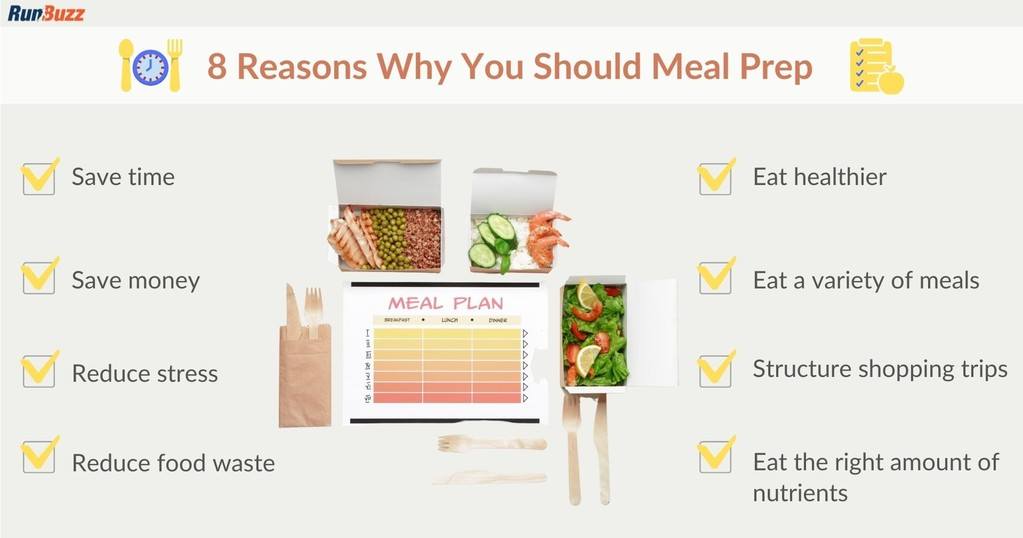
| What it gives you | What that looks like in practice |
|---|---|
| Hours back every week | One cook-and-clean session instead of seven. The dishes alone are worth it |
| Nutrition you actually hit | Carbohydrate before your run and protein after are only useful if they exist in your fridge at the moment you need them |
| Fewer bad decisions | Hungry with no plan is how drive-throughs happen. Hungry with a labeled container is how recovery happens |
| Less money spent | No impulse buys, no wilted produce, no 8pm delivery order |
| One grocery trip | A planned list gets you in and out once a week instead of three midweek top-ups |
| Less mental load | Decision fatigue is real, and "what's for dinner" is a decision you can delete permanently |
| A household that eats the same way | Prep with your family and the healthy option becomes the default for everyone, not a separate meal you make for yourself |
The one I would underline is the second. You can sleep well, train hard and own perfect gear, and still fall short if the food is not there. Good nutrition is not really a knowledge problem for most runners. It is a logistics problem.
What you are actually planning for
This is the part most meal planning advice skips, and it is the part that makes it different for a runner. You are not planning seven identical days. You are planning around a training week that has hard days and easy days in it.
The sports nutrition position stand used by dietitians sets daily targets by training load: roughly 5 to 7 grams of carbohydrate per kilogram of body weight per day for about an hour of moderate exercise daily, rising to 6 to 10 g/kg for one to three hours of moderate to high intensity work. Protein sits at 1.2 to 2.0 g/kg per day across the board.3
For a 150 pound (68 kg) runner, that is roughly 340 to 475 grams of carbohydrate and 82 to 136 grams of protein on a heavier training day. You do not need to weigh anything to use those numbers. You need them to answer one question when you build the plan: is there enough starch in this week? For most runners I work with, the honest answer before we start is no.
| Day type | What the fridge needs |
|---|---|
| Long run day | Easy carbohydrate for before, a real recovery meal ready for after, extra fluids and salt |
| Workout or intervals day | A carbohydrate snack timed to the session, plus a normal dinner |
| Easy run day | Standard meals. Nothing special needed |
| Rest day | Slightly less starch, same protein. Do not stop eating protein on rest days, that is when repair happens |
Two other things worth building in. Spread your protein across the day rather than loading it at dinner: an evenly distributed intake produced higher 24 hour muscle protein synthesis than the skewed pattern most people default to.4 And plan enough food overall. Chronic under-fueling relative to training is the mechanism behind Relative Energy Deficiency in Sport, which affects bone health, hormones, immunity and performance.5 Meal prep that quietly becomes a dieting tool is a problem, not a win.
For the detail on timing around individual runs, see what to eat before a run and how long to wait to run after eating.
Six ways to meal plan
There is no single correct method. Pick the one that matches your schedule and your tolerance for kitchen time.
| Method | Best for | Time on prep day |
|---|---|---|
| Cook dinner twice as big (my method, below) | Anyone who has tried and abandoned a big prep day | None, it happens at dinner |
| Cook once, eat for a week | Predictable schedules, cooking for one or two | 3 to 4 hours |
| Sheet pan meals | Minimum effort, minimum washing up | 1 hour, mostly hands off |
| Homemade frozen dinners | Shift work, irregular hours, cooking in bulk occasionally | 3 hours, once a month |
| Mason jar lunches | Office lunches, salads that need to survive until Thursday | 45 minutes |
| Slow cooker plans | Feeding a family, days you are out of the house | 15 minutes of setup |
| Grab-and-go fridge | Households with different schedules and appetites | 1 to 2 hours |
Cook once, eat for a week
The most popular approach. Shop, spend a few hours in the kitchen on your prep day, and finish every meal for the week in one go. By mid-afternoon the cooking and cleaning are done and you do not turn the stove on again until next weekend.
Sheet pan meals
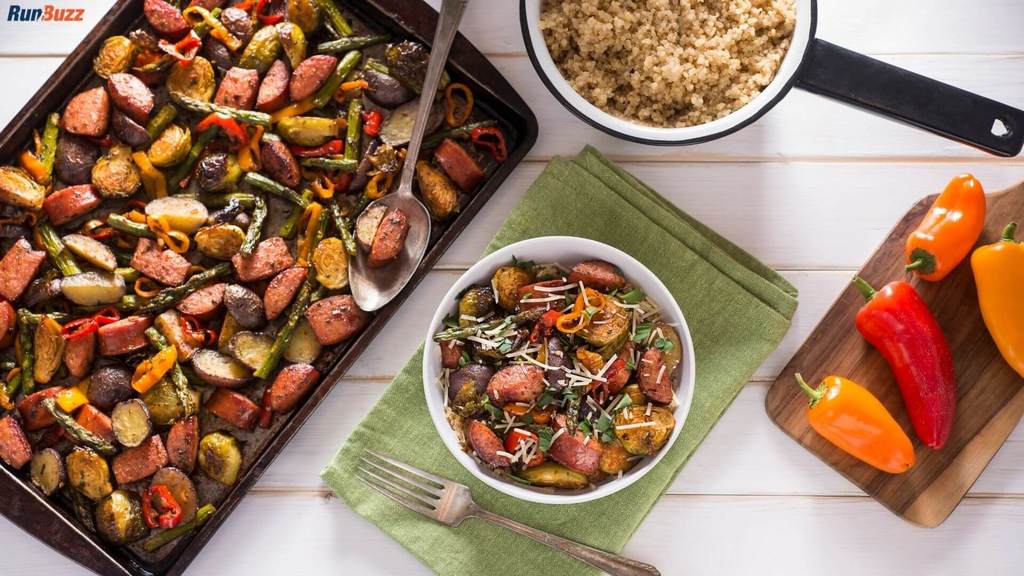
A lot of food, a short time, almost no mess. Protein and vegetables on the same pan, drizzle with oil, season, bake. Divide into containers and you are done.
Pro tip: group ingredients with similar cook times on the same pan, and add a starch such as potatoes or rice separately so you can scale the carbohydrate up on hard training days.
Homemade frozen dinners
Nothing beats pulling dinner out of the freezer and eating five minutes later. Store-bought frozen meals tend to be high in sodium and short on nutrients, so make your own. All you need are simple recipes, fresh ingredients, and containers that go from freezer to microwave without cracking.
Mason jar lunches
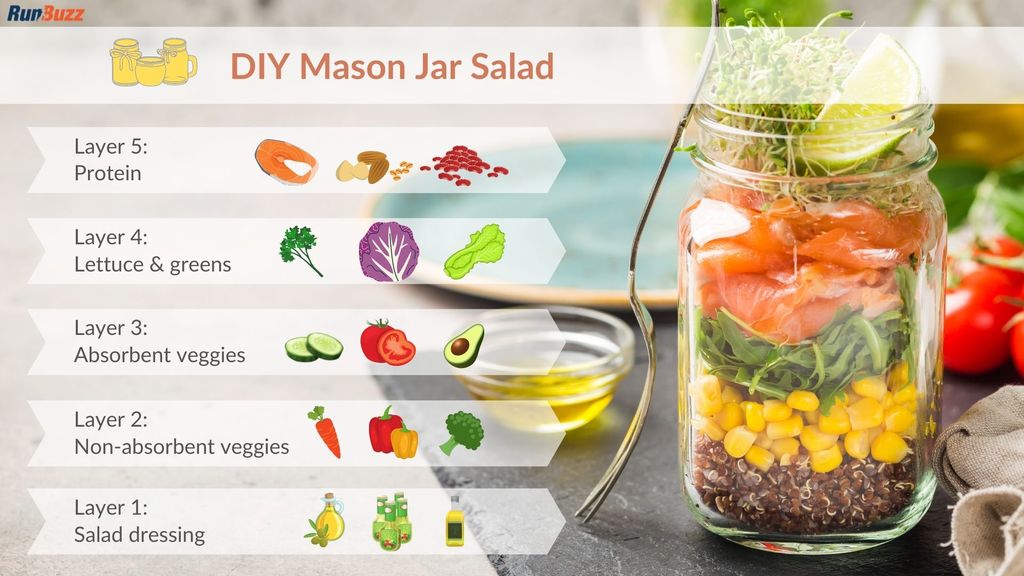
Easy to prep, easy to store, and they hold up. Layer dressing at the bottom, then hard vegetables, then grains and protein, then leaves at the top, and nothing goes soggy before Thursday. Layered salads, overnight oats and homemade instant noodles all work.
Slow cooker plans
No time to stand in a kitchen? Load the slow cooker, switch it on, and six to eight hours later you have several meals. Chilli, stews, shredded chicken and big batches of beans all freeze well, which makes this method pair naturally with the frozen dinner approach.
Organized grab-and-go fridge
Use dividers or baskets so the whole family can grab what they need. A protein section with cold meats, hard-boiled eggs, cheese or tofu. A fruit section with sliced apples and oranges. A vegetable section, pre-cut and bagged. Nuts and trail mix in the pantry. This is the lowest-effort method and the best one for households where everyone eats at a different time.
Pre-made meals vs batch prepping
Whichever method you pick, you are choosing between two philosophies. This is the decision that determines whether meal prep survives contact with a real week.
| Pre-made meals | Batch prepping | |
|---|---|---|
| What you make | Complete meals, portioned into individual containers | Components in bulk: a protein, a starch, roasted vegetables |
| At mealtime | Grab one and heat it | Build a plate from the components |
| Strengths | Fastest possible meal, portions fixed, freezes well | Flexible portions, feeds a family, adapts to a changed training day |
| Weaknesses | No flexibility on a day you need more food, harder for families, monotony sets in | Slightly more work at each meal, less grab-and-go |
| Best for | Fixed schedule, cooking for yourself | Runners whose training and appetite vary day to day |

For most runners I would start with batch prepping, for one reason: your appetite on a 16 mile Saturday does not match your appetite on a rest day, and a fixed container cannot flex. Cook a big pot of rice, a tray of chicken, a tray of roasted vegetables and a batch of hard-boiled eggs, and you can build a small lunch or an enormous one from the same shelf.
The hybrid method that finally worked for me
Everything above assumes a prep session. Mine kept collapsing, and I tried the big-Sunday version half a dozen times over 10 years before I admitted it was never going to be the thing I stuck with.
What finally worked was almost embarrassingly simple. We stopped planning lunches. We plan dinners, and we cook enough of each one that it becomes the next day's lunch. That is the whole system.
It sounds like a small change and it is not. Consider what it removes:
- Half the planning disappears. Seven dinners and seven lunches becomes four or five dinners. You are choosing fewer meals, buying fewer ingredients, and making fewer decisions.
- The dedicated prep session disappears. There is no Sunday afternoon to protect, because the cooking is already happening at dinner time. This is the part that killed every previous attempt for me.
- The monotony problem mostly disappears. You are eating food you actively chose for dinner, once. Nobody is on day four of a meal they merely tolerate.
- Portioning gets easier. Cook for double the number of people at the table and you are done. No scale, no containers lined up on the counter.
How to actually run it
- Pack the lunch before you sit down to eat. This is the one rule that matters. If the extra portion is still in the pan when you serve dinner, it will get eaten. Plate the leftovers into a container first, then serve.
- Plan four or five dinners, not seven. Two nights of genuine leftovers and one night that goes sideways are normal, and the plan should expect them.
- Size the batch for tomorrow, not tonight. If tomorrow is a long run day, cook extra starch tonight so lunch carries more carbohydrate.
- Favor food that reheats. Chili, curries, stews, pasta bakes, rice bowls, roasted vegetables and shredded proteins all improve overnight. Crisp things, delicate fish and dressed salads do not.
It does not solve everything. Breakfast still needs its own answer, and there are meals that are simply worse the next day. But it turned meal prep from a project I kept abandoning into how my family eats, and it is the first thing I suggest now when a runner tells me prep has never worked for them.
Building your plan and shopping list
Before you prep anything, you need a plan. Keep it boring and repeatable. A plan you can reuse for a month beats a beautiful one you build once and never again.
Fill in a grid like this, then turn it into a list:
| Day | Training | Breakfast | Lunch | Dinner | Around the run |
|---|---|---|---|---|---|
| Mon | Easy 5 | Oats and fruit | Rice bowl | Sheet pan chicken | Nothing needed |
| Tue | Intervals | Oats and fruit | Rice bowl | Pasta | Toast before, chocolate milk after |
| Wed | Easy 5 | Eggs and toast | Wrap | Leftovers | Nothing needed |
| Sat | Long run | Bagel and jam | Big rice bowl | Family dinner | Bagel before, gels during, recovery meal ready |
Then write the shopping list in the order of your store's layout: produce, dairy, meat, frozen, grains, drinks, other. It sounds fussy. It cuts a 50 minute shop to about 20 and stops you forgetting the one ingredient that makes Thursday work.
Three rules that keep a plan alive:
- Repeat meals on purpose. Three lunches on rotation is not boring, it is efficient. Save novelty for dinner.
- Plan one fewer dinner than there are nights. Something always comes up. Leaving a gap means the plan absorbs it instead of collapsing.
- Write the plan where you will see it. Fridge door, shared note, whiteboard. A plan in a drawer is a wish.
The kitchen gear that makes this easier
You do not need much, and you almost certainly do not need what the meal prep videos are selling. Three things do most of the work, and each one maps to a method above.
Some links below are affiliate links. If you buy through them RunBuzz earns a small commission at no extra cost to you, which helps keep the guides free. See our affiliate disclosure.
Glass containers with compartments are the one upgrade I would insist on. Glass does not stain, does not hold onto smells, and goes from freezer to oven to microwave, which plastic largely cannot. The compartments matter more than they sound: they stop a portioned meal turning into one homogeneous pile by Wednesday.
A half sheet pan is the cheapest item here and does the most. Rimmed aluminum, roughly 13 by 18 inches, fits a full protein and vegetable prep in one go. Buy two so you can run a starch on one and everything else on the other.
Wide mouth jars are what make layered lunches work. Wide mouth rather than regular, because you have to get a fork in there and you have to get the salad out.
Things you can skip until you are certain you will keep this up: a vacuum sealer, a dedicated meal prep app, a second freezer, and anything described as a system.
Cookbooks worth owning
A good cookbook solves the hardest part of meal planning, which is not cooking. It is deciding what to cook. These five are the ones I recommend most often, and all of them are built around real meals rather than performance gimmicks.

Best for busy weeknights
Run Fast. Cook Fast. Eat Slow.
Shalane Flanagan and Elyse Kopecky
The one I recommend first, and the one most likely to actually get used. Every recipe is built to be quick, which is the constraint that kills most meal planning attempts. Flanagan is an Olympic silver medalist and 2017 New York City Marathon champion, and Kopecky is a chef and nutrition coach, so the food is genuinely good rather than merely functional.
The philosophy running through it is worth absorbing on its own: real fat, real ingredients, and enough food. Runners who are chronically under-eating tend to find this book unlocks something.

Best for meal plans you can follow
The Runner's Kitchen
Emma Coburn
Written by Olympian and world championship medalist Emma Coburn, and the most directly useful of the five if what you want is a plan rather than a pile of recipes. It pairs 100 recipes with actual meal plans across breakfast, lunch, dinner and snacks, which saves you the assembly work.
Pairs well with my guide to fueling on the run if you are building toward a longer race.

Best all-rounder
The Runner's World Cookbook
Runner's World, 150 recipes
The broadest of the group at 150 recipes, and the one to pick if you cook for a household with different tastes. Recipes are tagged by what they are for, so finding an easily digestible pre-run option or a substantial post-training meal takes seconds rather than flipping through the whole book.
It is the least distinctive book here and the most consistently useful, which is a fair trade for a working cookbook.

Best on the nutrition science
The Runner's Cookbook
Anita Bean
Anita Bean is a registered nutritionist as well as an athlete, and it shows. More than 100 recipes, but the reason to own this one is the explanation around them: it is the book that tells you why a meal is built the way it is, not just how to make it.
Get this if you want to eventually stop following recipes and start building your own meals around your training.

Best for plant-based runners
The Runner's World Vegetarian Cookbook
Runner's World, 150 meatless recipes
The meatless companion to the Runner's World cookbook, with 150 recipes. Worth owning even if you are not vegetarian, because hitting protein targets without meat takes more deliberate planning and this does that thinking for you.
Beans, lentils and other legumes feature heavily, so keep the higher fiber meals away from the hours before a run and use them on rest days and evenings instead.
For a wider reading list covering training, mindset and strength as well as nutrition, see the best books about running.
Start small: your first four weeks
This is where nearly everyone goes wrong, myself very much included. The failure mode is not laziness. It is starting too big.
- Week 1: two dinners, doubled. Pick two nights you already cook, make twice as much, and pack tomorrow's lunch before you sit down. No prep session, no new recipes. That is the whole assignment.
- Week 2: four dinners, doubled. Same move, more nights. By now you will know which of your meals reheat well and which do not.
- Week 3: add breakfast. The one meal the method does not cover. Overnight oats, egg muffins or a batch of pancakes in the freezer, about 20 minutes.
- Week 4: add your training food. Pre-run snacks portioned out, and one recovery meal ready for after your long run. This is the week it starts affecting your running.
If a week goes badly, repeat it rather than pushing on. The goal for the first month is not efficiency, it is proving to yourself that the habit survives a normal week.
Common meal prep mistakes
| Mistake | Fix |
|---|---|
| Prepping all 21 meals in week one | Start with two doubled dinners. Add one meal type per week |
| Building the whole system around a prep day you will not protect | Cook dinner bigger instead. No prep day means nothing to abandon |
| Leaving the extra portion in the pan | Pack tomorrow's lunch before you serve dinner, every time |
| Cooking food you do not actually like | Prep what you already eat. Discipline does not survive four days of a meal you tolerate |
| Same meal seven days running | Two or three on rotation, and vary the sauce. Monotony is the number one reason people quit |
| Under-portioning on hard training days | Batch prep so portions flex, and size the long run day deliberately5 |
| Forgetting the training food entirely | Pre-run snacks and recovery meals go on the plan, not in the "I'll figure it out" pile |
| Treating meal prep as a diet | If your prep is quietly cutting calories while your mileage climbs, that is under-fueling with extra steps5 |
| Keeping cooked food too long | Three to four days in the fridge. Anything beyond that goes in the freezer on prep day, not later |
My personal meal prep journey
I will be honest. Getting started with meal prepping was easy for me. I bought a stack of plastic containers and a load of food, and spent most of a Sunday prepping a week's worth of meals.
That lasted two weekends, tops.
I repeated that approach probably half a dozen times over 10 years with the same result, and walked away frustrated each time.
Then, in early 2023, I landed on a hybrid approach that actually stuck: we planned dinners with enough quantity to cover the next day's lunch, rather than planning separate meals for both. That is the whole trick, and I have written up how to run it above. A few months earlier I had earned my nutrition coaching certification with Precision Nutrition, which I pursued to help my coaching clients build better eating habits. And, if I am honest, my own.
My history with meal prep was tangled up with weight loss. I prepped when I wanted to lose weight and stopped when I did not, which produced a love-hate relationship and a lot of cycling on and off. Separating the two is what finally made it work: meal prep as the way my household eats, not as a diet I go on.
I have been meal prepping consistently for several years now and it has become our family's standard way of eating.
Frequently asked questions about meal planning for runners (FAQ)
How do I meal prep without spending a whole Sunday on it?
Cook dinner in a large enough quantity that it covers the next day's lunch, and pack the lunch container before you sit down to eat. There is no separate prep session because the cooking already happens at dinner time. This is the approach that finally worked for me after 10 years of abandoning big Sunday prep days.
How long does meal prepped food last in the fridge?
Three to four days for most cooked proteins, grains and roasted vegetables. That is why a Sunday prep usually covers Monday to Thursday, with Friday onwards coming from the freezer. If you want a full week from one session, freeze the back half on prep day rather than deciding on Wednesday.
How many hours a week does meal prepping take?
Between 90 minutes and four hours depending on the method. Sheet pan meals and mason jar lunches sit at the low end, cook-once-eat-all-week at the high end. Almost everyone reports it takes less total time than cooking daily, because the cleanup happens once.
Should runners meal prep differently than other people?
Yes, in one specific way: your plan has to account for training days. That means more carbohydrate on long run and workout days, a recovery meal ready for after your hardest sessions, and pre-run snacks portioned in advance. Everything else is standard meal prep.
What should I meal prep for a long run day?
An easy breakfast you can eat two to three hours before, something portable for during the run, and a recovery meal that is ready when you walk in the door. That last one matters most, because the window after a long run is exactly when you are least likely to cook.
Is meal prepping cheaper than eating out?
Substantially, yes. You buy in bulk, you waste less, and impulse purchases mostly disappear. Research on home cooking found people who cook at home more often have better diet quality without spending more on food.
Can I meal prep if I have a family with different tastes?
Batch prepping is built for this. Prepare components rather than complete meals and everyone assembles their own plate with the portions they want. The grab-and-go fridge method works well for households where people eat at different times.
Will meal prepping help me lose weight?
It can, and that is not always the right goal for a runner in training. Planning improves diet quality and portion awareness, and studies link meal planning to lower odds of obesity. But if your prep quietly turns into calorie restriction while your mileage is climbing, you are setting up under-fueling. Plan enough food first, and treat body composition as a separate conversation.
What containers are best for meal prep?
Glass with compartments and leak-resistant lids. Glass does not stain or retain odours and moves from freezer to oven to microwave, which most plastic cannot. Buy one set and see whether the habit sticks before buying more.
Key takeaways
- Cook dinner twice as big and pack the lunch before you eat. Planning dinners that cover the next day's lunch removes half the planning and the whole prep session. It is the reason meal prep finally stuck for me.
- Start small. Two doubled dinners in week one. Not 21 meals. This is the single biggest predictor of whether it lasts.
- Prep components, not just complete meals. Your appetite on a long run day does not match a rest day, and components flex where a sealed container cannot.
- Put your training on the plan. Pre-run snacks and recovery meals belong in the prep, not in your good intentions.
- Plan enough food. Meal prep that becomes a diet during a training block is under-fueling with better packaging.5
- Repetition is a feature. Three lunches on rotation is what a sustainable plan looks like.
Browse dozens of runner-friendly recipes in our recipe library, or read up on what to eat before a run and natural fuel options for runners.
Have a great week.
Sources
- Ducrot P, Mejean C, Aroumougame V, et al. Meal planning is associated with food variety, diet quality and body weight status in a large sample of French adults. International Journal of Behavioral Nutrition and Physical Activity, 2017. PubMed 28153017
- Wolfson JA, Bleich SN. Is cooking at home associated with better diet quality or weight-loss intention? Public Health Nutrition, 2015. PubMed 25399031
- Thomas DT, Erdman KA, Burke LM. Position of the Academy of Nutrition and Dietetics, Dietitians of Canada, and the American College of Sports Medicine: Nutrition and Athletic Performance. Journal of the Academy of Nutrition and Dietetics, 2016. PubMed 26920240
- Mamerow MM, Mettler JA, English KL, et al. Dietary protein distribution positively influences 24-h muscle protein synthesis in healthy adults. Journal of Nutrition, 2014. PubMed 24477298
- Mountjoy M, Ackerman KE, Bailey DM, et al. 2023 International Olympic Committee's (IOC) consensus statement on Relative Energy Deficiency in Sport (REDs). British Journal of Sports Medicine, 2023. PubMed 37752011
This article is general information for healthy adult runners and is not medical or individualized nutrition advice. If you have a medical condition, a history of disordered eating, or specific dietary requirements, work with your physician or a registered dietitian.
Related Articles




Related Podcast Episodes
Dive deeper into this topic with these episodes from the RunBuzz Running Podcast.
Episode 162
How To Develop Systems So You Can Have A Healthy Relationship With Food - Jaclyn Ricchio Stover
Episode 160
Easy, Quick Meal Prepping For Runners With Simone McKenna
Episode 158
How To Acclimate To Cold Temperatures So You Can Enjoy Winter Running
Episode 149