
Best Running Watches for Cross Country and Track Athletes (2026)
 Steve Carmichael·Last updated
Updated April 2026 by Steve Carmichael, RRCA/USATF Certified Running Coach.
The short answer: For most cross country and track athletes — especially high schoolers — I recommend the Garmin Forerunner 165 as the best overall value. Athletes who want advanced features should look at the Garmin Forerunner 265. If price is the biggest factor, the COROS PACE 4 is the best value under $250. For athletes who also want a full smartwatch, the Apple Watch SE is a solid alternative.
FTC disclosure: Some links below are affiliate links. If you buy through them, I may earn a small commission at no extra cost to you. I only recommend gear I have tested, used with the athletes I coach, or both.
Quick Pick Summary
If you want the short version and plan to read the details later, here is what I tell parents and athletes who ask me this question.
| Best for | Watch | Price (approx) | Why |
|---|---|---|---|
| Best overall value | Garmin Forerunner 165 | ~$250–$300 | Bright AMOLED display, multi-band GPS, HR zones, training readiness, ~11 days battery, 39 g. |
| Best upgrade | Garmin Forerunner 265 | ~$449 | Everything the 165 does, plus triathlon mode, Morning Report, music, 42 mm size option for smaller wrists. |
| Best budget alternative | COROS PACE 4 | ~$249 | 32 g, AMOLED display, dual-frequency GPS, 41-hour GPS battery, onboard music, no subscription. |
| Best smartwatch alternative | Apple Watch SE | ~$249 | Full smartwatch plus fitness tracking. Safety features parents like (Fall Detection, Crash Detection, SOS). |
Want to compare all current watches side by side? Try the RunBuzz Running Watch Finder — it compares 17 GPS running watches from Garmin, COROS, and Apple by price, features, and running style.
Why a GPS Running Watch Helps Cross Country and Track Athletes
A GPS running watch is a specialized tool that tracks pace, heart rate, distance, and intensity along with a long list of other useful metrics. For a young cross country or track athlete, the point is not to chase graphs — it is to make sure each workout lands at the right effort level. Most young runners go too fast on easy days and too slow on hard days. A watch fixes that.
A GPS running watch helps in three specific ways:
- Track improvement over time. Pace, distance, and heart rate at a given effort are all objective markers. You can see real progress through the season.
- Hit the right intensity on every workout. Easy runs should feel easy. Tempo runs should feel hard but controlled. Intervals should hurt and then recover. A GPS watch + heart rate zones give you the feedback needed to run each workout the way the coach intended.
- Monitor recovery. Modern watches (Garmin especially) show sleep, HRV, and training readiness scores that tell an athlete when to push and when to back off. Overtraining is the biggest threat to a teen distance runner — and the hardest to see without data.
We have a saying among the athletes I coach: anyone can go for a run. We want to train so we get the right outcome. A GPS watch is what makes the difference between running and training. For a deeper dive on why this matters, see why every runner needs a GPS watch.
Are GPS Watches Allowed at Cross Country and Track Meets?
This is the single most important thing to understand before race day: in most organized meets, GPS watches are not allowed during competition. Wearing one can get you disqualified. Use your watch for training. Leave it in the tent at the meet.
The specific rules vary by level:
NFHS (High School)
Per NFHS Rule 4-6-5, a wristwatch secured to the athlete may be worn in track & field and cross country competition. In practice, however, many state associations modify this rule to treat GPS-enabled watches as an unfair aid, which makes them illegal at sanctioned high school meets. Your state’s rule is the one that matters — Ohio (OHSAA), for example, prohibits GPS watches during competition. California, Texas, and Florida each have their own modifications.
Coach’s rule of thumb: Assume your meet prohibits GPS watches unless your head coach has told you otherwise in writing. Do not ask at the starting line. Do not assume Saturday’s rule is Monday’s rule.
NCAA
The NCAA rulebook does not explicitly ban GPS watches, but at NCAA Regionals and Nationals it is standard for coaches to tell athletes watches are not allowed. The reasoning usually comes from the timing company, which doesn’t want runners obscuring their bibs or stopping watches at the chute. If you compete at the college level, check with your coach before every meet.
USATF
USATF-sanctioned meets generally follow World Athletics rules. Personal watches are typically allowed, but restrictions apply at championship events. Again — confirm with the meet director.
Bottom line: A running watch is a training tool. The benefit is in the workouts between meets — the speed work, tempo runs, long runs, and easy days. That is where most of a season’s improvement is built. On meet day, the watch stays home or in the tent.
My Top Picks for 2026
Best Overall Value: Garmin Forerunner 165

Garmin Forerunner 165 / 165 Music
AMOLED running watch with premium features at an entry-level price
- AMOLED display
- Multi-band GPS
- Training Readiness & suggested workouts
- Under $300
The Garmin Forerunner 165 is my top pick for cross country and track athletes. It hits the sweet spot between features, usability, and price.
What it does well:
- Bright AMOLED display — easy to read at a glance during workouts, even in sunlight
- Multi-band GPS — the same accurate GPS technology found on watches costing twice as much
- Heart rate monitoring and zones — athletes can see exactly how hard they are working on easy, tempo, and interval days
- Training Readiness score — a simple 1–100 indicator of how recovered you are
- Daily suggested workouts — good for the off-season when the athlete is training on their own
- Lightweight — 39 g, comfortable for all-day wear and full long runs
- Battery life — up to 11 days in smartwatch mode, 19 hours with GPS on
- Music version available — the Forerunner 165 Music adds onboard storage for Spotify, Amazon Music, or Apple Music (upgrade is ~$50)
Where it falls short:
- No triathlon / multisport mode
- Single screen size (43 mm)
- Base model has no onboard music
Who should buy it: 90% of cross country and track athletes. If you are shopping for a high school runner and want to buy once, this is the one.
Best Upgrade: Garmin Forerunner 265

Garmin Forerunner 265 / 265S
Mid-range AMOLED running watch with triathlon mode and comprehensive training metrics
- AMOLED display
- Triathlon mode
- Training Readiness & Morning Report
- Two size options (46mm / 42mm)
If the athlete wants the latest and greatest — or is going to transition into triathlons or adult marathon training — the Garmin Forerunner 265 is the step up. I wear one myself and wrote a detailed review of the Forerunner 265 a while back.
What it adds over the 165:
- Triathlon and multisport mode — seamless transitions between swim, bike, and run in a single activity
- Morning Report — a daily briefing showing sleep quality, HRV, training readiness, and weather
- Music storage — sync Spotify or Amazon Music playlists directly
- Longer battery — up to 13 days smartwatch mode, 20 hours of GPS
- Two sizes — 46 mm Forerunner 265 and 42 mm Forerunner 265S for smaller wrists
- Race Predictor and running dynamics — more advanced stats for athletes who like the data
Who should buy it: athletes who want a watch that will last through high school and into college or adult running, athletes who need the smaller 42 mm size for a petite wrist, and anyone already cross-training into triathlon.
Best Budget Alternative: COROS PACE 4

COROS PACE 4
Ultralight AMOLED running watch with voice features and 41-hour GPS battery
- Only 32g with AMOLED display
- 41-hour GPS battery
- Voice Pins for training notes
- Best value running watch 2025
The COROS PACE 4 is the watch I recommend most often to parents who want a serious training tool without the Garmin price tag. It replaced the Pace 3, which had been the runaway favorite in high school distance-running forums, and it keeps what made that watch popular while adding an AMOLED screen and onboard music.
What it does well:
- Price — around $249, one of the best values in running watches, period
- Dual-frequency GPS — more accurate than the GPS on watches twice the price, especially on tree-lined cross country courses
- Featherweight — 32 g in the nylon strap, barely noticeable on a teen’s wrist
- Battery — up to 19 days smartwatch mode, 41 hours GPS — way more GPS time than any Garmin in this price range
- AMOLED display — a bright, sharp screen at a price where most rivals still use a dimmer memory-in-pixel panel
- Onboard music — the Pace 3 had none, so this closes the biggest gap against the Forerunner 165 Music
- No paid subscription — all features are free, unlike some rivals that paywall premium metrics
- Strava and Apple Health integration
Where it falls short:
- Smaller app ecosystem than Garmin Connect
- No daily suggested workouts in the Garmin style
- Less refined UI and fewer smartwatch features
Who should buy it: budget-conscious families who still want a real training watch, athletes who care about raw GPS accuracy and battery over smart features, and lighter wrists.
Best Smartwatch Alternative: Apple Watch SE
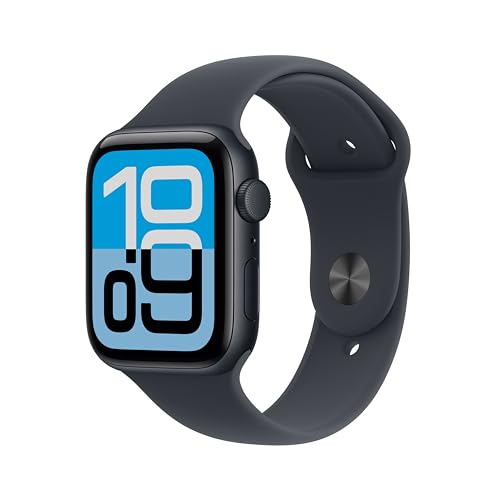
Apple Watch SE 3
The most affordable Apple Watch — great for casual runners in the Apple ecosystem
- Best smartwatch features
- Cellular option available
- Apple ecosystem integration
- Crash Detection & SOS
Currently unavailable at Amazon — check the link for other sellers or a newer model.
The Apple Watch SE is the right pick for athletes who want an everyday smartwatch first and a fitness tracker second. It handles pace, distance, heart rate, and workouts — and the safety features are genuinely useful for teens.
What it does well:
- Kids actually wear it — which matters. A Garmin sits on the nightstand between workouts; an Apple Watch is on the wrist all day.
- Safety features — Fall Detection, Crash Detection, Emergency SOS, and location sharing with parents
- Full smartwatch — notifications, Apple Pay, music, Siri
- Strava integration via third-party apps, or native Apple Fitness
- Apps like WorkOutdoors give Apple Watch serious training-screen functionality that Apple’s native Workout app lacks
Where it falls short:
- Battery — one day, maybe two. You will charge it every morning.
- GPS and heart-rate accuracy slightly behind the Garmin and COROS running-specific models
- No training-readiness or recovery scoring at the level Garmin offers
Who should buy it: athletes who want one watch for life, families already in the Apple ecosystem, younger athletes where safety features matter more than training metrics.
How to Pick the Right Watch for a Younger Athlete
When recommending a running watch for kids and teens, I suggest keeping it simple. Focus on the basics: distance, pace, heart rate, ease of use. The last thing we want is for the watch to be a distraction.
My decision framework:
- How committed is the athlete? If this is their third season and they love the sport, invest in a running-focused watch (Garmin FR 165 / 265 or COROS PACE 4). If they are just trying out cross country, an Apple Watch they’ll wear all day is better than a Garmin they’ll leave in a drawer.
- How big is the wrist? For a smaller wrist, look at the Forerunner 265S (42 mm) or the COROS PACE 4 (nylon strap). A 46 mm watch on a 5'2" runner is just too much.
- Do they want music? Forerunner 165 Music, Forerunner 265, Apple Watch SE, or COROS PACE 4. All four store music on the watch.
- What is the budget? Under $250: COROS PACE 4 or FR 165. $250–$350: FR 165 or FR 165 Music. $400+: FR 265 or FR 265S.
- Will they wear it 24/7? Apple Watch: yes, they will. Garmin/COROS: probably only during workouts and sleep tracking. If a parent wants location sharing and daily safety features, Apple is the move.
If I were buying a watch for my own kid today — committed runner, medium wrist, wants music, reasonable budget — I would go with the Garmin Forerunner 165 (Music version if they like podcasts on long runs). For pacing workouts at the right effort, I also recommend pairing it with our pace calculator and heart rate calculator.
Do You Need a Heart-Rate Chest Strap?
Here is the honest answer most articles skip: the optical heart-rate sensor on every running watch — Garmin, COROS, Apple, all of them — is not reliable during intervals. It is fine for easy runs, sleep tracking, and steady-state efforts. But during short, hard intervals on the track, the wrist sensor often lags or misreads the cadence as heart rate.
If an athlete is using heart rate to pace workouts — especially lactate-threshold or VO2-max intervals — a chest strap is the single best accessory to add. The Polar H10 and Garmin HRM-Pro Plus both pair with all three brands above via Bluetooth and ANT+.
You do not need one to start. But if your athlete gets serious about heart-rate training and you want the data to actually be correct on hard days, budget another $60–$130 for a chest strap.
Related RunBuzz Guides and Tools
- Why Every Runner Needs a GPS Watch — the case for training with data
- How to Choose a Running Watch — the feature-by-feature framework
- Garmin vs. COROS vs. Apple Watch for Runners — brand comparison
- Running Watch Finder — compare 17 watches side by side
- Pace Calculator — set proper training paces
- Heart Rate Calculator — find your training zones
- VDOT Calculator — translate a recent race to training paces
Frequently Asked Questions
Can my athlete wear a GPS watch during a cross country or track meet?
Usually no. NFHS Rule 4-6-5 permits wristwatches, but most state high school associations modify that rule and prohibit GPS or smartwatches during competition. Always check your state’s rule and confirm with your coach before the meet. Assume watches are banned unless you have explicit written permission.
Is the Garmin Forerunner 165 or Forerunner 265 better for a high school runner?
For most high school runners, the Forerunner 165 is the right pick — same core GPS and heart-rate functionality, same AMOLED display, about $150 cheaper. Upgrade to the Forerunner 265 only if the athlete wants triathlon mode, onboard music, a 42 mm size, or the extended training metrics.
Is the COROS PACE 4 good enough for serious training?
Yes. The dual-frequency GPS, 32 g weight, and massive battery make the PACE 4 a legitimate competitor to Garmin at twice the price. The tradeoffs are a smaller app ecosystem and fewer smartwatch features — but if you want pure training functionality on a budget, it is arguably the best value in GPS running watches right now.
Is an Apple Watch accurate enough for tracking runs?
Yes, for most athletes. Native GPS and heart-rate tracking are accurate for steady-state running. The two weaknesses are interval accuracy (optical HR lags, like every wrist sensor) and battery life (one day instead of a week). A third-party app like WorkOutdoors improves the training-screen functionality significantly.
Do I need a chest-strap heart-rate monitor?
Not to start. The optical sensor on any modern watch is good enough for easy and steady runs. But if you train by heart rate on intervals or lactate-threshold workouts, add a chest strap — the Polar H10 or Garmin HRM-Pro Plus. Wrist-based HR is not reliable during short, hard efforts.
What about the Garmin Forerunner 55?
The Forerunner 55 has been discontinued. It is still available refurbished or on clearance at some retailers and it is a capable budget watch, but I no longer recommend buying a brand-new unit of a discontinued model. If budget is the driver, the COROS PACE 4 is the better pick in 2026.
Can my watch connect to Strava?
Yes, all three brands (Garmin, COROS, Apple) sync workouts to Strava. Garmin Connect and COROS do it natively; Apple Watch uses a bridge like HealthFit or the Strava iPhone app. Most athletes love sharing runs with teammates — it builds accountability and healthy competition.
Is a running watch waterproof?
All the watches I recommend above carry a swim-ready water rating (5 ATM / 50 m on Garmin and COROS, WR50 on Apple Watch SE). Rain, sweat, and pool swims are fine. None are rated for scuba.
Will my athlete need a new watch for college?
No. Any of these watches — especially the Forerunner 165 or 265 — will last through high school and well into college running. Garmin watches routinely get firmware updates for 5+ years.
Final Thoughts
A GPS running watch is an investment — but when used appropriately, it helps athletes train smarter, not just harder. The data is only useful if the training is designed around it, which is where a coach and a structured plan come in. The watch is the tool; the training is the point.
In my coaching practice, I don’t require the athletes I work with to wear a running watch. But when one is available, I use it to confirm the workout was done correctly, set proper paces based on current fitness, and track progress over the season. It gives me a data trail I can actually coach from.
If you’re shopping for a young cross country or track athlete, start with the Forerunner 165 unless there’s a reason to choose otherwise. Spend the money you save on a chest-strap heart rate monitor, good shoes, and a race-entry fee or two.
Steve Carmichael is an RRCA and USATF Certified Running Coach.
Sources
Affiliate disclosure: As an Amazon Associate I may earn from qualifying purchases. Prices and availability are subject to change.
Related Articles


Related Podcast Episodes
Dive deeper into this topic with these episodes from the RunBuzz Running Podcast.
Episode 159
Running Gear Fabrics That Keep You Cool, Warm, And Comfortable
Episode 157
Running Form, Cadence, Footstrike and Shoes - Injury Prevention with Brodie Sharpe
Episode 109
Stay Safe! Essential Safety Tips For Runners
Episode 21