
Heart Rate Training For Runners
 Steve Carmichael·Last updated
Heart rate training (HRT) is a training approach that uses a heart rate monitor or running watch to guide the intensity of your workouts based on your real-time heart rate. Instead of focusing solely on pace or perceived effort, heart rate training helps you stay within specific heart rate zones that target distinct physiological adaptations.
When combined with Heart Rate Variability (HRV) monitoring, you can also measure your recovery status and readiness to train. Depending on workout intensity, full recovery can take anywhere from 24 hours after an easy run to 72 hours or more after a hard tempo session or long run. A standard training plan might only give you one rest day. Heart rate data helps you answer the question: have I actually recovered enough to train hard again?
By using heart rate zones, you can define what a recovery run, easy run, interval session, or tempo run actually means for your body. Without heart rate data, most runners default to perceived effort, and in my experience coaching hundreds of runners, most people run their easy days too fast and their hard days not hard enough.
External factors like illness, temperature, hydration, altitude, and stress also influence your heart rate. Heart rate training accounts for all of these variables in real time, making it one of the most adaptive training approaches available.
Quick Navigation
Is Heart Rate Training Right for You?
Heart rate training is one of the most effective ways to train, but it is not for everyone. It requires a bit more setup, patience, and willingness to trust the data over your ego. Before jumping in, take some time to evaluate how it fits your goals and personality as a runner.
Are You a Good Fit for Heart Rate Training?
Before considering heart rate training, identify your real goals. What do you expect to get out of running? Are you driven by competition and personal records, or do you run primarily for enjoyment and stress relief? Are you the type who analyzes every metric on your watch after a run, or do you prefer to just lace up and go?
Either type of runner can benefit from heart rate training, but you should know that it involves extra preparation. You need to determine your heart rate zones, calibrate them correctly, and make adjustments over time as your fitness improves. It is not a set-it-and-forget-it approach.
Key point: Heart rate training often requires you to slow down before you speed up. Most runners resist this at first, but the runners who trust the process and commit for 6+ months consistently see breakthrough results.
In most cases, you will need a longer runway to see results. Heart rate training often forces you to slow down before you speed up. For many runners, this means swallowing your pride and running slower than you think you should. But if you stick with it long term, runners who train by heart rate consistently outperform those who do not.
As a running coach, I have had clients who struggle with patience. They want the immediate gratification of hitting a certain pace and have a hard time accepting that running slower now leads to running faster later. That mental shift is the hardest part of heart rate training.

I had one client, James, who started at a 12 minute mile. His primary goals were to run injury free and get faster. He had been dealing with peroneal tendonitis that kept flaring up. For the first 3 months of heart rate training, his pace barely improved, but his injury cleared up within 3 to 4 weeks. He questioned the process and almost quit. I suggested he give it a few more months.
By the 18 month mark, James was running a low 8 minute pace on his easy runs. His biggest improvements came between months 9 and 16. This is a pattern I see repeatedly. The aerobic base takes time to build, but once it is there, pace improvements come in waves.
For most people, heart rate training simply takes time. If you have a race within 6 months, you may not see a major time improvement, but you will most likely feel stronger and finish races with more left in the tank.
For runners who truly commit to it, I consistently see better long term consistency, fewer injuries, and stronger performance gains. Running feels less punishing because heart rate training keeps you in the right intensity zones instead of grinding every run into the ground.
Personal Health and Medical Considerations
Low heart rate training is generally considered one of the safest approaches to developing cardiovascular fitness. That said, you should be cleared by a qualified medical professional before starting any exercise program, especially if you are over 40, have a family history of cardiovascular disease, or take medications that affect heart rate such as beta blockers. Beta blockers artificially suppress heart rate, which means standard heart rate zone calculations will not be accurate without medical guidance.
External Factors That Affect Heart Rate
One of the strengths of heart rate training is that it automatically accounts for external stressors. When your body is under more stress from heat, altitude, or dehydration, your heart rate rises and your monitor signals you to slow down. While that might feel frustrating in the moment, your body IS working harder, even at a slower pace. You are still getting the cardiovascular stimulus you need.
Environment
- Temperature: Hot weather increases heart rate significantly. Research shows heart rate can rise 5 to 10 beats per minute for every 5 degree Fahrenheit increase above 75°F. More blood is diverted to the skin for cooling, leaving less available for working muscles. Cold weather has less impact, though extreme cold can constrict blood vessels and shift blood away from extremities to protect core temperature.
- Altitude: Higher elevations mean less available oxygen per breath. Your heart and lungs must work harder to deliver oxygen-rich blood to your muscles. At 5,000 feet, expect your heart rate to be 10 to 20 bpm higher at the same effort level. Full acclimatization takes 2 to 3 weeks.
- Air quality: Poor air quality and pollution can irritate the airways and reduce oxygen exchange efficiency, causing a compensatory increase in heart rate and breathing rate.
Hydration and Nutrition
- Dehydration: Even mild dehydration (2% body weight loss) decreases blood plasma volume, which reduces stroke volume. Your heart compensates by beating faster to maintain the same cardiac output. This phenomenon is called cardiovascular drift and is one of the main reasons heart rate climbs during long runs even at a steady pace.
- Electrolyte imbalance: Sodium, potassium, and magnesium are critical for proper cardiac function. Significant electrolyte losses through sweat can disrupt the electrical signaling that controls heart rhythm.
- Caffeine: Caffeine is a stimulant that can elevate resting and exercise heart rate, particularly if you are not a habitual consumer. The effect varies widely between individuals. If you use caffeine before runs, keep your intake consistent so your heart rate data stays comparable.
- Recent meals: Digestion diverts blood flow to the gut. Running within 1 to 2 hours of a large meal can raise heart rate as your body competes for blood flow between digestion and exercise.
Lifestyle and Stress
- Sleep: Poor sleep quality or insufficient sleep elevates resting heart rate and reduces heart rate variability. Even one night of bad sleep can raise your exercise heart rate by 5 to 10 bpm the next day.
- Psychological stress: Work stress, emotional events, and anxiety activate the sympathetic nervous system and can elevate both resting and exercise heart rate.
- Illness: Even a mild cold or infection causes your immune system to ramp up, which raises resting heart rate. If your resting heart rate is elevated by more than 5 bpm above baseline, consider taking an easy day or rest day.
Comparing Heart Rate Training with Other Methods
Heart rate training is not the only approach. The two most common alternatives are pace-based training and perceived effort training. Understanding how they compare helps you decide which method, or combination of methods, works best for you.
Pace-Based Training
Pace-based training structures workouts around target times per mile or kilometer. For example, your plan might prescribe an 8:00 per mile tempo run and a 9:30 per mile easy run.
The advantage of pace-based training is its simplicity. The number on your watch tells you exactly where you stand. However, pace does not account for how your body is actually responding on any given day. If you slept poorly, are slightly dehydrated, or it is 90°F outside, running an 8:00 mile tempo requires significantly more physiological effort than it would under ideal conditions. You end up overreaching without realizing it.
Over time, consistently overreaching leads to accumulated fatigue, stalled progress, and a higher risk of running injuries. Pace-based training works best when combined with heart rate or perceived effort as a secondary check.
Perceived Effort Training
With perceived effort (also called RPE, or Rate of Perceived Exertion), you adjust pace based on how you feel. A long run should feel easy, almost too easy. A tempo run should feel comfortably hard, a pace you could sustain for about 45 to 60 minutes.
Perceived effort is actually the method I use most often for my own running. Over years of cross-referencing my effort levels with heart rate data, I have developed an accurate internal sense of where my zones are. When I check my heart rate after a run done by feel, I am usually within a few beats of my target zone.
The downside is that this calibration takes time and experience. Most newer runners have not developed that internal awareness yet. The most common pattern I see is runners who think they are running easy but are actually in their tempo zone. They run their easy runs too hard and their hard runs not hard enough, which is the opposite of effective training plan structure.
Heart rate training solves this problem by providing objective, real-time feedback that removes guesswork.
Psychological Aspects of Heart Rate Training
For runners new to the sport, heart rate training can actually make workouts feel easier and more enjoyable. Because you are training at a lower intensity in the aerobic zones, you are not gasping for breath or dreading every run. Many of my clients tell me that heart rate training helped them fall in love with running again.
On the other hand, experienced runners can find the early transition frustrating. When your heart rate monitor tells you to slow down or walk, it can feel like a step backward. This is actually a sign that your aerobic base is underdeveloped relative to your pace, which is exactly the problem heart rate training is designed to fix.
The key is to mentally prepare for a period of slower running. Accept that the first 2 to 4 months will feel slower than what you are used to. Progress will come, and when it does, it tends to be sustainable and injury-free.
Common Misconceptions About Heart Rate Training
- "I have to run in Zone 2 all the time." Zone 2 is the foundation of aerobic training, but a well-structured program includes work in all five zones. Easy runs, tempo runs, intervals, and race-pace efforts all serve different purposes. About 80% of your weekly volume should be in Zones 1 and 2, with 20% in Zones 3 through 5. This is known as the 80/20 polarized training model.
- "Heart rate training is only for beginners." Elite runners use heart rate data extensively. The difference is they combine it with lactate testing, VO2max data, and pace. Heart rate training scales to every level.
- "The 220 minus age formula is accurate enough." The 220 minus age formula can be off by 10 to 20 beats per minute. If your zones are based on an inaccurate max heart rate, every zone is wrong. Use a field test or the Karvonen method for more accurate results.
- "If my heart rate is high, I am out of shape." Heart rate is highly individual. A max heart rate of 195 is not better or worse than 175. What matters is training in the correct percentage ranges relative to YOUR max, not someone else's numbers.
- "Walking during a run means I am failing." Walking to stay in your target zone is a feature of heart rate training, not a flaw. It means your aerobic system is not yet efficient enough to sustain running at that intensity. As your fitness improves, you will walk less and run more at the same heart rate.
Benefits of Heart Rate Training for Runners
Integrating heart rate training into your routine delivers measurable benefits across performance, health, and overall running experience. Below are the specific advantages backed by exercise physiology research and my coaching experience.
Improved Cardiovascular Efficiency
Stronger heart muscle: Consistent aerobic training strengthens the myocardium (heart muscle), allowing it to pump more blood per contraction. This is called cardiac hypertrophy, and it is one of the primary adaptations of endurance training.
Increased stroke volume: Stroke volume is the amount of blood your heart pumps per beat. As your aerobic fitness improves, stroke volume increases, which means your heart can deliver more oxygen per beat. This is why trained runners have lower resting heart rates. Their hearts are simply more efficient.
Improved capillary density: Training in aerobic zones stimulates the growth of new capillaries (angiogenesis) in your muscles. More capillaries mean better oxygen delivery and waste removal at the cellular level, which directly improves endurance.
Mitochondrial adaptation: Zone 2 training specifically targets mitochondrial growth and efficiency. Mitochondria are the cellular structures that produce aerobic energy (ATP). More and larger mitochondria mean your muscles can produce energy aerobically at higher intensities before relying on anaerobic pathways that produce fatigue-causing metabolites.
Lower resting heart rate: As cardiovascular efficiency improves, your resting heart rate decreases. A well-trained runner might have a resting heart rate of 45 to 55 bpm compared to 70 to 80 bpm for a sedentary person. A lower resting heart rate is associated with reduced risk of cardiovascular disease and overall mortality.
Effective Pace Management
Heart rate data lets you adjust pace based on real-time conditions. If it is hot, hilly, or you are fatigued, your heart rate tells you to slow down before you dig yourself into a hole. During races, this prevents the most common pacing mistake: starting too fast. By targeting a specific heart rate zone for each segment of a race, you conserve energy for the second half when it matters most.
This is especially valuable for half marathon and marathon distances where pacing errors in the first few miles can devastate your finish time.
Optimized Training Intensity
The fundamental principle of effective training is applying the right stimulus at the right time. Heart rate zones ensure that easy runs are truly easy (allowing recovery and aerobic base building) and hard runs are genuinely hard (providing the stimulus needed for speed and lactate threshold improvements).
Because heart rate responds to all stressors, not just pace, you can trust that your training intensity is appropriate regardless of external conditions. A run in 95°F heat at a 10:30 pace might be the same cardiovascular effort as a run in 55°F weather at a 9:00 pace. Heart rate captures that reality; pace alone does not.
Injury Prevention and Recovery
Overtraining is one of the leading causes of running injuries. Heart rate training directly addresses this by keeping your training intensity in check. When you are fatigued or under-recovered, your heart rate will be elevated at the same pace, signaling you to back off. This built-in feedback loop reduces the risk of stress fractures, tendonitis, IT band syndrome, and other overuse injuries.
Heart rate data also helps you manage return-to-running after an injury. Rather than guessing whether you are ready for a tempo run, you can use heart rate zones to gradually increase intensity and monitor how your body responds.
Better Performance Tracking
One of the most powerful metrics in heart rate training is aerobic decoupling. This measures how much your heart rate drifts upward (or your pace drifts downward) during a steady-state run. A well-trained aerobic system shows minimal decoupling, meaning your heart rate stays stable even as the run progresses. Tracking decoupling over weeks and months gives you a clear, objective measure of aerobic fitness improvement.
You can also track pace at a given heart rate over time. For example, if your Zone 2 pace was 10:30 per mile in January and 9:15 per mile in June at the same heart rate, that is concrete proof your aerobic engine has improved. No race needed to validate progress.
Increased Motivation and Enjoyment
Many runners dread their training because every run feels like a grind. Heart rate training changes this dynamic. When 80% of your runs are in comfortable aerobic zones, running stops feeling like punishment. You finish runs feeling good instead of destroyed. This leads to better consistency, which is the single most important factor in long-term improvement.
Long-Term Health Benefits
Beyond performance, heart rate training promotes cardiovascular health that extends well beyond running. Regular aerobic training at appropriate intensities reduces resting blood pressure, improves cholesterol profiles (raising HDL, lowering LDL), enhances insulin sensitivity, and reduces chronic inflammation. These adaptations lower your risk of heart disease, type 2 diabetes, and stroke. Training by heart rate ensures you are getting these health benefits without the elevated injury risk that comes from chronic overtraining.
The Basics of Heart Rate Training
Before diving into zone calculations and training plans, it helps to understand why heart rate training works at a physiological level and the key terminology you will encounter.
The Science Behind Heart Rate Training
Heart rate training works because there is a direct, linear relationship between heart rate and oxygen consumption (VO2) at submaximal intensities. As exercise intensity increases, your muscles demand more oxygen, and your heart beats faster to deliver it. By controlling heart rate, you are effectively controlling the metabolic demand on your body.
At lower heart rates (Zones 1 and 2), your body primarily uses aerobic metabolism, burning a mix of fat and carbohydrates with oxygen to produce energy. This system is highly efficient and sustainable for long durations. It is where your body makes the aerobic adaptations (mitochondrial growth, capillary density, stroke volume increases) that form the foundation of endurance.
As heart rate increases into Zones 3 and 4, you approach and cross your lactate threshold. This is the intensity at which lactate production exceeds your body's ability to clear it. Training at and near this threshold improves your body's lactate buffering capacity and raises the pace you can sustain before fatigue sets in.
At the highest heart rates (Zone 5), you are near your VO2max, the maximum rate at which your body can consume oxygen. Training in this zone improves VO2max and neuromuscular power but generates significant fatigue and requires substantial recovery time.
Key Terms and Terminology
- Maximum Heart Rate (MHR): The highest heart rate you can achieve during all-out effort. This is genetically determined and decreases with age but varies significantly between individuals.
- Resting Heart Rate (RHR): Your heart rate at complete rest, ideally measured first thing in the morning before getting out of bed. A lower RHR generally indicates better cardiovascular fitness.
- Heart Rate Reserve (HRR): The difference between your MHR and RHR. This is used in the Karvonen formula to calculate training zones and is considered more accurate than using MHR alone.
- Lactate Threshold (LT): The exercise intensity at which blood lactate begins to accumulate faster than it can be cleared. For most trained runners, this occurs at approximately 80 to 90% of MHR. Improving your lactate threshold is one of the most effective ways to get faster at distances from 10K to the marathon.
- VO2max: The maximum volume of oxygen your body can utilize during intense exercise, measured in milliliters per kilogram per minute (ml/kg/min). Higher VO2max values indicate greater aerobic capacity.
- Aerobic Threshold: The lower boundary of your productive training range, roughly where Zone 1 transitions to Zone 2. Below this point, exercise intensity is too low to produce meaningful training adaptations.
- Cardiac Drift: The gradual increase in heart rate that occurs during prolonged steady-state exercise, even when pace remains constant. This is caused by dehydration, rising core temperature, and hormonal changes during extended efforts.
- Aerobic Decoupling: A metric that compares your pace-to-heart-rate ratio in the first half of a run versus the second half. Low decoupling (under 5%) indicates strong aerobic fitness.
- Heart Rate Variability (HRV): The variation in time intervals between consecutive heartbeats. Higher HRV generally indicates better recovery status and parasympathetic nervous system activity.
Understanding Heart Rate Zones
Heart rate zones divide your effort into five distinct ranges, each targeting different physiological systems. Here is a breakdown of the five standard zones based on percentage of maximum heart rate:
| Zone | Name | % of Max HR | Effort Feel | Purpose |
|---|---|---|---|---|
| Zone 1 | Recovery | 50 to 60% | Very light, conversational | Active recovery, warm-up and cool-down |
| Zone 2 | Aerobic Base | 60 to 70% | Comfortable, can hold a full conversation | Fat oxidation, mitochondrial growth, capillary development, endurance foundation |
| Zone 3 | Tempo | 70 to 80% | Moderate, can speak in short sentences | Improved aerobic capacity, muscular endurance |
| Zone 4 | Threshold | 80 to 90% | Hard, only a few words at a time | Lactate threshold improvement, race-pace training |
| Zone 5 | VO2max | 90 to 100% | Maximum effort, cannot speak | VO2max improvement, neuromuscular power, speed |
The 80/20 rule: Research consistently shows that the most effective endurance training distribution is approximately 80% of your weekly training volume in Zones 1 and 2, and 20% in Zones 3 through 5. This polarized training approach builds a massive aerobic base while still including enough high-intensity work to develop speed and race fitness. Elite runners across all distances follow this distribution.
Quick tip: Count your weekly training minutes, not miles. If you run 5 hours per week, roughly 4 hours should be in Zones 1 to 2 and 1 hour in Zones 3 to 5. Most running watches provide a weekly zone breakdown to help you track this.
Heart Rate Monitors, Running Watches, and Tools
Accurate heart rate data requires reliable hardware. Here is an overview of the main types of heart rate monitoring devices and the software platforms that help you analyze the data.
Running and Fitness Watches
Modern GPS running watches from Garmin, Apple, Polar, and COROS include optical wrist-based heart rate sensors. These use LED lights to detect blood flow changes in your wrist and estimate heart rate from the signal.
Wrist-based sensors are convenient because they require no additional equipment. However, they have limitations. Accuracy decreases during high-intensity intervals, in cold weather (reduced blood flow to extremities), and when the watch shifts position on your wrist. For steady-state runs in Zones 1 through 3, wrist sensors are generally accurate enough. For interval work and threshold training, consider pairing with a chest strap.
If you are choosing your first heart rate capable running watch, check out my Garmin GPS watch comparison guide to find the right fit for your needs and budget.
Chest Straps
Chest strap heart rate monitors (like the Garmin HRM-Pro, Polar H10, or Wahoo TICKR) use electrical sensors to detect the actual electrical impulses from your heart. This is the same technology used in medical ECG devices, which makes chest straps the gold standard for accuracy during exercise.
Chest straps are recommended if you do a lot of interval training, want the most accurate zone data, or find that your wrist sensor gives inconsistent readings. They pair with your running watch or phone via Bluetooth or ANT+. The trade-off is wearing an additional piece of gear, though most runners find they forget it is there after the first few minutes.
Apps and Software for Heart Rate Training
Several apps and platforms help you track and analyze heart rate training data:
- Garmin Connect: Automatically syncs with Garmin watches. Provides heart rate zone breakdowns, training load metrics, and long-term trend analysis.
- Strava: Popular social running platform that displays heart rate data, relative effort scores, and aerobic fitness trends when paired with a heart rate monitor.
- TrainingPeaks: Advanced analytics including aerobic decoupling, training stress scores (TSS), and chronic training load (CTL). Popular with coaches and serious runners.
- Whoop: A wrist-worn band focused on recovery, strain, and sleep metrics. Uses HRV extensively to score daily recovery readiness. I use this personally and discuss it in detail in the HRV section below.
- Polar Flow: Pairs with Polar watches and provides orthostatic test functionality, training load monitoring, and recovery tracking.
How to Set Up Your Heart Rate Training Program
Setting up heart rate training requires two things: an accurate max heart rate and properly calculated zones. Below are the methods for determining both, followed by specific guidance for beginner, intermediate, and advanced runners.
How to Calculate Your Personal Heart Rate Zones
Accurate zones start with knowing your maximum heart rate. There are several methods, ranging from simple estimates to lab-tested precision.
Method 1: The Age-Based Formula (Least Accurate)
The classic formula is 220 minus your age. For a 40 year old runner, this gives a max heart rate of 180 bpm. While easy to calculate, research shows this formula can be off by plus or minus 10 to 20 beats per minute. A more recent formula from Tanaka et al. (2001) is 208 minus (0.7 times your age), which tends to be slightly more accurate for active adults. For a 40 year old, this gives 180 bpm. For a 50 year old, it gives 173 bpm versus 170 with the old formula.
I do not recommend relying on age-based formulas alone. If your estimated max is 10 beats off, every training zone is wrong.
Method 2: Field Test (Recommended)
A field test gives you a real-world max heart rate measurement. After a thorough warm-up (at least 15 minutes of easy running), run 3 to 4 intervals of 2 to 3 minutes at progressively harder effort on a moderate hill or flat stretch, with the final interval being an all-out effort. Your peak heart rate during the final interval is a strong estimate of your true max heart rate. Make sure you have medical clearance before attempting a max heart rate test.
Method 3: The Karvonen Formula (Most Accurate Without Lab Testing)
The Karvonen formula uses heart rate reserve (HRR), which accounts for your resting heart rate and gives more individualized zones. The formula is:
Target HR = ((MHR - RHR) x % intensity) + RHR
For example, if your max heart rate is 185 and your resting heart rate is 55, your heart rate reserve is 130. To calculate the boundaries of Zone 2 (60 to 70%):
- Lower bound: (130 x 0.60) + 55 = 133 bpm
- Upper bound: (130 x 0.70) + 55 = 146 bpm
The Karvonen method is more accurate than MHR percentages alone because two runners with the same max heart rate but different resting heart rates have different fitness levels and should have different zone boundaries.
Key point: Whichever method you choose, recalculate your zones every 3 to 6 months as your fitness improves. As your resting heart rate drops and your aerobic base builds, your zones will shift. Using outdated zones means you are not training at the right intensities.
Method 4: The MAF Method (Maffetone)
Dr. Phil Maffetone's Maximum Aerobic Function (MAF) method uses a single number to define your aerobic training ceiling: 180 minus your age, with adjustments for fitness level and health history. If you are recovering from illness or injury, subtract an additional 5 to 10 beats. If you have been training consistently for 2 or more years without injuries, add 5 beats.
The MAF method is popular because of its simplicity. You keep your heart rate at or below your MAF number for most of your training. Over time, you track your pace at that heart rate to measure aerobic progress. The downside is that it does not provide multiple zones for different workout types. It works well for base building phases but should be supplemented with zone-based training for race preparation.
Beginner Runners: Setting Up Your Zones
If you are new to running or returning after a long break, your priority is building an aerobic base. This means spending the majority of your training in Zone 2.
A typical beginner heart rate training week might look like:
- 3 to 4 runs per week, all in Zone 1 to 2
- Duration: 20 to 40 minutes per run
- Walk breaks are expected. If your heart rate climbs into Zone 3, slow down or walk until it drops back to Zone 2. This is normal and will improve within weeks.
- One slightly longer run on the weekend (add 5 to 10 minutes to your longest run each week)
Expect the first 4 to 8 weeks to feel slow. Resist the temptation to push harder. Your aerobic system is adapting, building the capillaries, mitochondria, and cardiac efficiency that will support faster running later. If you are following a 5K training plan, heart rate training helps you execute the easy days properly while still building toward race fitness.
Intermediate Runners: Expanding Your Zone Work
Once you have built a solid aerobic base (typically after 8 to 12 weeks of consistent Zone 2 training), you can begin incorporating structured workouts in higher zones.
A typical intermediate week might include:
- 4 to 5 runs per week
- 2 to 3 easy runs in Zone 1 to 2
- 1 tempo run in Zone 3 to 4 (20 to 30 minutes at tempo after warm-up)
- 1 interval session targeting Zone 4 to 5 (intervals of 400m to 1600m with recovery jogs in Zone 1 to 2)
- 1 long run primarily in Zone 2 with the last 15 to 20 minutes at Zone 3 effort
The 80/20 principle applies here. Count your total weekly minutes and make sure roughly 80% is at Zone 1 to 2 intensity. The most common mistake intermediate runners make is creeping their easy runs into Zone 3. Discipline on easy days is what allows you to go truly hard on workout days.
Advanced Runners: Fine-Tuning Intensity
Advanced runners benefit from heart rate training as a secondary metric alongside pace and perceived effort. At this level, you likely have strong body awareness, but heart rate data catches things you might miss: accumulated fatigue, incomplete recovery, or early signs of overtraining.
Advanced zone training strategies include:
- Lactate threshold runs: Sustained efforts at the upper end of Zone 4 for 20 to 40 minutes. This is the most race-specific intensity for half marathon and marathon runners.
- VO2max intervals: Hard intervals at Zone 5 lasting 2 to 5 minutes with equal recovery. These improve your aerobic ceiling and are most relevant for 5K and 10K racing.
- Progressive long runs: Start in Zone 2 and finish the last 20 to 30% of the run in Zone 3 to 4. This simulates race-day fatigue and teaches your body to perform when tired.
- Aerobic decoupling monitoring: During long Zone 2 runs, track whether your pace-to-heart-rate ratio stays consistent. If decoupling exceeds 5%, your aerobic base needs more work before adding intensity.
How to Interpret Your Heart Rate Training Data
Raw heart rate numbers are useful in the moment, but the real value comes from tracking trends over time. Here is what to look for:
- Pace at Zone 2 heart rate: This is your single best metric for aerobic fitness. Track it monthly. If your Zone 2 pace is getting faster at the same heart rate, your aerobic engine is improving.
- Resting heart rate trend: A gradual decline in RHR over months indicates improved cardiovascular fitness. A sudden spike (5+ bpm above your norm) can signal illness, overtraining, or poor recovery.
- Recovery heart rate: After a hard effort, how quickly does your heart rate drop? A faster recovery (measured as beats dropped in the first 60 seconds after stopping) indicates better cardiovascular fitness. A recovery of 20+ bpm in one minute is a good benchmark for trained runners.
- Time in zones per week: Review your weekly zone distribution to ensure you are maintaining the 80/20 balance. Most running apps and watches provide this breakdown automatically.
Quick tip: Keep a simple training log. Each week, record your Zone 2 pace for one representative easy run. After 3 months, you will have a clear trendline showing your aerobic improvement, even if your race times have not changed yet.
Advanced Heart Rate Training Techniques
Once you are comfortable with basic zone training, these advanced techniques can further refine your approach:
Negative split heart rate runs: Start your run in the lower half of Zone 2 and allow your pace to gradually increase while keeping heart rate steady. By the end of the run, you should be running faster at the same heart rate. This teaches pacing discipline and builds confidence in your aerobic engine.
Heart rate cap long runs: Set an absolute heart rate ceiling (for example, 145 bpm) for your entire long run. Do not exceed it regardless of hills, wind, or conditions. This forces you to walk uphills if needed, but it builds massive aerobic efficiency over time. After several months, you will be able to run your long run pace significantly faster at that same ceiling.
Race simulation by zones: Structure a workout that mirrors your race-day heart rate plan. For a marathon, this might mean 10 miles at Zone 2 heart rate transitioning to Zone 3 for the final 3 miles. This rehearses both the physiological and mental aspects of race-day execution.
Tracking cardiac drift: During steady-state runs of 60+ minutes, note how much your heart rate rises in the second half at the same pace. Reducing cardiac drift is a sign of improved hydration strategies, heat adaptation, and aerobic fitness. If drift exceeds 10%, consider more Zone 2 base work and better in-run hydration.
Heart Rate Variability (HRV) and Recovery
Heart rate training is NOT the same thing as heart rate variability. While heart rate training guides your workout intensity, HRV is a recovery and readiness metric that tells you how prepared your body is to handle training stress.
What is Heart Rate Variability (HRV)?
Heart rate variability (HRV) measures the variation in time intervals between consecutive heartbeats, usually expressed in milliseconds. If your heart beats 60 times per minute, the intervals between beats are not exactly 1,000 milliseconds each. They might vary from 950ms to 1,050ms. This variation is your HRV.
HRV reflects the balance between your sympathetic nervous system (fight or flight, stress response) and your parasympathetic nervous system (rest and digest, recovery). Higher HRV generally indicates that your parasympathetic system is dominant, meaning your body is in a recovered, adaptable state. Lower HRV suggests your sympathetic system is elevated, indicating stress, fatigue, or incomplete recovery.
For runners, HRV provides a window into how your body is responding to training stress and life stress combined. It is one of the best objective tools for answering the daily question: should I train hard today, go easy, or rest?
My Personal Experience Using HRV for Recovery
I measure my heart rate variability using a Whoop band. As the Whoop collects biometric data (heart rate, HRV, sleep quality, skin temperature, respiratory rate, and resting heart rate), it generates a daily recovery score that tells me how ready my body is to train.
Here is a graph that shows my 6 month HRV trend. I chose this period specifically because it illustrates a clear downward trend and the lifestyle factors behind it.
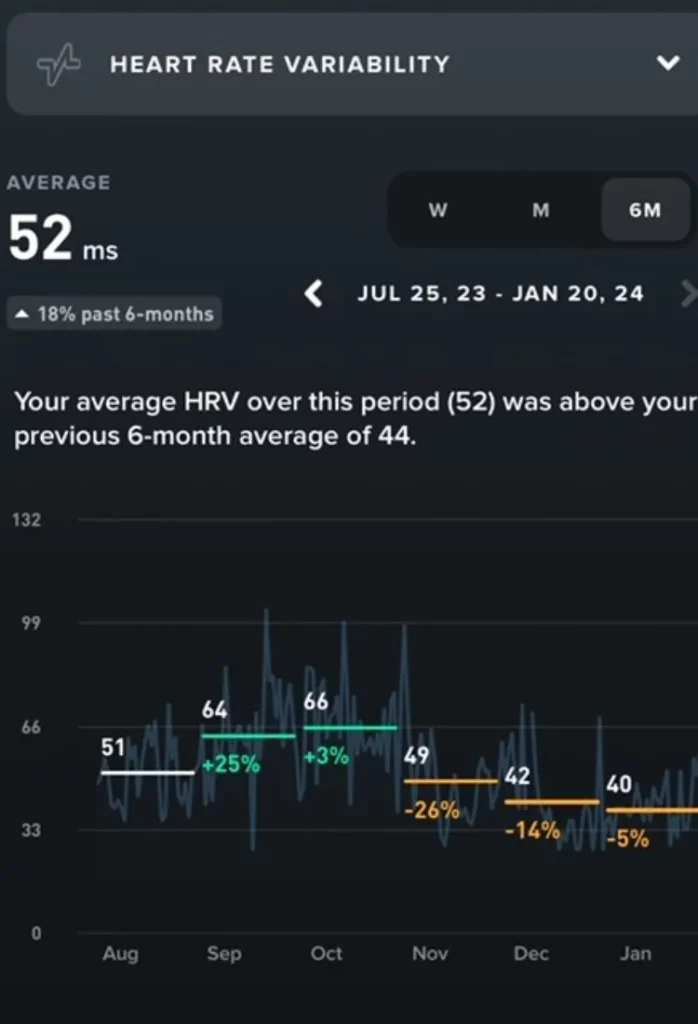
During Spring, Summer, and Fall, my HRV showed an upward trend. I was running consistently and eating well. Starting around mid-November through the first week of January, my average HRV declined noticeably. During that stretch, I was eating holiday foods, having late night snacks, consuming alcohol more frequently, and dealing with the general stress of the holiday season.
Here is what I learned from tracking specific factors against my HRV:
- Alcohol: Even one or two drinks before bed consistently dropped my recovery score and HRV for the following day. This was one of the clearest and most repeatable patterns in my data.
- Eating before bed: When I ate within 2 to 3 hours of sleeping, my HRV and recovery scores dropped compared to nights when I stopped eating earlier. Your body is working on digestion instead of recovery during sleep.
- Hard training days: After an intense workout, my HRV dropped until I was fully recovered. This is actually the expected and desired response. A hard training stimulus should create temporary stress. The key is making sure HRV rebounds before the next hard effort.
- Poor sleep: Insufficient or disrupted sleep was the most impactful factor on my recovery scores. Even one night of poor sleep produced a measurable HRV drop the next morning.
None of these things mean you cannot run the next day, but they do inform how hard you should train. A low recovery score tells me to keep it in Zone 1 to 2. A high score gives me the green light for a hard interval session or tempo run.
How to Measure Heart Rate Variability
HRV is best measured consistently under the same conditions. The gold standard is measuring first thing in the morning, before getting out of bed, over a period of at least 60 seconds. This removes the variability of daily activity and gives you a clean baseline reading.
Common tools for measuring HRV include:
- Whoop: Measures HRV automatically during sleep. No morning routine required. Provides a daily recovery score based on HRV, resting heart rate, respiratory rate, and sleep quality.
- Garmin watches: Many Garmin models now measure HRV during sleep and provide a morning report with your HRV status and training readiness.
- Polar watches: Offer an orthostatic test (lying and standing heart rate measurement) that provides HRV data and recovery recommendations.
- Oura Ring: Measures HRV during sleep via a finger-worn ring. Provides recovery, sleep, and readiness scores.
- HRV4Training app: A smartphone app that uses your phone's camera or a chest strap to measure morning HRV. Provides trend analysis and training recommendations. This is a cost-effective option if you do not want a dedicated wearable.
The most important factor is consistency. The specific device matters less than using the same device, at the same time, under the same conditions, every day. HRV is most valuable as a trend, not a single data point.
How to Interpret Your HRV Score
Important: HRV is highly individual. A "good" HRV for one person might be 45ms while another person's baseline is 80ms. Do not compare your numbers to anyone else. Focus only on your personal trends over time.
- Baseline trend moving upward: Your overall fitness and recovery capacity are improving. Your body is adapting well to your training load.
- Baseline trend moving downward: You may be accumulating fatigue, under-recovering, or dealing with external stressors (sleep deprivation, work stress, illness). Consider reducing training volume or intensity for a few days.
- Single day dip: One low reading is not cause for alarm. It might reflect a hard workout, poor sleep, or alcohol the night before. Make it an easy day and reassess tomorrow.
- Multiple days below baseline: Three or more consecutive days of suppressed HRV is a stronger signal that something needs to change. Reduce training intensity, prioritize sleep, and address any lifestyle factors that might be contributing.
- Abnormally high HRV: Occasionally, a very high HRV reading can indicate overreaching or excessive parasympathetic activity. If it is accompanied by fatigue, take it as a recovery signal rather than a green light to train hard.
Incorporating HRV into Your Recovery Strategy
The practical application of HRV is straightforward: use it to modulate daily training intensity.
- High recovery / high HRV (green): Your body is ready for a hard effort. Schedule your tempo runs, intervals, or long runs on these days.
- Moderate recovery / normal HRV (yellow): You can train, but keep it moderate. Zone 2 easy runs or light strength training are appropriate.
- Low recovery / suppressed HRV (red): Your body is telling you it needs recovery. Take a rest day, do a very easy Zone 1 walk or jog, or do gentle mobility work. Pushing through a red day regularly is a path toward overtraining syndrome.
Over time, this responsive approach to training produces better results than rigidly following a predetermined schedule. You train hard when your body is ready and recover when it needs to, rather than forcing a hard workout on a day when your body is not prepared for it.
How to Improve Your HRV Scores
Since HRV reflects your overall autonomic nervous system health, improving it comes down to managing total stress and recovery:
- Prioritize sleep: This is the single most impactful factor. Aim for 7 to 9 hours per night with consistent bed and wake times. Sleep quality (measured by time in deep and REM sleep) matters as much as total duration.
- Train appropriately: Follow the 80/20 rule. Excessive high-intensity training without adequate recovery is one of the fastest ways to suppress HRV.
- Manage nutrition timing: Avoid large meals within 2 to 3 hours of bedtime. Your body recovers better when it is not digesting during sleep.
- Limit alcohol: Alcohol suppresses HRV for 24 to 48 hours after consumption. If you choose to drink, be aware of the trade-off.
- Manage stress: Chronic psychological stress suppresses HRV just like physical overtraining does. Breathwork, meditation, and time in nature have all been shown to improve parasympathetic tone and HRV.
- Stay hydrated: Chronic mild dehydration can suppress HRV. Consistent hydration throughout the day supports cardiovascular function and recovery.
- Aerobic base training: Consistently training in Zone 2 is one of the most reliable ways to improve HRV over months. This is yet another reason to build a strong aerobic foundation.
Common Misconceptions and Limitations of HRV
- "Higher HRV is always better." Not necessarily. HRV that is abnormally high relative to your baseline can indicate parasympathetic overactivity, which sometimes occurs during overreaching. Context matters more than the raw number.
- "One low reading means I am overtrained." A single low reading could be caused by alcohol, poor sleep, or a hard workout the day before. Look at 7-day rolling averages, not individual readings.
- "HRV can replace all other recovery metrics." HRV is one piece of the puzzle. Combine it with resting heart rate, sleep quality, subjective fatigue, and muscle soreness for a complete recovery picture.
- "My watch HRV is as accurate as a chest strap." Wrist-based HRV measurements are improving but are still less accurate than chest strap or finger-based measurements (like Oura). For trend tracking, wrist-based is adequate. For clinical-grade precision, use a chest strap.
Special Considerations
Heart rate training is adaptable to nearly every runner, but age and nutrition are two factors that deserve specific attention.
How Age Impacts Heart Rate Training
Maximum heart rate declines with age at a rate of roughly 0.7 bpm per year. A runner with a max heart rate of 195 at age 30 might have a max of 181 at age 50. This means heart rate zones need to be recalculated periodically, ideally every 1 to 2 years or whenever you notice a significant change in your training response.
The good news is that the benefits of heart rate training actually become more pronounced with age. Older runners are more susceptible to overtraining and take longer to recover, which makes the pacing discipline of heart rate training even more valuable. Zone 2 training also provides substantial cardiovascular health benefits that become increasingly important as you age, including improved blood pressure regulation and arterial elasticity.
Runners over 50 should pay particular attention to recovery metrics (HRV, resting heart rate) and may benefit from an extra recovery day per week compared to their younger selves.
How Nutrition and Hydration Impact Heart Rate Training
What you eat and drink has a direct impact on your heart rate response during training. Proper nutrition supports the adaptations you are trying to build.
Pre-run fueling: Running on empty (fasted runs) can elevate heart rate because your body has less readily available glycogen. For Zone 2 base runs, fasted running is generally fine as your body relies primarily on fat oxidation. For tempo or interval sessions, eat a light carbohydrate-rich snack 60 to 90 minutes before to ensure adequate fuel for the higher intensity.
During-run hydration: Dehydration is one of the primary causes of cardiac drift during long runs. Losing as little as 2% of body weight through sweat can increase heart rate by 5 to 10 bpm at the same pace. For runs over 60 minutes, plan to consume 4 to 8 ounces of fluid every 15 to 20 minutes, adjusted for heat and sweat rate.
Post-run recovery nutrition: Consuming protein and carbohydrates within 30 to 60 minutes after training supports muscle repair and glycogen replenishment. This recovery nutrition directly affects how quickly your HRV and heart rate return to baseline, which determines your readiness for the next training session.
Daily nutrition quality: Chronic inflammation from a poor diet (high in processed foods, refined sugars, and seed oils) can elevate resting heart rate and suppress HRV. An anti-inflammatory diet rich in whole foods, lean proteins, fruits, vegetables, and healthy fats supports the cardiovascular adaptations you are training to build.
Case Studies and Real-World Examples
Beyond James's story at the top of this article, here are patterns I have observed across hundreds of coaching clients who adopted heart rate training:
The chronic overreacher: Many runners come to me running every run at Zone 3 to 4 intensity without realizing it. They are always tired, frequently injured, and frustrated that they are not getting faster despite running hard every day. Within 2 to 3 months of switching to heart rate based training with proper zone discipline, their injuries clear up and their easy pace gradually drops. By 6 to 12 months, they are running faster than they were when they were pushing hard every day.
The returning runner: Runners coming back from injury or a long break often struggle with their new (slower) fitness level. Heart rate training gives them an objective framework that prevents the ego-driven mistake of trying to run at their old pace. It provides a safe, structured path back to fitness without re-injury.
The plateau breaker: Runners who have been stuck at the same race times for years often see breakthroughs after committing to heart rate training. The issue is almost always an underdeveloped aerobic base caused by years of running in "no man's land" (Zone 3), which is too hard for recovery but too easy for threshold improvement. Building a proper Zone 2 base breaks the plateau.
Getting Started: Your First 30 Days
If you are ready to try heart rate training, here is a simple 30-day plan to get started:
Week 1: Determine your max heart rate using a field test (or estimate with the Karvonen formula). Calculate your five zones. Run 3 to 4 times in Zone 2 only. Note your pace at that heart rate as your starting baseline.
Week 2: Continue running in Zone 2. Focus on keeping your heart rate below the Zone 2 ceiling even if it means walking uphills. Track your Zone 2 pace at the end of each run.
Week 3: Add one run with a brief Zone 3 tempo segment (10 to 15 minutes after a warm-up). Keep other runs in Zone 2.
Week 4: Maintain the same structure. Compare your Zone 2 pace from week 4 to week 1. Even in this short period, many runners see a 10 to 30 second per mile improvement at the same heart rate.
After 30 days, you will have baseline data, a feel for training by heart rate, and the foundation to build a more structured heart rate training program going forward.
Quick tip: Take a screenshot of your first Zone 2 run (pace, heart rate, how it felt). Save it. In 6 months, compare it to a current Zone 2 run. The difference will be your most powerful motivation to keep going.
Additional Zone Calculation Methods
The Joel Friel Lactate Threshold Field Test
Joe Friel, author of Total Heart Rate Training and one of the most respected endurance coaches in the world, developed a practical field test for estimating your lactate threshold heart rate (LTHR). Your LTHR represents the upper boundary of your aerobic zone — the point where your body shifts from primarily aerobic to primarily anaerobic energy production.
Key point: Your lactate threshold heart rate is arguably the most useful number in heart rate training. Once you know it, you can accurately set all five training zones.
How to perform the Friel 30-minute test:
All that's required is running as hard as you can possibly go for 30 minutes ALL BY YOURSELF. It must be solo. Doing this as a part of a race or with training partners will change the outcome. Your number will be too high. If you want to do it with others or as a part of a race then you need to make it 60 minutes duration instead of 30.
Once you've captured the data in your device download it to your software and find your average heart rate for the last 20 minutes. That's an approximation of your lactate threshold heart rate. If you don't have software all you have to do is push the lap button 10 minutes into the test. That will then capture the last 20 minutes as a standalone "interval." Your average heart rate for that portion is close to your lactate threshold heart rate. Note that this DOES NOT mean that you go easy for 10 minutes and then turn it on with 20 minutes remaining. It's 30 minutes all out.
Do not watch your heart rate during the test. You're not trying to produce a given number. Do not be concerned with anything other than are you going as hard as you can go right now. If the answer is "yes" then you are doing the test right.
— Joe Friel, Total Heart Rate Training
Once you have your lactate threshold heart rate, you have the upper limit of your aerobic zone. Anything above this is anaerobic training, and anything below is aerobic training.
Practical tip: The Friel test is demanding but safer than a max heart rate test. It works best for runners who are comfortable pushing themselves hard for 30 minutes. If that feels daunting, start with the MAF method and work up to this test as your fitness improves.
What to Do When Your Zone Calculations Don't Agree
It is common for the MAF formula and the Friel lactate threshold test to produce different numbers. In theory, your lactate threshold and your maximum aerobic function threshold should be close, but variances of 20 to 30 beats per minute can occur.
If you encounter a large discrepancy, here is how to approach it:
- Understand the context: The MAF method is heavily geared toward the base building phase of training. If you are in a base building phase and not fully fitness-optimized, the MAF estimation may produce a lower number than expected. This is by design — it forces aerobic development.
- Use the Friel test as your primary reference if you are an experienced runner who can execute a true 30-minute all-out effort. The Friel test measures your actual physiological response rather than estimating from a formula.
- Start conservative: If your numbers disagree, use the lower estimate for 4 to 6 weeks. Track your pace at that heart rate. If you see improvement, the zone is working. If you cannot run at all (only walk), the number may be too low — retest with the Friel protocol.
- Retest every 8 to 12 weeks as your fitness changes, especially during the first year of heart rate training. Your zones are not static — they should evolve as your aerobic base develops.
Key point: Do not get paralyzed by conflicting numbers. Pick a starting point, be consistent for 6 to 8 weeks, and let your body's response tell you if the zones are working. Heart rate training is an iterative process, not a one-time calculation.
Sources and Citations
- Tanaka, H., Monahan, K. D., & Seals, D. R. (2001). Age-predicted maximal heart rate revisited. Journal of the American College of Cardiology, 37(1), 153-156.
- Seiler, S. (2010). What is best practice for training intensity and duration distribution in endurance athletes? International Journal of Sports Physiology and Performance, 5(3), 276-291.
- Maffetone, P., & Laursen, P. B. (2016). Athletes: Fit but unhealthy? Sports Medicine - Open, 2(1), 24.
- Karvonen, M. J., Kentala, E., & Mustala, O. (1957). The effects of training on heart rate: A longitudinal study. Annales Medicinae Experimentalis et Biologiae Fenniae, 35(3), 307-315.
- Buchheit, M. (2014). Monitoring training status with HR measures: do all roads lead to Rome? Frontiers in Physiology, 5, 73.
- Plews, D. J., Laursen, P. B., Stanley, J., Kilding, A. E., & Buchheit, M. (2013). Training adaptation and heart rate variability in elite endurance athletes. International Journal of Sports Physiology and Performance, 8(6), 688-694.
Related Podcast Episodes
Dive deeper into this topic with these episodes from the RunBuzz Running Podcast.
Episode 125
Coach Cari Masek Tips On Getting Faster, Coachng Kids, and Avoiding Heat Illness
Episode 29
Heart Rate Training – Setting Up Your Heart Rate Training Zones
Episode 28
Heart Rate Training – Calculating Maximum Heart Rate And Lactate Threshold
Episode 27