
Running Cadence and Stride Length: The Complete Guide
 Steve Carmichael·Last updated
Running cadence — also called stride rate — is the number of steps you take per minute while running. It is one of the two variables that determine your running speed (the other being stride length), and it plays a significant role in your efficiency, injury risk, and overall running form.
For years, the "magic number" of 180 steps per minute dominated the running conversation. The idea originated from legendary coach Jack Daniels, who observed that elite runners at the 1984 Olympics almost universally ran at or above 180 spm. That observation has been misinterpreted ever since. The reality is more nuanced: your optimal cadence depends on your body, your pace, and your biomechanics.
In this guide, I will break down what cadence actually is, what the research says about optimal ranges, how cadence connects to injury prevention, and how to measure and improve yours without wrecking your form in the process.
Quick Navigation
- What Is Running Cadence?
- Why Cadence Matters for Runners
- What Is the Optimal Running Cadence?
- Cadence, Overstriding, and Injury Prevention
- Cadence vs. Stride Length: The Speed Equation
- How to Measure Your Running Cadence
- How to Safely Improve Your Cadence
- Common Mistakes When Changing Cadence
- When You Should NOT Change Your Cadence
- Cadence Drills and Exercises
- Frequently Asked Questions
What Is Running Cadence?
Running cadence (stride rate) is the total number of steps you take per minute while running. If your right foot hits the ground 85 times in one minute and your left foot hits 85 times, your cadence is 170 steps per minute (spm).
Cadence is one of the simplest metrics to measure and one of the most actionable aspects of running form. Unlike complex biomechanical variables like ground contact time or vertical oscillation, cadence gives you a single number you can monitor in real time and adjust deliberately.
Key concept: Running speed = cadence × stride length. These are the only two variables that determine how fast you run. You get faster by increasing one or both. The trick is finding the right balance for your body and your goals.
Cadence vs. Stride Rate vs. Step Rate
You will see these terms used interchangeably, and they mean slightly different things depending on who is writing:
- Cadence / step rate: Total steps per minute (both feet). A cadence of 170 means 170 total foot strikes per minute.
- Stride rate: Sometimes refers to full strides per minute (one stride = two steps). In this case, 170 spm cadence equals 85 strides per minute.
Throughout this article, I use cadence to mean total steps per minute (both feet), which is the standard used by Garmin, Polar, Apple Watch, and most running apps.
Why Cadence Matters for Runners
Cadence is not just a number on your watch. It is a window into how efficiently your body is moving and how much stress you are placing on your joints with every step. Here is why it matters:
1. Ground Contact Time and Efficiency
Higher cadence generally means less time on the ground per step. When your foot spends less time in contact with the ground, you waste less energy braking and re-accelerating. Research published in the Journal of Sports Sciences (Heiderscheit et al., 2011) found that even a modest 5 to 10% increase in cadence reduced braking forces and improved running economy without requiring runners to consciously change their form.
Think of it this way: a runner with a cadence of 160 spm is spending more time on the ground per step than a runner at 175 spm. That extra ground time means more energy absorbed by the legs on every single step. Over the course of a 10K (roughly 8,000 to 10,000 steps), those small inefficiencies add up to real fatigue.
2. Vertical Oscillation (Bouncing)
Runners with a low cadence tend to "bounce" more with each stride. This vertical oscillation wastes energy moving you up and down instead of forward. A higher cadence naturally reduces bounce because shorter, quicker steps keep your center of mass more stable.
I have seen this pattern repeatedly in my coaching. Runners who come to me with a cadence below 160 almost always have a visible bounce in their gait. When we work on gradually increasing their cadence, the bounce decreases and they report feeling smoother and less fatigued at the same pace.
3. Impact Loading and Joint Stress
Every step you take generates an impact force of 2 to 3 times your body weight. The way that force is distributed through your body depends largely on where your foot lands relative to your center of mass. A lower cadence is strongly correlated with overstriding (landing with your foot well ahead of your hips), which increases the peak impact force on your knees, shins, and hips.
A landmark study by Heiderscheit et al. (2011) in Medicine & Science in Sports & Exercise found that increasing cadence by just 5 to 10% significantly reduced loading at the hip and knee joints. This is one of the most frequently cited findings in running biomechanics research, and it is one of the reasons physical therapists often recommend cadence adjustments as a first-line intervention for runners with knee pain or shin splints.
4. Injury Prevention
The connection between cadence and injury is not just theoretical. Multiple studies have demonstrated that runners with a lower cadence have higher rates of shin splints, plantar fasciitis, patellofemoral pain (runner's knee), and stress fractures compared to runners with a moderate to high cadence at the same pace.
This does not mean that simply increasing your cadence will make you injury-proof. But if you are dealing with chronic lower-leg injuries and your cadence is below 160 at easy pace, cadence is one of the first things I would look at as a coach.
What Is the Optimal Running Cadence?
The short answer: there is no single optimal cadence for all runners.
The "180 steps per minute" guideline has been repeated so many times that many runners treat it as gospel. Here is the origin story and why it needs context:
Where the 180 Number Came From
In 1984, exercise physiologist Jack Daniels observed runners at the Los Angeles Olympics and noted that virtually all of them ran at 180 spm or higher during distance events. He published this observation, and the running world latched onto 180 as the target for everyone.
The problem is that those were elite runners racing at elite speeds. Cadence naturally increases with pace. An elite runner's easy pace is significantly faster than a recreational runner's easy pace, so their cadence at easy effort is naturally higher.
What Current Research Actually Says
More recent research paints a clearer picture:
- Recreational runners typically have a cadence of 150 to 170 spm at easy pace.
- Experienced recreational runners typically fall between 165 and 180 spm at easy pace.
- Competitive and elite runners typically run at 180 to 200+ spm at race pace.
- Cadence increases with speed. The same runner might have a cadence of 165 on an easy run and 190 during a 5K race. This is completely normal.
A 2019 study published in the Journal of Applied Physiology (Burns et al.) analyzed over 25,000 runners using wearable data and found that the average cadence was 163.4 spm, with a wide distribution. Faster runners had higher cadences, but the relationship was not as linear as the 180 rule would suggest.
Key point: Rather than chasing a specific number, focus on whether your cadence is appropriate for your pace and body. If you are running at an easy pace with a cadence of 165 and you are comfortable, injury-free, and efficient, there is no reason to force it to 180. If your cadence is below 155 at easy pace and you are dealing with recurring injuries, a gradual increase may help.
Factors That Influence Your Natural Cadence
- Height and leg length: Taller runners with longer legs naturally take fewer, longer steps. A 6'3" runner with a cadence of 168 at easy pace may be perfectly efficient, while a 5'4" runner at the same cadence might be overstriding.
- Running pace: Cadence increases with speed. Do not compare your easy-run cadence to someone else's race cadence.
- Fitness level: As runners gain experience and fitness, cadence tends to naturally increase because their neuromuscular coordination improves.
- Terrain: Cadence typically increases on uphills (shorter, quicker steps) and may decrease on downhills (longer steps to control speed).
- Fatigue: Cadence often decreases late in long runs or races as neuromuscular fatigue sets in. Maintaining cadence when tired is one marker of good running fitness.
Cadence, Overstriding, and Injury Prevention
The most important reason to pay attention to cadence is its relationship to overstriding — the most common form flaw in recreational runners and one of the primary contributors to running injuries.
What Is Overstriding?
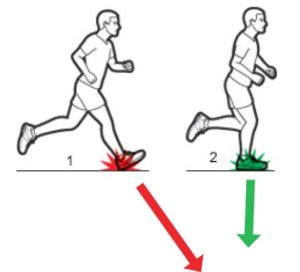
Overstriding occurs when your foot lands well ahead of your center of mass (your hips) with each step. When this happens:
- Your leg is extended with your knee relatively straight at initial contact
- Your foot typically lands heel-first with the toe pointed up
- Your body has to absorb a large braking force with every step
- The impact radiates up through your foot, shin, knee, and hip — the entire kinetic chain
How Cadence Corrects Overstriding
When you increase cadence, you are forced to take shorter steps. Shorter steps naturally bring your foot landing position back under your hips instead of out in front. This single change creates a cascade of biomechanical improvements:
- Reduced braking force: Your foot lands under your center of mass instead of ahead of it, eliminating the "brakes-on" feeling.
- Midfoot or forefoot contact: Shorter steps make it nearly impossible to land with a hard heel strike. Your foot naturally shifts to a midfoot landing.
- Lower peak impact: The Heiderscheit study found that a 10% cadence increase reduced peak knee joint loading by approximately 20%.
- Less vertical oscillation: Shorter steps mean less time in the air and less bouncing.
- Improved forward momentum: Instead of losing energy to braking with each step, more of your effort goes toward moving forward.
Important: Increasing cadence is NOT the same as "running on your toes." The goal is a midfoot landing under your hips, not a forced forefoot strike. Trying to run on your toes without proper calf and Achilles conditioning can lead to calf strains and Achilles tendinopathy. Let the cadence change drive the foot strike change naturally.
Injuries Linked to Low Cadence and Overstriding
- Shin splints (medial tibial stress syndrome): The repetitive braking force of heel striking with an extended leg places excessive stress on the tibialis anterior muscle and the shin bone periosteum.
- Patellofemoral pain (runner's knee): Overstriding increases the load on the patellofemoral joint. Cadence increases reduce this load significantly.
- Plantar fasciitis: A hard heel strike increases eccentric loading on the plantar fascia with each step.
- Tibial stress fractures: High peak impact forces from overstriding are the primary mechanical driver of stress fractures in the tibia.
- IT band syndrome: The extended knee position at heel strike changes the mechanics of the IT band as it tracks over the lateral femoral condyle, contributing to friction and inflammation.
Cadence vs. Stride Length: The Speed Equation
Speed is the product of cadence and stride length. Understanding how these two variables interact is critical for training effectively.
Speed = Cadence × Stride Length
For example:
- A runner at 170 spm with a stride length of 1.0 meters covers 170 meters per minute (about a 9:28 min/mile pace).
- The same runner at 180 spm with the same stride length covers 180 meters per minute (about an 8:56 min/mile pace).
- Or at 170 spm with a stride length of 1.06 meters, they also cover 180 meters per minute.
You can get faster by increasing cadence, increasing stride length, or both. The question is which approach is safer and more sustainable.
Why Cadence Is the Safer Lever to Pull
Deliberately increasing stride length usually means reaching further forward with each step — which is overstriding. This increases impact forces and injury risk. It is generally a bad strategy for getting faster.
Increasing cadence, on the other hand, naturally shortens your stride in the front while encouraging a more powerful push-off in the back. The net effect is that your stride length may actually stay the same or even increase slightly, but the extra length comes from a stronger posterior push-off (glutes and hamstrings) rather than reaching forward. This is the biomechanically efficient way to increase speed.
Coaching tip: When I want a runner to get faster, I almost never tell them to "take longer steps." Instead, I focus on two things: increasing cadence slightly and building posterior chain strength (glutes and hamstrings) through strength training. The longer stride comes naturally as a result of more powerful hip extension, not by reaching further forward.
How Cadence Changes With Pace
It is completely normal for your cadence to vary by 15 to 25 spm across different workout intensities:
- Easy runs: 160–175 spm (lower cadence is fine here — you are not trying to be fast)
- Tempo / threshold runs: 170–185 spm
- Intervals and speed work: 180–200+ spm
- Sprinting: 200+ spm
If your cadence does NOT increase as your pace increases, that is a sign you are getting faster by overstriding rather than by increasing turnover. Pay attention to this pattern.
How to Measure Your Running Cadence
You have several options, from free to tech-enhanced:
Method 1: Manual Count (Free)
During a run at your normal easy pace:
- Set a timer or glance at your watch for 30 seconds.
- Count how many times your right foot hits the ground.
- Multiply that number by 4.
For example, if your right foot hits the ground 42 times in 30 seconds: 42 × 4 = 168 spm.
Do this at multiple points in your run (beginning, middle, end) since cadence can change as you fatigue.
Method 2: GPS Watch (Recommended)
Most modern GPS running watches measure cadence automatically using a built-in accelerometer. Garmin, Polar, COROS, and Apple Watch all provide real-time cadence data. This is the most convenient and accurate method for regular monitoring.
Check your watch settings to make sure cadence is displayed on one of your run data screens. You can also review cadence data after your run in the companion app, which typically shows average cadence, max cadence, and cadence over time.
Method 3: Foot Pod
A foot pod (like the Stryd or Garmin Running Dynamics Pod) attaches to your shoe and provides highly accurate cadence, ground contact time, and power data. These are particularly useful if you run on a treadmill where GPS is unreliable.
Method 4: Video Analysis
Recording yourself running from the side with a smartphone at 120 or 240 fps (slow motion) lets you analyze your foot strike position, cadence, and overall form. This is the best way to see whether overstriding is an issue. You can use apps like Hudl Technique or Coach's Eye for frame-by-frame analysis.
Practical tip: Measure your cadence at three different paces: easy, moderate, and fast. This gives you a baseline range. Record these numbers and recheck every 4 to 6 weeks as you work on improvements.
How to Safely Improve Your Cadence
If your cadence is consistently below 155 at easy pace, or if you are dealing with chronic lower-leg injuries that may be related to overstriding, gradually increasing your cadence is worth exploring. The key word is gradually.
The 5% Rule
Increase your target cadence by no more than 5% at a time. Your muscles, tendons, and nervous system need time to adapt to the new movement pattern. A sudden jump in cadence can cause calf soreness, Achilles irritation, or hip flexor fatigue because different muscles are being recruited differently.
For example, if your current easy-run cadence is 160 spm:
- First target: 168 spm (5% increase)
- Practice at this cadence for 3 to 4 weeks until it feels natural
- Next target: 176 spm (another 5% increase)
Step-by-Step Protocol
- Establish your baseline. Run three easy runs and note your average cadence for each. Take the average of all three as your starting point.
- Set your first target. Add 5% to your baseline. If your baseline is 158, your target is 166.
- Use a metronome or music. A metronome app (like RunCadence or MetroTimer) set to your target cadence provides an audible beat to match your footsteps. Alternatively, Spotify has playlists organized by BPM — search for "180 BPM running" or whatever your target is.
- Practice during short portions of your run. Do not try to hold the new cadence for your entire run. Start with 5-minute intervals at the higher cadence mixed with your natural cadence. Gradually extend the intervals over weeks.
- Focus on the cue "quick feet" rather than "shorter steps." Thinking about shorter steps can cause a shuffling motion. Thinking about quick, light feet produces a more natural cadence increase.
- Monitor for negative symptoms. Calf tightness, Achilles soreness, or hip flexor fatigue are signs you increased too quickly. Back off to your previous cadence for a week, then try a smaller increase (3% instead of 5%).
- Do not change cadence during a volume increase phase. If you are building mileage, keep your cadence stable. Change cadence during a maintenance or base phase when your distance is consistent. Changing two variables at once is a recipe for injury.
Important: Never force a cadence change during a race or key workout. Practice during easy runs only until the new pattern is automatic. It typically takes 4 to 8 weeks for a new cadence to feel natural.
Common Mistakes When Changing Cadence
1. Trying to Hit 180 Immediately
The most common mistake. A runner with a cadence of 155 reads that 180 is the "optimal" number and tries to run at 180 the next day. This is a 16% increase — far too much at once. It changes the loading pattern on every muscle and tendon in the legs and almost always leads to injury or severe soreness.
2. Increasing Cadence by Shuffling
Some runners increase their step rate by taking tiny, shuffling steps without any knee drive or push-off. This is worse than a low cadence. The goal is quick, purposeful steps with adequate knee lift, not a shuffle.
3. Focusing Only on the Front Leg
Cadence improvement should focus on what happens behind you, not in front of you. Think about pushing off the ground quickly with your back foot rather than placing your front foot faster. A strong, quick push-off naturally increases cadence while maintaining stride length.
4. Ignoring Strength Training
Your calves, Achilles tendons, glutes, and hip flexors all work harder at a higher cadence. If these structures are weak, a cadence increase will overload them. Strength training — particularly calf raises, single-leg squats, and hip flexor exercises — should accompany any cadence change program.
5. Not Accounting for Pace Variation
Your cadence will and should be different at different paces. A cadence of 165 at easy pace and 185 at tempo pace is completely fine. Do not try to force the same cadence across all intensities.
When You Should NOT Change Your Cadence
Cadence adjustments are not for everyone. Leave your cadence alone if:
- You are injury-free and running well. If it is not broken, do not fix it. A cadence of 165 with no injuries and good race times does not need to be changed.
- You are in the middle of a training build-up. Do not add cadence work when you are also increasing weekly mileage or intensity. One variable at a time.
- You are recovering from an injury. Focus on healing first. Cadence changes can wait until you are running consistently and pain-free.
- Your cadence is already above 170 at easy pace. You are in a healthy range. Further increases offer diminishing returns for recreational runners.
Cadence Drills and Exercises
These drills help train your neuromuscular system to handle a higher cadence without forcing it during your regular runs.
1. Strides
After an easy run, do 4 to 6 strides of 80 to 100 meters. Accelerate to about 90% effort with a focus on quick, light foot turnover. Walk back to recover between each one. Strides naturally push your cadence above 185 spm and train your body to handle higher turnover.
2. Downhill Strides
Find a gentle downhill (2-3% grade). Run strides on the downhill where gravity assists your turnover. This makes high cadence feel effortless and teaches your nervous system what a faster leg turnover feels like.
3. Metronome Intervals
During an easy run, set a metronome to your target cadence and match it for 3 to 5 minutes. Then turn it off and run naturally for 5 minutes. Repeat 3 to 4 times. Over weeks, the "metronome on" intervals should start to feel like your natural rhythm.
4. Quick Feet Drill
Stand in place and run with as many quick, short steps as possible for 15 seconds. Rest for 30 seconds. Repeat 6 to 8 times. This trains the hip flexors and calves for rapid turnover.
5. Single-Leg Calf Raises
Higher cadence places more demand on your calves and Achilles tendons. Build capacity by doing 3 sets of 15 single-leg calf raises on each leg, 3 times per week. Progress to doing them on a step for full range of motion.
Frequently Asked Questions
Is 180 spm the right cadence for everyone?
No. 180 spm was observed in elite distance runners at race pace. Your optimal cadence depends on your height, leg length, pace, and fitness level. Most recreational runners fall between 160 and 180 spm at easy pace, and that is perfectly fine.
Does higher cadence automatically make me faster?
Not directly. Higher cadence with shorter stride length covers the same distance. Speed increases come from maintaining stride length while increasing cadence, or from the improved efficiency that results from less braking force and bounce. The speed benefit is real but comes from efficiency gains over time, not an immediate jump.
Will changing my cadence prevent injuries?
A modest cadence increase (5 to 10%) has been shown to reduce joint loading at the knee and hip, which can help prevent or manage conditions like runner's knee, shin splints, and stress fractures. It is not a guarantee, but it is one of the most evidence-supported form changes a runner can make.
My cadence is 155 on easy runs. Is that too low?
It is on the lower end and may be worth investigating, especially if you are dealing with recurring injuries. Start by checking whether you are overstriding (video analysis is the best way). If overstriding is present, a gradual cadence increase toward 165 to 170 could help.
Should I think about cadence during races?
Generally no. By race day, your cadence should be an automatic result of your training. Trying to consciously control cadence during a race takes mental energy away from pacing, fueling, and competing. The exception is the late miles of a marathon where fatigue causes cadence to drop — a brief mental cue of "quick feet" can help you maintain form.
Do treadmill runners have different cadence than outdoor runners?
Treadmill cadence tends to be slightly higher than outdoor cadence at the same pace because the belt is moving under you. This is normal. If you train on both, measure your cadence separately for each and do not try to match them.
Sources and Research
- Heiderscheit, B. C., Chumanov, E. S., Michalski, M. P., Wille, C. M., & Ryan, M. B. (2011). Effects of step rate manipulation on joint mechanics during running. Medicine & Science in Sports & Exercise, 43(2), 296-302.
- Burns, G. T., Zernicke, R. F., Manal, K., & Brent, J. (2019). Cadence in recreational runners. Journal of Applied Physiology.
- Daniels, J. (2013). Daniels' Running Formula. Human Kinetics. (3rd edition)
- Schubert, A. G., Kempf, J., & Heiderscheit, B. C. (2014). Influence of stride frequency and length on running mechanics: a systematic review. Sports Health, 6(3), 210-217.
- Willy, R. W., Buchenic, L., Rogacki, K., Ackerman, J., Schmidt, A., & Willson, J. D. (2016). In-field gait retraining and mobile monitoring to address running biomechanics associated with tibial stress fracture. Scandinavian Journal of Medicine & Science in Sports, 26(2), 197-205.
Related Podcast Episodes
Dive deeper into this topic with these episodes from the RunBuzz Running Podcast.
Episode 88
Running Cadence And Stride Rate Explained (And Tips To Improve)
Episode 157
Running Form, Cadence, Footstrike and Shoes - Injury Prevention with Brodie Sharpe
Episode 156
Jeff Galloway - Olympian and Founder of the Galloway Run Walk Run Method
Episode 138